Research
|
|
 |
Perception of parasites by plants
Being stationary organisms, plants are unable to move to evade pathogens or parasites and pests. To compensate for this lifestyle, plants have evolved several layers of defenses allowing them to overcome the invaders. One of these is the ability to perceive the invader. Work from our group and others have recently shown that plants can perceive nematodes similar to microbial pathogens. This perception requires the well-characterized cell surface localized co-receptor BAK1/SERK3. We are currently working on characterizing the plant mechanisms involved in nematode perception.
|
 |
The atypical disease resistance gene Mi-1
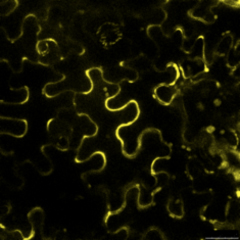
The tomato gene Mi-1, that encodes an NLR protein, confers resistance to nematode parasites and insect pests. Among these parasites and pests are three species of root-knot nematodes and the potato aphid, respectively. We have shown that Mi-1 requires a cell surface localized co-receptor, SERK1, for its function. Furthermore, Mi-1 forms a complex with SERK1 which changes conformation upon pest recognition to trigger an immune response. We are interested in identifying the other components of the Mi-1-SERK1 complex to better understand how resistance proteins perceive these parasites and pests.
|
 |
Secreted aphid effectors
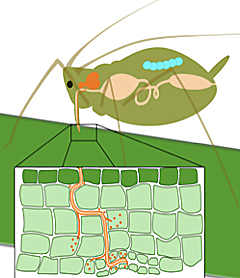
Aphids are important agricultural pests causing direct damage to plants as well as indirect damage by transmitting viruses. During feeding, they deliver in their saliva a cocktail of proteins or effectors into the plant host, altering plant immunity and metabolism to their advantage. Using salivary glands transcriptome and proteome of the aphid saliva, our laboratory discovered a large number of aphid-derived proteins as well as those originating from bacterial endosymbionts and novel viruses. Among these, we have identified a subset to be effectors with functions in triggering or suppressing plant immunity. We are currently working on identifying plant targets of these aphid effectors and mechanisms by which they alter plant immune responses.
|
|
|
|
|
|
|
|
|
|
|
|
|
|
|
|
