|
Chemical
Mediation of Host Selection by a Biocontrol Agent |
|||||
|
We
identified the water-soluble compound from scale covers that stimulated
oviposition behavior by A. melinus,
as reported by R. F. Luck and N. Uygun [1].
This research was tedious because the compound occurs only at nanogram
levels within the covers of scale insects, so it required the collection of
thousands of covers to obtain even microgram quantities of material for
chemical purification and identification.
None of this work would have been possible without the production of
both scale insects and parasitoids in continuous culture by the laboratory of
Robert F. Luck at UC Riverside. Our
research on this behavioral kairomone (e.g. a chemical messenger emitted by
one species that benefits another species) can be separated into three
components focusing upon the following questions: 1) what is the identity of the compound 2)
is the compound a reliable cue for the quality of scale for utilization by A. melinus? and 3) can we
utilize the compound to improve the ability of A. melinus to provide biological control of the California red
scale? Prior
research showed the importance of the size of California red scale on the
production of fecund, female A. melinus
[2], but little was known about how A. melinus might identify and select
larger scale hosts. The first ~1
minute video below shows female wasps investigating potential scale hosts by
lowering their antennae and passing them over the scale cover, then turning
and repeating the behavior as though they were assessing the size of the
scale cover. This “drumming and
turning” behavior [3] is followed by the female wasp
inserting her ovipositor through the scale cover and depositing an egg on the
scale body below (see also Fig. 1).
The second video shows the same drumming and turning behavior after an
extract of scale covers was applied to a disk of filter paper, including an
attempted oviposition through the filter paper disk. This behavior was the basis of our
bioassays for biological activity of extracts, fractions of extracts, and
synthetic compounds. |
|||||
|
|
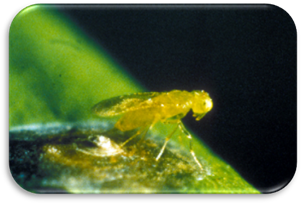
Figure 1. Adult female Aphytis melinus ovipositing through a cover of California red scale and depositing
an egg on the scale body beneath the cover. |
Figure 2. Close-up of
California red scale covers and bodies.
The non-living covers have been removed from two scales to show the
yellow bodies beneath. |
|||
|
Identification |
|||||
|
Scale
covers are not attached to scale bodies during the period of growth of the
juvenile stages of the scales and are easily removed (Fig.2). Thousands of scale covers were collected from
scales reared on lemon fruit, extracted with aqueous methanol, fractionated
by high performance liquid chromatography, and bioassayed. Through several spectroscopic methods,
principally proton nuclear magnetic resonance spectroscopy (Fig. 3), the biologically
active compound was found to be a previously unknown ester of two ubiquitous
components – the amino acid tyrosine, and the phenolic acid, caffeic acid - forming
O-caffeoyltyrosine, or OCT [4, 5].
OCT was synthesized and found to be as biologically active as the
natural compound [5].
|
|||||
|
Figure 3. 1H NMR spectrum (in CD3OD) and
assignment of protons to the structure of O-caffeoyltyrosine. Protons marked with asterisks were lost due
to exchange. From Millar & Hare
1993. |
|||||
|
Is OCT a reliable indicator of the quality of California red scale for A. melinus? |
|||||
|
Preliminary
studies showed that A. melinus
showed a narrow, curvilinear response to increasing concentrations of OCT (Fig.
4) and that highest OCT concentrations occurred in covers of newly-molted
third-instar scales (Fig. 5). The
concentration of free OCT concentration then declines, presumably as it
polymerizes and is incorporated into the scale cover [4].
Thus, by utilizing a precursor of California red scale’s cover and
responding in a dose-dependent manner, A.
melinus may facilitate the identification of the most suitable scale life
stages for parasitization. However,
scale body size and scale cover size vary with the citrus cultivar and
substrate on which the scales are reared, and scale cover size is more
variable than scale body size [6].
This suggested that any environmental factors affecting scale cover
growth will affect the concentration of OCT, possibly altering the
susceptibility of those scales to attack by A. melinus |
|||||
|
Figure 4. Attractiveness of filter-paper disks
treated with the indicated doses of O-caffeoyltyrosine to A. melinus. Bars indicate the mean (+
standard error) percentage of drums and turns (filled bars) and oviposition
probes (open bars) at each dosage.
From Hare et al. 1993. |
Figure 5. Concentration of O-caffeoyltyrosine
in California red scale covers as a function of development in degree-days
and size. Open circles and dashed
line: mean (+ SE) O-caffeoyltyrosine concentration; filled circles and solid line: mean
(+ SE) scale cover area. From
Hare et al. 1993. |
||||
|
In a series of field experiments, both scale cover area and 0-caffeoyltyrosine concentrations were only qualitatively related to the body size of third instar scales, the most suitable stage for A. melinus [7, 8]. Scale cover area and 0-caffeoyltyrosine concentrations were reduced, relative to scale body size, when scale were reared on bark and leaves compared to fruits. Scale cover area and OCT concentration were also relatively reduced when scales were reared in mid-summer compared to spring and fall, and when reared on orange cultivars compared to lemon cultivars in the field (Fig. 6). Overall, scales appear to be chemically conspicuous to A. melinus for a short period of the time in which they are physiologically susceptible, but scales of similar quality for utilization by A. melinus may differ in conspicuousness to A. melinus due to variation in OCT concentrations. Scales that minimize their cover size and maximize the incorporation rate of OCT into covers may minimize their conspicuousness to A. melinus. These results are consistent with an evolutionary tension between the emitter and receiver of kairomones such that although receivers such as A. melinus may be under strong selection pressure to recognize kairomones, emitters like California red scale should be under strong selection pressure to minimize the production or persistence of those kairomones. |
|||||
|
Figure 6. Mean + SE scale
cover area and OCT concentration adjusted for scale body size for scales
reared on fruit, leaves, or bark of lemon
or orange. From Hare & Morgan
2000. |
|||||
|
Can OCT be used to improve
biological control of California red scale? |
|||||
|
Aphytis melinus reared in commercial insectaries
and released to control California red scale are reared on oleander scale, themselves
reared on squash. Oleander scale do
not produce any OCT. Like many wasps, the
early experiences of adult A. melinus
can greatly influence future foraging decisions, and the earliest experience
of adult A. melinus reared on
oleander scale is the absence of OCT.
Wasps that were removed from their hosts as pupae and allowed to
emerge as adults isolated from their hosts retained a strong preference for
California red scale regardless of rearing host (Fig. 7). This preference was reduced if wasps were
allowed to emerge from oleander scale, thus acquiring early adult experience
with oleander scale (Fig. 8). The
preference for California red scale was restored by exposing wasps reared on
oleander scale to synthetic OCT prior to bioassay [9].
Thus, it may be possible to improve the host recognition skills of A. melinus reared on oleander scale by
exposing them to OCT prior to release. |
|||||
|
Figure 7. Oviposition probes (mean % + SE) by A. melinus on California red scale covers when wasps were reared on California
red scale on lemons (black bars) or on oleander scale reared on either lemons
(grey bars) or squash (open bars). Naïve wasps were isolated from their hosts as pupae so they had no adult
experience with their rearing host.
Experienced wasps were allowed to emerge naturally from their host and
therefore acquired early adult experience with their host. From Hare 1996. |
Figure 8. Oviposition probes (mean % + SE) by A. melinus on California red scale covers when reared on oleander scale. “Oleander reared but Naïve” wasps were
isolated as pupae and had no adult experience with oleander scale, California
red scale, or OCT prior to bioassay.
“Oleander Emerged” wasps emerged from oleander scale and acquired
early adult experience with oleander scale, then were exposed to filter paper
disks treated with solvent prior to bioassay.
“Oleander Emerged and OCT-Conditioned” wasps also emerged naturally
from oleander scale but then were exposed to OCT-treated filter paper disks
prior to bioassay. From Hare 1996. |
||||
|
We carried out a field
experiment using isofemale genetic lines of A. melinus carrying distinguishable electrophoretic alleles
(Strains “A” and “B”) to determine the number of progeny from A. melinus reared on oleander scale
only, and A. melinus reared on
oleander scale but conditioned to OCT prior to release. In half of the releases, Strain ‘A’ was conditioned to O-caffeoyltyrosine and Strain ‘B’ served as the control,
while this pattern of conditioning was reversed for the other half of the releases.
Although there were differences in the
rates of population growth of the two strains, whichever strain was the
conditioned strain left 6 – 12% greater than expected number of progeny
compared to the control strain in all comparisons (Fig. 9) [10]. |
|||||
|
Figure 9. Mean (+ SE) percent Strain “A" and Strain “B" progeny of A. melinus recovered from a field conditioning experiment. Horizontal lines (+ binomial SE) indicate the expected proportion of Strain “A” (38.4%) and Strain “B” (61.6%) in the absence of conditioning (see Hare et al. 1997 for more details). Rearing Site abbreviations: LF, lemon fruit; OF, orange fruit; LL, lemon leaves; OF, orange leaves. From Hare et al. 1997. |
|||||
|
Although large numbers of wasps can be
conditioned simply by spraying the parasitized oleander scales on banana squash with a dilute OCT solution
[11], the relatively imprecise recommendations for the number of A. melinus to release suggest
that a ~10% increase in host finding by A.
melinus may be overwhelmed by other factors affecting the interaction
between California red scale and A.
melinus in commercial citrus groves.
If release recommendations are improved and become more closely linked
to densities of California red scale, then a ~10% improvement in host finding
might prove to be economically beneficial. 1
Luck, R.F. and
Uygun, N. (1986) Host recognition and selection by Aphytis species: Response to California red, oleander, and cactus
scale cover extracts. Entomol. Exp.
Appl. 40, 129-136. DOI:
10.1111/j.1570-7458.1986.tb00493.x 2 Hare, J.D. and Luck, R.F. (1991) Indirect
effects of citrus cultivars on life history parameters of a parasitic wasp. Ecology 72, 1576-1585. DOI: 10.2307/1940957 3 Luck, R.F.,
et al. (1982) Host selection and egg allocation behaviour by Aphytis melinus and A lingnanensis: Comparison of two
facultatively gregarious parasitoids. Ecol.
Entomol. 7, 397-408. DOI: 10.1111/j.1365-2311.1982.tb00682.x. 4 Hare, J.D.,
et al. (1993) A caffeic acid ester mediates host recognition by a
parasitic wasp. Naturwissenschaften
80, 92-94. DOI: 10.1007/BF01140427 5 Millar, J.G. and Hare, J.D. (1993)
Identification and synthesis of a kairomone inducing oviposition by
parasitoid aphytis melinus from
California red scale covers. J. Chem.
Ecol. 19, 1721-1736. DOI: 10.1007/bf00982303 6 Hare, J.D.,
et al. (1990) Variation in life history parameters of California red
scale on different citrus cultivars. Ecology
71, 1451-1460. DOI: 10.2307/1938282. 7 Hare, J.D. and Luck, R.F. (1994)
Environmental variation in physical and chemical cues used by the parasitic
wasp, Aphytis melinus, for host
recognition. Entomol. Exp. Appl.
72, 97-108. 10.1111/j.1570-7458.1994.tb01807.x 8 Hare, J.D. and Morgan, D.J.W. (2000) Chemical
conspicuousness of an herbivore to its natural enemy: effect of feeding site
selection. Ecology 81, 509-519. DOI: 10.2307/177444 9 Hare, J.D. (1996) Priming aphytis: behavioral
modification of host selection by exposure to a synthetic contact kairomone. Entomol. Exp. Appl. 78, 263-269. DOI: 10.1111/j.1570-7458.1996.tb00790.x 10 Hare, J.D., et al. (1997) Increased parasitization of California red scale
in the field after exposing its parasitoid, Aphytis melinus, to a synthetic kairomone. Entomol. Exp. Appl. 82, 73-81. DOI: 10.1046/j.1570-7458.1997.00115.x 11 Hare, J.D. and Morgan,
D.J.W. (1997) Mass-priming Aphytis:
Behavioral improvement of insectary-reared biological control agents. Biol. Control 10, 207-214. DOI: 10.1006/bcon.1997.0565 |
|||||