Morphological Abnormalities in Frogs on National
Wildlife Refuges in
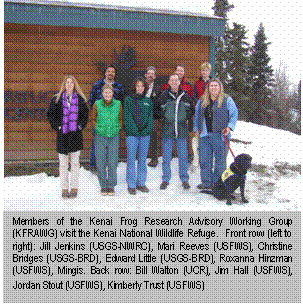
 The Kenai Frog Research
Advisory Working Group (K-FRAWG) is a technical advisory committee assisting
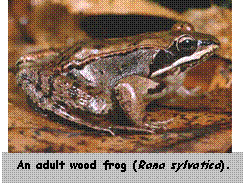
with a study of the factors contributing to abnormalities in wood frogs (Rana sylvatica) on
the Kenai National Wildlife Refuge in southern
The Kenai Frog Research
Advisory Working Group (K-FRAWG) is a technical advisory committee assisting
with a study of the factors contributing to abnormalities in wood frogs (Rana sylvatica) on
the Kenai National Wildlife Refuge in southern  Branch of the U.S. Fish
and Wildlife Service (USFWS) in
Branch of the U.S. Fish
and Wildlife Service (USFWS) in
The USFWS is assessing
amphibian deformities on refuge lands across the
The goals of the project are to identify
the factors contributing to the high incidence of abnormalities in metamorph 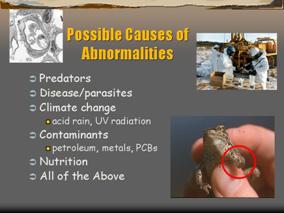 wood frogs and to help revise
management policies for the Kenai NWR.
The project addresses the third phase of the USFWS’s
National Abnormal Amphibian Project that began in 1997: Phase I – Observation
and assessment, Phase II – Stressor identification, Phase III – Cause and
effect linkages and management recommendations.
wood frogs and to help revise
management policies for the Kenai NWR.
The project addresses the third phase of the USFWS’s
National Abnormal Amphibian Project that began in 1997: Phase I – Observation
and assessment, Phase II – Stressor identification, Phase III – Cause and
effect linkages and management recommendations.
Possible
causes of abnormalities in wood frogs on the Kenai NWR include predators,
disease/parasites, environmental change, contaminants, and nutrition. The relative importance of each factor and
potential synergisms among the factors remain to be determined. Known contaminants on the refuge include
PCBs, petroleum, metals and herbicides/defoliants. Oil and natural gas exploration occurs on the
Kenai NWR. The productivity of wells has
declined during the last decade and, depending on the location of the oil/gas field
on the refuge and the resource, extraction is predicted to cease over the next
5 to 15 years. In addition to
identifying the causative agents of abnormalities in the frogs, the results
from this 3-year study will assist with the development of Kenai’s Comprehensive Conservation Plan (CCP) which will
include discussions of what to do with oil and gas fields after operations have
closed.