|
File: <killer.htm> Glossary <Principal Natural Enemy Groups > <Citations> <Home> |
|
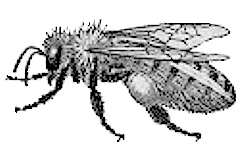
KILLER BEES / AFRICANIZED BEES Dr. E. F. Legner,
University of California, Riverside (Contacts) Hybridized honeybees, or "killer
bees" as they frequently are called, invaded the United States from
Mexico. They crossed the border into
south Texas in 1992, and gradually spread through the Southwest, appearing in
California in 1995, a couple of years later than was originally predicted
(see Taylor 1985 and Legner 1989c).
Killer bees were originally purposely
bred by scientists in one of the leading honeybee research laboratories of
the world in Brazil in an effort to create a type that possessed superior
foraging ability and honey production.
Honey bee strains from Europe and southern Africa were crossed in this
effort. However, these experiments
led ultimately to the creation of the killer bee strain instead. Most of the characteristics that
distinguish killer bees from the original European stock, such as
aggressiveness, early‑day mating times, degrees of pollen and honey
hoarding, etc., are thought to be quantitative and, therefore, under the
control of polygenic systems.
Unfortunately, because of difficulties inherent in studying quantitative
traits in honeybees, knowledge of this phase of their genetics is scant. In fact, Taylor (1985) acknowledged that
there is an overall limited understanding of honeybee genetics. Thus, we really cannot predict what will
occur following hybridization of African and European strains because
practically all opinions are being derived from their behavior in South
America (Kerr et al. 1982, McDowell 1984, Rinderer et al. 1982, 1984, Taylor
1985). Perhaps some indications can
be obtained from other groups of Hymenoptera. A great deal of information about
hymenopteran quantitative inheritance has been gathered recently from
parasitic wasps in the genus Muscidifurax that
attack synanthropic Diptera. For
example, in Muscidifurax raptorellus Kogan
& Legner, a South American species, traits for fecundity and other
reproductive behavior are under the control of a polygenic system (Legner 1987b, 1987a, 1988b, 1989a). Males in this species are able to change
the female's oviposition phenotype and the aggressiveness of their larval
offspring upon mating by transferring an unknown substance capable of evoking
behavioral changes. It appears as if
a proportion of the genes in the female have the phenotypic plasticity, or
norm of reaction, to change expression under the influence of the male
substance environment. The intensity
of this response is different, depending on the respective genetic composition
of the mating pair (Legner 1989a). Thus, the genes involved, which regulate
phenotypic changes in the mated female, cause partial expression of the
traits they govern shortly after insemination and before being inherited by
resulting progeny. Such genes that
are capable of phenotypic expression in the mother and her immature offspring
have been called "Wary genes"
because of their partial expression in the environment before maturity. In the process of hybridization, wary
genes are thought to quicken the pace of evolution by allowing natural
selection to begin to act in the parental generation and on immature
individuals (Legner 1987a, 1989a, 1993). Wary genes, which are detrimental to the
hybrid population, might thus be more prone to elimination, and beneficial
ones may be expressed in the mother before the appearance of her adult offspring. If such a system prevails in
honeybees, greater importance could be placed on drones because it may be
possible for African or European drones to convey directly to unmated queens
of either strain some of their own
characteristics. The rapid
domination of the African type in bee colonies in South and Central America
could be explained partly by this process, although early‑day mating of
African drones has been considered primarily responsible (Taylor 1985). It is admittedly presumptuous at this
time to infer similarities in the genetics of genera Apis and Muscidifurax, and the presence of wary genes in both. Some speculation seems justified where
similarities might exist, however, especially as there is general agreement that
permanent control of the killer bees will probably involve genetic
manipulation and mating biology (The Calif. Bee Times 1988). If they are present, wary genes could
offer a means to the abatement of this potentially severe public health
pest. However, the possible
occurrence of similar hybridization events in honeybees, as has been observed
in Muscidifurax, would dictate
extreme caution in setting into motion any processes that might lead to the
formation of new strains. Available
means for identifying hybridized colonies and eliminating queens that possess
the most aggressive characteristics (Page & Erickson 1985, Taylor 1985)
are tedious and imperfect. With the
understanding that hybridization events and wary genes of the kind found in Muscidifurax have yet to be
substantiated in Apis, the
following suggestions for killer bee abatement are tentative. Considerations for Deploying Wary
Genes in Abatement.--Wary genes could be used to induce in queen bees and
their offspring immediate changes in behavior such as aggressiveness, a
reduced dispersal tendency, greater susceptibility to winter cold, lower
fecundity, or even a preference for subsequent matings to occur in the
afternoon when European drones are most active. Killer bee queens that mate with
different strains of European drones might exhibit immediate postmating
depression in some cases, as was reported recently in some species of Muscidifurax (Legner 1988c). However, the offspring of crosses between
African queens and certain strains of European drones might be expected to
show hybrid vigor, expressed as increased fecundity and stamina, while other
crosses involving different strains of European bees might produce a negative
effect. Crosses between hybrid queens
and hybrid males could result in superactive queens after mating, followed by
even more highly active progeny, as was observed recently in M. raptorellus (Legner 1989d). Selection favoring the superactive
hybrids would tend to guarantee the survival of both parental strains and a
continuous formation of hybrid bees, as has been suggested for Muscidifurax (Legner 1988c). Such a process could direct events leading
to the relatively rapid evolution of a new strain. A superiorly adapted strain might displace killer bees and
prevail in the area. Of course this
strain also would have to display desirable characteristics of honey
production, pollination, and nonaggression to be acceptable. Mating European queens with strains
of drones from feral northern European populations might cause such queens to
acquire increased winter tolerance and give rise to hybrids that have even
greater tolerances. On the other
hand, having drones available that possess a reduced winter tolerance, could
increase winter kill. The selection of appropriate
populations for intra specific crosses is critical to avoid detrimental
outcomes from negative heterosis, or hybrid dysgenesis, as well as
undesirable positive heterotic behavior, such as increased
aggressiveness. Preintroduction
assessments are essential to reveal such tendencies (see Legner 1988c, 1989c). The introduction of alien genes into
a population by hybridization utilizing naturally evolved parental
populations, would probably be less risky than introducing genetically
engineered ones where no natural selection has acted priorly. Researchers, working to inject laboratory‑engineered
products into natural populations, should consider what kind of behavior will
be demonstrated once heterosis has had a chance to act. Unless the engineered populations can be
completely isolated reproductively from resident, wild populations, there is
considerable risk involved. There are many other
possibilities. However, the first
step should involve a more thorough understanding of honeybee genetics, and whether
or not enough similarity exists with known hymenopteran systems to derive
safe and viable strategies. Certain
aspects of genetics are as yet unclear in Hymenoptera, which was demonstrated
recently with the discovery of paternal influences in males (Legner 1989b). However, there is a clear rationale for
preintroduction assessments as presently advocated for parasitic Hymenoptera
(Coppel & Mertins 1977, Legner 1986, 1988c). References: [Also see MELVYL Library] Coppel, H. C. and J. W.
Mertins. 1977. Biological insect pest suppression. Springer‑Verlag,
Berlin, Heidelberg, New York. 314 p. Falconer, D. S. 1981.
Introduction to quantitative genetics, 2nd ed. Longman, London, and New York. Kerr, W. E., S. de Leon Del Rio, and M.
D. Barrionuevo. 1982. The southern limits of the distribution of
the Africanized honey bee in South America. Am. Bee J. 122:196‑198. Legner, E. F. 1986. Importation of exotic natural
enemies. Fortschr. Zool. 32:19‑30. Legner, E. F. 1987a. Further insights into extranuclear influences
on behavior elicited by males in the genus Muscidifurax
(Hymenoptera: Pteromalidae).
Proc. Calif. Mosq. Vector Control Assoc. 55:127‑130. Legner, E. F. 1987b. Inheritance of gregarious and solitary
oviposition in Muscidifurax raptorellus Kogan
& Legner (Hymenoptera: Pteromalidae).
Can. Entomol. 119: 791‑808. Legner, E. F. 1988a. Muscidifurax
raptorellus (Hymenoptera: Pteromalidae) females exhibit post mating
oviposition behavior typical of the male genome. Ann. Entomol. Soc. Am. 81: 524527. Legner, E. F. 1988b. Quantitation of heterotic behavior in
parasitic Hymenoptera. Ann. Entomol. Soc.
Am. 81: 657‑681. Legner, E. F. 1988c. Hybridization in principal parasitoids of
synanthropic Diptera: the genus Muscidifurax
(Hymenoptera: Pteromalidae).
Hilgardia 56(4): 36 pp. Legner, E. F. 1989a. Wary genes and accretive inheritance in
Hymenoptera. Ann. Entomol. Soc.
Am. 82: 245‑249. Legner, E. F. 1989b. Paternal influences in males of Muscidifurax raptorellus
[Hymenoptera:
Pteromalidae]. Entomophaga 34(3): 307-320. Legner, E. F. 1989c. Might wary genes attenuate Africanized
honey bees? Proc. 57th Annu. Conf.
Calif. Mosq. & Vector Contr. Assoc., Inc., Jan 29-Feb. 1, 1989. pp 106-108. Legner, E. F. 1989d. Fly parasitic wasp, Muscidifurax raptorellus Kogan and Legner (Hymenoptera: Pteromalidae)
invigorated through insemination by males of different races. Bull. Soc. Vector Ecol. 14: 291-300. Legner, E. F. 1993. Theory for quantitative inheritance of
behavior in a protelean parasitoid, Muscidifurax
raptorellus (Hymenoptera:
Pteromalidae). European J. Ent. 90: 11-21. McDowell, R. 1984.
The Africanized honey bee in the United States: what will happen in
the U.S. beekeeping industry? U. S.
Dept. Agric., Agric. Econ. Rept. 519. Page, R. E., Jr. and E.
H. Erickson, Jr. 1985. Identification and certification of
Africanized honey bees. Ann. Entomol.
Soc. Am. 78: 149158. Rinderer, T. E., A. B.
Bolten, A. M. Collins, and J. R. Harbo.
1984. Nectar‑foraging
characteristics of Africanized and European honeybees in the neotropics. J. Apic. Res. 23: 70‑79. Rinderer, T. E., K. W.
Tucker, and A. M. Collins. 1982. Nest cavity selection by swarms of
European and Africanized honeybees.
J. Apic. Res. 21: 93‑103. Taylor, O. R., Jr. 1985.
African bees: potential impact in the United States. Bull. Entomol. Soc. Am. 31(4): 14‑24. Taylor, O. R. and M.
Spivak. 1984. Climatic limits of tropical African
honeybees in the Americas. Bee World
58:19‑30. The California Bee
Times. 1988. Calif. State Beekeepers Assoc. Fall
1988.19 p. Winston, M. I. 1979.
The potential impact of the Africanized honeybee on apiculture in
Mexico and Central America. Am. Bee J. 119:
584586, 642‑645. Winston, M. L., O. R.
Taylor, and G. W. Otis. 1983. Some differences between temperature of
European and tropical African and South American honeybees. Bee World 64:12‑21. Wright, S.
1968. Evolution and the
genetics of populations. Vol. I.
Genetic and Biometric Foundations, Univ. of Chicago Press,
Chicago. 469 p. |