FILE: <31aug95.mus.htm> [Use Landscape orientation to print]
<Navigate to COMMUNITY
INSTRUCTION>
|
MONARCH
& VICEROY BUTTERFLIES
Dr. E. F. Legner,
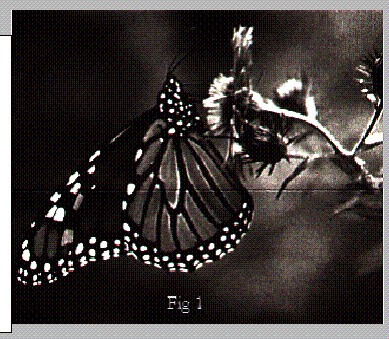
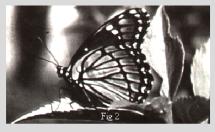
University of California, Riverside (Contacts) Monarch and Viceroy Butterflies share a unique quality. Both of these butterflies have a similar shape, both are almost the same size, and both have the same colors (Figs. 1 & 2). These butterflies have orange wings with black veins and white spots on the black wing tips. The big difference is that the viceroys have a narrow black band across each hind wing (Fig. 2). This black band is absent from the hind wings of the monarch (Fig. 1). However, to the untrained eye, the monarch and the viceroy look alike.
Viceroy The butterfly, or adult stage, is the only time when these two
insects look so much alike. The
larval (or caterpillar) stage, of the monarch has yellow, black, and white
rings around its body. On the other
hand, the viceroy caterpillar is blotched with green, yellow, and tan. At the pupal stage (or nonmotile stage
when internal changes are occurring), the viceroy chrysalis (or protective
case) is tan and cream colored, but the monarch=s chrysalis is light green
with shiny gold dots. Even the shapes
of the two chrysalises are different. Monarch When specialists
began studying these butterflies, they asked questions such as, why are these
animals colored similarly? They
decided that the reason for the similar appearance was that the viceroy had
evolved colors that mimic, or copy, the monarch colors to confuse predators
and thereby protected themselves.
Monarch larvae eat milkweed plants that contain chemicals poisonous to
birds and other predators. Because of
these chemicals, monarchs taste bad when they are eaten by an animal. The animal becomes ill, vomits and learns
to avoid this butterfly or others that look similar. Because viceroys look like monarchs, the
viceroys benefit because the birds learn to avoid them as they do the
monarchs. This kind of mimicry, where
one insect tastes bad (the monarch) and the other tastes good (the viceroy),
is called Batesian Mimicry. It was
named after Henry Bates, a 19th Century English naturalist who first
described this phenomenon. Ever since,
specialists have looked further into the viceroy/monarch relationship and
realized that this is, in fact, not an example of Batesian Mimicry. It was found that the viceroy butterfly
also has a taste that is offensive to the predators. Because both butterflies look alike and both
taste bad, any predators who would have the misfortune of eating either
species learn twice as quickly to avoid either butterfly. This type of mimicry, in which both
similar looking species taste bad, is called Mullerian Mimicry and was named
after Fritz Muller who was a 19th century Brazilian zoologist who first
described this phenomenon. MONARCH
BUTTERFLY MIGRATION Cold weather in
autumn and winter is fatal to most adult insects. Most butterflies die in autumn and leave their young
chrysalises so they can survive the weather extremes in winter. The monarch butterfly, Danaus plexippus, is an insect that is
unable to survive cold weather in any life stage (larval, pupal, or
adult). In developing mechanisms to
protect itself from the cold winter weather, the monarch has acquired the
ability to migrate. Monarchs spend the
winter in the warm areas of coastal California, or in small, protected land
areas in the mountains of central Mexico.
Once the weather in the north begins to warm and the milkweed plants
(the favorite food of monarch caterpillars) begin to grow, the delicate
insects begin their 2,000 mile journey to the north. The migration north
from California and Mexico to Canada, which covers most of the United States,
begins around March. On their way to
Canada, the butterflies stop only to eat flower nectar or to lay eggs on
milkweed plants. These larvae hatch
in about three days after the eggs are laid, and in about two weeks the
larvae are fully grown. After a larva
is about 2 inches long, it hangs upside down from a branch on some silk
strands that are produced by a spinneret in its mouth. After 24 hours, its skin falls away
revealing a light green chrysalis.
From 1-3 weeks later, the chrysalis will open to show a new, brightly
colored butterfly. When autumn arrives
and the weather becomes colder, the migration south begins. This time, the newly-emerged butterflies
leave their birthplaces and travel south where they will spend the winter
with millions of other monarchs. None
of the butterflies that migrated north are alive to lead the migration south,
and it is not understood how the young butterflies find their destination to
Mexico. When butterflies reach their
southern, winder destinations, they gather on trees in such large numbers
that entire trees become completely covered with butterflies. The monarch migrations return to these
trees year after year. The distance of
2,000 miles is amazing for any animal, such as birds and butterflies, to
migrate. For insects with such small,
fragile bodies, it is even more remarkable.
Be sure this autumn to look outside for monarchs in any life stage in
this process as they are coming back from the north In Riverside, the monarch migration should pass through
sometime in October or November, depending on weather events further
north. (For more information about
monarch butterflies and their migration, contact Julie Ellis at
JELLIS@KUHUB.CC.UKANS.EDU (or c/o O. R. Taylor, Dept. Of Entomology, Univ. Of
Kansas, Lawrence, KS 66045). For
information about helping with the next spring migration, contact Elizabeth
Donnelly at JNORTH@INFORMNS.K12.MN.US (or Journey North, 125 North First St.,
Minneapolis, MN. 55401). INSECTS FROM
THE LAWN
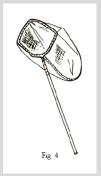
To make the net,
your parents or older brother, sister or friend might help. An inexpensive insect net can be
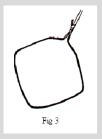
constructed from a wire coat hanger.
First, bend the hanger into a square (Fig. 3). The bag for the net should be made from a
fine mesh cloth. A 5-gallon nylon
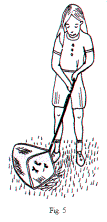
paint strainer is a good size to sew The net is swung
back and forth so that a flat side is brushing the tops of the blades of
grass (Fig. 5). Begin by sweeping for
about 30 seconds. Then swing the net
swiftly through the air to force the insects to the bottom. Quickly grab the net about 1/3rd of the
way from the bottom to prevent the insects from escaping. While a friend holds a clear, self-sealing
plastic bag (for example, ZIPLOC), turn the insect net inside-out into the
bag, and shake the insects into the bag.
Once the insects are inside, seal the bag. After sealing the
bag, count the numbers and kinds of insects.
Using your memory and the guide book, try to identify as many insects
as you can. How many different colors
of insects can you count? How do you
think an insect=s color might help keep it from being eaten by other
animals? What other kinds of animals
did you catch beside insects? Empty
the bag and make another sweeping collection for 30 seconds. Did you catch the same number of
insects? Make several 60-second
collections. Did you catch about
twice as many insects in the 60-second collection as you did in the 30-second
collections? If you keep a nature
journal, you can record these observations.
Do this experiment several times throughout the year and see how the
insects change. When using the
sweep net, be careful to avoid areas where clover or other flowers are to
avoid catching bees and getting stung. References: Arnett, R. H., Jr. & R.
L. Jacques, Jr. 1981 Guide to Insects. Simon An Schuster Publ, N.Y..Entomological
Society of America. 1995. Monarchs and viceroys. Mimicry: the art of disguise. Ent. Soc.
Amer. Newsletter, August 1995. |