FILE: <ch-99.htm> GENERAL INDEX [Navigate to MAIN MENU
]
|
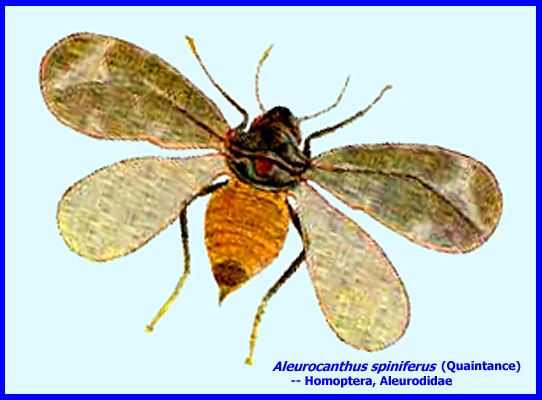
SPINY BLACKFLY Aleurocanthus spiniferus (Quaintance) --
Aleurodidae (Contacts) ----- CLICK on Photo to enlarge &
search for Subject Matter with Ctrl/F. GO TO ALL: Bio-Control Cases One of the best examples of a
biological control success, this project was casually arranged on a
cooperative basis and apparently did not sustain any cost (DeBach 1974). Drs. I. Kuwana and T. Ishii discovered
this blackfly near Nagasaki in Japan around 1922, although it most likely had
been present earlier and was spreading for some time. Within a few years it became one of the
serious pests of citrus trees in the southern island of Kyushu. Fumigation and insecticide treatments
failed to control the pest.
There were no
effective natural enemies in Japan and it was believed that the pest
originated in south China, which is in the native range of citrus and where
the spiny blackfly was known to occur.
Entomologists and horticulturalists were planning to search for
natural enemies in China when Dr. F. Silvestri of Portici, Italy, who was on
a temporary foreign exploration for the University of California to find
parasitoids of the California red scale, visited Japan. At that time the Japanese requested that
he try to find the spiny blackfly upon his return to the Asiatic mainland. Silvestri
discovered a parasitoid, Prospaltella
smithi Silvestri and a
ladybird beetle, Cryptognatha
sp., both of which he brought with him on his second visit to Nagasaki on May
23, 1925. These were colonized on
heavily infested trees in the village of Ikiriki, near Nagasaki. There were only 20 parasitoids and 10
beetles involved. The beetles did not
establish, but the parasitoids reproduced so that by November, adult
parasitoids were easily found on the leaves of the original release tree. However, because Nagasaki has a colder
winter than Canton, China, it was feared that the parasitoids might not
overwinter successfully. However, by
June 1926 parasitoid activity was observed on the release tree, and 74% of
the whitefly pupae showed exit holes from which adult parasitoids had
emerged. They spread rapidly and were
aided by distribution of leaves bearing parasitized pupae, so that within a
short time the pest was almost completely eliminated (Kuwana 1934). DeBach (1974) maintained that the control
remained perfect to the 1970's. Please also see Sawada
et al. (1932), Peterson (1955), Watanabe (1958) and Smith et al. (1964) for
additional details on biological control efforts and the biologies of host
and natural enemies. Also <ch-81.htm> REFERENCES: [Additional references may be found at: MELVYL
Library ] DeBach, P. 1974. Biological Control by Natural
Enemies. Cambridge University Press,
London & New York. 323 p. Kuwana, I.
1934. Notes on a newly imported parasite of the
spiny whitefly attacking citrus in Japan.
Proc. 5th (1933) Pacific Science Congress 5: 3521-3. Peterson, G. D., Jr.
1955. Biological control of
the orange spiny whitefly in Guam. J. Econ.
Ent. 48: 681-83. Sawada, E., N. Ikeda & K.
Tanaka. 1932.
Studies on Prospaltella
smithi Silv., and enemy of Aleurocanthus spiniferus Quaint. Japan Dept. Agric. & Forestry Bur.
Agric. Materials for Agric. Impr. 42:
1-28 [in Japanese; Abs. in REv. Appl. Ent. (A), 20: 495.] Smith, H. D., H. L. Maltby & J. E. Jimenez. 1964.
Biological control of the citrus blackfly in Mexico. U. S. Dept. Agric. Tech. Bull. 1311. 30 p. [may mention whitefly]. Watanabe, C. 1958. Review of biological control of insect
pests in Japan. Proc. 10th Intern.
Congress Ent., Monteral 4: 515-17. |