FILE: <ch-76.htm>
GENERAL INDEX [Navigate
to MAIN MENU ]
|
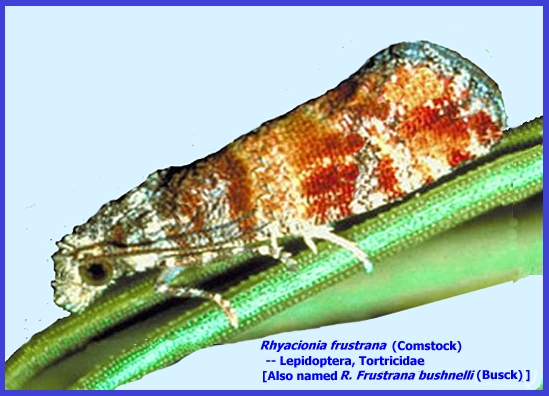
NANTUCKET PINE TIP MOTH Rhyacionia frustrana
(Comstock) -- Lepidoptera, Tortricidae [Also named R. frustrana
bushnelli (Busck)] (Contacts) ----- CLICK on Photo to enlarge &
search for Subject Matter with Ctrl/F. GO TO ALL: Bio-Control Cases
The ichneumonid Scambus aplopappi (Ashmead), and a native tachinid, Erynnia tortricis (Coquillett), parasitized the tip moth to about
10% (Scriven & Luck 1978). A
decision was made to introduce natural enemies from the eastern and southern
United States in 1979, when an ichneumonid Campoplex frustranae
Cushman and a tachinid Lixophaga
mediocris Aldrich were
introduced. The tachinid did not
become established but C. frustranae was established and
increased rapidly from 1976-1977 (Scriven & Luck 1978). Parasitization of overwintering tip moths
reached 50% by 1979, and many Monterey pin trees at the original parasitoid
establishment site improved in appearance and vigor, suggesting that
biological control was successful (Scriven & Luck 1978). Campoplex
frustranae has continued to
spread in southern California with expansion of the tip moth population
(Dahlsten & Hall 1999). Additional
references relating to biological control effort, and biologies of host and
natural enemies may be found in the following (Baumhofer 1932, Cushman 1932,
Schaffner 1950, Graham 1956, Dowden 1962). \ REFERENCES: [Additional references may be found at: MELVYL
Library ] Baumhofer, L. G. 1932. Biological control of the pine tip moth in
Nebraska. Wash. Ent. Soc. Proc.
34: 28. Coulson, R. N. & J. A. Witter. 1984. Forest
Entomology. John Wiley & Sons,
New York. 669 p. Cushman, R. A. 1932. Note on the biological control of the pine
tip moth in Nebraska. Wash. Ent. Soc.
Proc. 34: 28. Dahlsten, D. L. & R. W. Hall. 1999. Biological control
of insects in outdoor urban environments.
In: Bellows, T. S. & T. W. Fisher (eds.), Handbook of Biological Control: Principles and Applications. Academic Press, San Diego, New York. 1046 p. Dowden, P. B. 1962. Parasites and predators of forest insects
liberated in the United States through 1960.
U. S. Dept. Agric. Agric. Handbk. 226. 70 p. Graham, S. A. 1956. Forest insects and the law of natural
compensations. Canad. Ent.
88: 45-55. Schaffner, J. V., Jr. 1950. Butterflies and
moths. Order Lepidoptera. In: F. C. Craighead (ed.), Insect Enemies of
Eastern Forests. U. S. Dept. Agric.
Misc. Pub. 657: 343-505. Scriven, G. T. & R. F. Luck.
1978. Natural enemy promises
control of Nantucket pine tip moth.
Calif. Agric. 32(10): 19-20. |