FILE: <ch-70.htm> GENERAL INDEX [Navigate to MAIN MENU
]
|
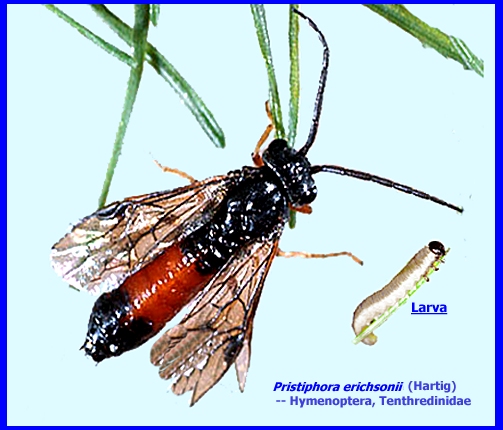
LARCH SAWFLY Pristiphora erichsonii (Hartig) -- Tenthredinidae (Contacts) ----- CLICK on Photo to enlarge &
search for Subject Matter with Ctrl/F. GO TO ALL: Bio-Control Cases
Collections
were made in Great Britain during the early phase of introductions (McGugan
& Coppel 1962). They were shipped
to Canada for quarantine, screening and direct release. This led to the establishment of the
specific ichneumonid larval parasitoid Mesoleius
tenthredinis Morley, which in
Manitoba was found in 20% of sawfly cocoons in 1960 and had parasitized over
80% of the population by 1927 (Criddle 1928). Subsequently a tachinid Zenillia
nox (Hall), was collected in
Japan in 1934 by the U. S. Dept. of Agriculture and released both in New
Brunswick and British Columbia but failed to establish. The success of parasitism by M. tenthredinis prompted an extensive relocation program to
distribute this parasitoid throughout Canadian larch forests. Rapid establishment was reported with subsequent
reductions in sawfly populations and reduced timber losses. This
appeared to be another example of the success of classical biological control
in Canada, but in the late 1930's larch sawfly defoliation again became
prevalent in Manitoba. Parasitism by M. tenthredinis appeared to have dropped to low levels, so
75,000 parasitoids were transferred from British Columbia across central
Canada. While the parasitoids' range
increased, levels of parasitism remained low due to the encapsulation of parasitoid
eggs by host larvae (Muldrew 1953).
The appearance of a resistant European strain of the sawfly, capable
of encapsulating M. tenthredinis eggs, appears to
have resulted from the parasitoid introduction program in 1913, when imported
larch sawfly cocoons were placed directly in the field. The resistant strain has since spread
across Canada and into neighboring states of the United States, becoming
predominant in most regions (Wong 1974). Renewed
efforts were made in 1957 to obtain more parasitoids from Europe and Japan,
and long term study plots were chosen in Manitoba to better evaluate the
dynamics of the larch sawfly populations and the impact of
introductions. These studies (Ives
1976) indicated that mortality in the cocoon and adult stages determined
population trends and that high water tables and predation by small mammals
were largely responsible for the erratic population abundance. The native tachinid, Bessa harveyi
(Tns.), considered the most important parasitoid in the renewed outbreaks,
had little impact. The
Commonwealth Institute of Biological Control collected 11 parasitoids in
Europe and Japan and shipped them to Canada between 1959-65. Five of the more abundant species were
selected for release and >200 adult were liberated. A separate introduction of the masked
shrew, Sorex cinereus Kerr from New
Brunswick to the island of Newfoundland was made in 1958 in order to fill the
vacant niche for an insectivore and to increase cocoon predation. The shrew as successfully established as
well as two of the parasitoids. One
of these parasitoids, the ichneumonid Olesicampe
benefactor Hinz., attacks
young sawfly larvae, the second, a Bavarian strain of M. tenthredinis,
was shown to be only weakly encapsulated by the resistant sawfly strain and
was able to pass its characteristics on to the progeny of mixed (Britain X
Bavarian) crosses (Turnock & Muldrew 1971). Parasitism by M.
tenthredinis initially
increased following the release of the Bavarian strain but O. benefactor became the dominant parasitoid influencing
cocoon survival. Parasitism by the
latter at the release point in Manitoba attained levels of ca. 90% between
1967-72 (Ives 1976) and was the dominant factor for the collapse of the
sawfly epizootic (ives 1976). Olesicampe benefactor was relocated from Manitoba to most other
Provinces in Canada (Turnock & Muldrew 1971) as well as to Maine (Embree
& Underwood 1972), Minnesota (Kulman et al. 1974) and Pennsylvania (Drooz
et al. 1985). Effects
of the masked shrew on larch sawfly cocoon survival in Newfoundland has never
been adequately estimated. Predation
of cocoons is thought to have increased (Dahlsten & Mills 1999), but
outbreaks have continued through the 1970's (Ives 1976). Therefore, O. benefactor
seems to offer the greatest potential for controlling larch sawfly in
Canada. However in 1966 a
hyperparasitoid, Mesochorus globulator Thunb. began to
attack this parasitoid in Manitoba.
The polyphagous hyperparasitoid is common in Europe and may also have
been accidentally introduced during the initial 1910-13 introductions
(Dahlsten & Mills 1999). It has
spread throughout the region and into Wisconsin, although it hasn't been
reported from Pennsylvania (Drooz et al. 1985). While hyperparasitism attained very high levels (80-90%) in
Manitoba during 1970's, sawfly populations continue to remain low in
abundance, and thus control may be achieved by O. benefactor
despite the occurrence of the hyperparasitoid. The
larch sawfly program gives further evidence of the value of the more specific
and well adapted parasitoids in classical biological control. As in the case of the European spruce
sawfly, while a wide range of parasitoids was released, only the more
specific species became established.
However, while in the absence of hyperparasitism O. benefactor
may have been an ideal control agent, its competitive superiority over the
Bavarian strain of M. tenthredinis may have prevented
the latter from establishing and spreading more widely (Dahlsten & Mills
1999). This and the known occurrence
of various geographic strains of M.
tenthredinis differing in
ability to avoid encapsulation by the host, emphasizes the value of detailed
studies of parasitoid biologies prior to introduction. Also, the accidental introduction of both
a parasitoid resistant strain of the host and probably also a hyperparasitoid
indicates the critical need for quarantine handling of imported material to
avoid unnecessary liberations. For
further detail on biological control effort, and biologies of host and
natural enemies, please see the following (Hewitt 1912, Graham 1931, 1953;
Hopping et al. 1943, Hawboldt 1947, McLeod 1952, 1954; Lejuene & Hildahl
1954, Reeks 1954, Muldrew 1955, 1967; Drooz 1957, 1960, 1961; Ives &
Prentiss 1959, Turnbull & Chant 1961, Turnock 1960, Dowden 1962,
Pschorn-Walcher & Eichhorn 1963, Eichhorn 1965, Eichhorn et al. 1965). REFERENCES: [Additional references may be found at: MELVYL
Library ] Bellows, T. S. & T. W. Fisher (eds.). 1999. Handbook
of Biological Control: Principles and
Applications. Academic Press, San
Diego, New York. 1046 p. Criddle, N.
1928. The introduction and
establishment of the larch sawfly parasite, Mesoleius tenthredinus
Morley, into southern Manitoba. Canad. Ent.
60: 51-53. Dahlsten, D.
L. & N. J. Mills. 1999.
Biological Control of Forest Insects.
In: Bellows, T. S.
& T. W. Fisher (eds.), Handbook of
Biological Control: Principles and
Applications. Academic Press, San
Diego, New York. 1046 p Dowden, P. B.
1962. Parasites and predators
of forest insects liberated in the United States through 1960. U. S. Dept. Agric. Agric. Handbk.
226: 70 p. Drooz, A. T.
1957. The importance of Mesoleius tenthredinis Morl., a parasite of the larch sawfly, in New
York State. J. Econ.
Ent. 50: 212. Drooz, A. T.
1960. The larch sawfly, its
biology and control. U. S. Dept.
Agric. Tech. Bull. 1212. 52 p. Drooz, A. T.
1961. Mesoleius tenthredinis
Morl. in Pennsylvania and Michigan.
Canad. Ent. 93: 804-07. Drooz, A. T., J. W. Quimby, L. C. Thompson
& H. M. Kulman. 1985. Introduction and establishment of Olesicampe benefactor Hinz (Hymenoptera: Ichneumonidae), a parasite
of the larch sawfly, Pristiphora
erichsonii (Hartig)
(Hymenoptera: Tenthredinidae), in Pennsylvania. Environ. Ent.
14: 420-23. Eichhorn,
O. 1965. Uber einige Lärchenschädlinge und ihre Parasiten in Japan,
Europa und Kanada. Betr. Ent. 15: 111-26. Eichhorn, O.,
H. Pschorn-Walcher & D. Schröder.
1965. Neue Untersuchungen sur
biologischen Bekámpfung verschleppter Forstinsekten. 2.
Bericht über die Arbeiten der europäischen Station des Commonwealth
Institute of Biological Control, Delémont, Switzerland. Pt. II.
Anz. Schädlingsk. 38: 104-09. Embree, D. G. & G. R. Underwood. 1972.
Establishment in Maine, Nova Scotia and New Brunswick of Olesicampe benefactor (Hymenoptera: Ichneumonidae), an introduced
ichneumonid parasite of the larch sawfly, Pristiphora
erichsonii (Hymenoptera: Tenthredinidae). Canad. Ent. 104: 89-96. Graham, A. R.
1931. The present status of
the larch sawfly, (Lygaeonamatus
erichsonii Hartig), in
Canada, with special reference to its specific parasite, Mesoleius tenthredinis
Graham, A. R.
1953. Biology and
establishment in Canada of Mesoleius
tenthredinis Morley
(Hymenoptera: Ichneumonidae), a parasite of the larch sawfly, Pristiphora erichsonii (Hartig)
(Hymenoptera: Tenthredinidae). Quebec
Soc. Protect. Plants, 35th Ann. Rept.:
61-75. Hawboldt, L. S. 1947. Bessa selecta (Meigen) (Diptera: Tachinidae) as a parasite of Gilpinia hercyniae (Hartig).
Canad. Ent. 79: 84-104. Hewitt, C. G.
1912. The larch sawfly (Nematus erichsonii) with an account of its parasites, other
natural enemies and means of control.
Canad. Dept. Agric. Bull. 10 (2nd Ser.), Ent. Bull. 5: 7-42. Hopping, G. R., H. B. Leech & C. V. G.
Morgan. 1943. The larch sawfly, Pristiphora erichsonii
(Hartig), in British Columbia with special reference to the cocoon parasites Mesoleius tenthredinis Morley and Tritneptis klugii
(Ratzburg). Sci. Agr. (Ottawa)
24: 53-63. Ives, W. G. H.
1976. The dynamics of larch
sawfly (Hymenoptera: Tenthredinidae) populations in southeastern
Manitoba. Canad. Ent. 108: 701-30. Ives, W. G. H. & R. M. Prentice. 1959.
Estimation of parasitism of larch sawfly cocoons by Bessa harveyi Tnsd. in survey collections. Canad. Ent. 91: 496-500. Kulman, H. M., L. C. Thompson & J. A.
Witter. 1974. Introduction of parasitoids of the larch
sawfly in Minnesota. Great Lakes Ent.
7: 23-25. Lejeune, R. R.
& V. Hildahl. 1954. A
survey of the parasites of the larch sawfly (Pristiphora erichsonii
(Hartig)) in Manitoba and Saskatchewan.
CAnad. Ent. 86: 337-45. McGugan, B. M. & H. C. Coppel. 1962.
A review of the biological control attempts against insects and weeds
in Canada. II. Biological control of forest insects,
1910-1958. Commonwealth Inst. Biol.
Control Tech. Comm. No. 2: 35-216. McLeod, J.
H. 1952. Notes on the
population and parasitism of the larch sawfly Pristiphora erichsonii
(Htg.) (Hymenoptera: Tenthredinidae) in British Columbia. Ent. Soc. Brit. Columbia Proc. (1951)
48: 81-5. Muldrew, J. A.
1953. The natural immunity of
the larch sawfly (Pristiphora
erichsonii (Htg.)) to the
introduced parasite (Mesoleius
tenthredinis Morley), in
Manitoba and Saskatchewan. Canad. J.
Zool. 31: 313-32. Muldrew, J. A.
1955. Parasites and insect
predators of the larch sawfly. Canad.
Ent. 87: 117-20. Muldrew, J. A.
1967. Biology and initial
dispersal of Olesicampe (Holocremnus) sp. nr. nematorium (Hymenoptera:
Ichneumonidae), a parasite of the larch sawfly recently established in
Manitoba. Canad. Ent.
99: 312-21. Pschorn-Walcher,
H. & O. Eichhorn. 1963.
Investigations on the ecology and natural control of the larch sawfly
(Pristiphora erichsonii (Htg.) Hym.,
Tenthredinidae) in Central Europe.
Part I. Abundance,
life-history and ecology of P.
erichsonii and other
sawflies on Larch. Commonwealth Inst.
Biol. Control, Tech. Bull. 3: 51-81. Reeks, W. A.
1954. An outbreak of the larch sawfly (Pristiphora erichsonii
(Htg.)) in the Maritime Provinces (Hymenoptera: Tenthredinidae) and the role
of parasites in its control. Canad.
Ent. 86: 471-80. Turnbull, A. L. & D. A. Chant. 1961.
The practice and theory of biological control of insects in
Canada. Canad. J. Zool. 39: 697-753. Turnock, W. J.
1960. Ecological life-history
of the larch sawfly, Pristiphora
erichsonii (Htg.)
(Hymenoptera: Tenthredinidae), in Manitoba and Saskatchewan. Canad. Ent. 92: 500-16. Turnock, W. J. & J. A. Muldrew. 1971.
Chapter 45. Pristiphora erichsonii (Hartig), larch
sawfly (Hymenoptera: Tenthredinidae), p. 175-94. In: Biological Control Programmes Against
Insects and Weeds in Canada.
1959-1968. Commonwealth Inst.
of Biol. Control, Tech. Commun. No. 4.
266 p. Wong, H. R.
1974. The identification and
origin of the larch sawfly, Pristiphora
erichsonii (Hymenoptera:
Tenthredinidae) in North America.
Canad. Ent. 106: 1121-31 |