FILE: <ch-7.htm> GENERAL INDEX [Navigate to MAIN MENU ]
|
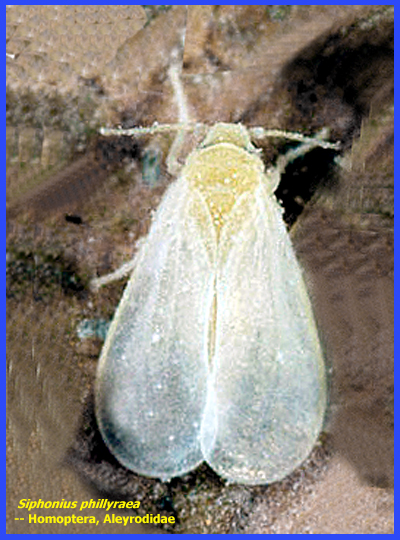
ASH WHITEFLY Siphonius phillyraea -- Homoptera, Aleyrodidae (Contacts) ------ CLICK on Photo to enlarge & search for Subject Matter with Ctrl/F. GO TO ALL: Bio-Control Cases
Biological control investigators at the University of California,
Riverside and in the California State Department of Food and Agriculture
concluded that ash whitefly had invaded from the Old World and developed a
plan to import parasitoids and predators from that part of the world. Two Encarsia spp. nr. inaron
were introduced, one from central Italy and the other from Israel, the latter
being supplied by Dr. Dan Gerling of the University of Tel-Aviv <PHOTO>. These parasitoids
were reared in California and distributed in 13 counties of California and
Arizona. Recoveries were made at all
sites, but the Israel strain seemed to predominate. A coccinellid predator, Clitostethus arcuatis
was also released in five California counties, but only with limited
recoveries (Bellows & Paine 1990).
With the establishment of these natural enemies in southern
California, ash whitefly was scarcely noticeable by the public in autumn of
1990.
By 1991 the ash whitefly had spread into central and northern
California, and the natural enemies have been released against it. It is expected that establishment will
result in complete biological control.
Whether this is possible as the whitefly spread to other parts of
North America is unknown, especially as the imported natural enemies
originated in subtropical or warm temperate parts of the Old World. However, natural enemies from temperate
climates are known and their acquisition should not pose any difficulty. REFERENCES: [ Additional references may be found at: MELVYL
Library ] Bellows, T.
S. & T. D. Paine. 1990. Distribution and biological evaluations of
Encarsia sp. nr. inaron, parasitoid of ash
whitefly, Siphonius phillyreae. Progress Rept. to the Statewide UC IPM Project, Davis, CA. 13 p. Bellows, T.
S., Jr., T. D. Paine, K-Y Arakawa, C. Meisenbacher, P. Leddy, & J. Kabashima. 1990. Biological control sought for ash whitefly. California Agriculture, 44 (l):
4-6. Bellows, T. S., T. D. Paine, & D. Gerling, 1992. Development, survival, and fecundity of Clitstethus
arcuatus (Coleoptera: Coccinellidae) on Siphoninus phillyreae
(Homoptera: Aleyrodiae) in the laboratory.
Environmental Entomology 21:
659-663. Evans, G. A. & A. B. Hamon. 2002. Whitefly
taxonomic and ecological Web site: an on-line interactive catalog of the
whiteflies (Hemiptera:Aleyrodidae) of the world and their parasites and predators.
http://www.fscadpi.org /homoptera_hemiptera/ Whitefly/whitefly catalog.htm. Gerling, D., O. T. S. Rottenberg
& S. J. Bellows. 2004. Role of Natural Enemies and Other Factors in the Dynamics of
Field Populations of the Whitefly Siphoninus phillyreae (Haliday) in
Introduced and Native Environments. Biological Control 31: 199-209. Haliday, A. H.
1835. Aleyrodes phillyreae. Entomology Magazine 2: 119-120. Huffman, D. & K. A. Kidd. 2010.
Ash whitefly in North Carolina.
North Carolina State University
Insect Notes 2010. Mound, L. A. 1966. A revision of the
British Aleyrodidae (Hemiptera: Homoptera).
Bulletin of the British Museum of National History, Entomolgy 17: 419-420. Mound, L. A. &
S. H. Halsey. 1978. Whitefly of the World. A Systematic
Catalogue of the Aleyrodidae (Homoptera) with Host Plant and Natural Enemy
Data. British Museum of Natural
History) and John Wiley and Sons, New York, NY. pp. 192-193. Nechols, J. R. 1995.
Biological Control in the Western United States: Accomplishments and
Benefits of Regional Research Project W-84, 1964-1989. UCANR Publications. pp. 101–106. Pickett, C. H. & M. J. Pitcairn. 1999. Classical
biological control of ash whitefly: factors contributing to its success in
California. Biocontrol 44: 143-158. Sumner, Daniel A.
& Frank H. Buck, Jr. 2007.
Exotic Pests and Diseases: Biology and Economics for Biosecurity. John Wiley & Sons. pp. 203–220. Stocks, I.. & Hodges G. 2010. Ash whitefly, Siphoninus phillyreae
(Haliday), a new exotic whitefly (Hemiptera: Aleyrodidae) in central Florida,
and Encarsia inaron,
its parasitoid (Hymenoptera: Aphelinidae).
Florida Division of Plant Industry
2010. Viggiani, G. & P.
Mazzone. 1980. Encarsia pseudopartenopea n.sp.,
parassita di Siphoninus phillyreae (Haliday) (Hom. Aleyrodidae). Bollettino el Laboratorio di Entomologia Agraria 'Filippo
Silvestri' 37: 9-12. Viggiani, G. & D.
Battaglia. 1983.
Le specie italiane del genere Eretmocerus Hald. (Hymenoptera:
Aphelinidae). Bolletino del
Laboratorio di Entomologia Agraria 'Filippo Silvestri' 40: 97-101. |