FILE: <ch-60.htm> GENERAL INDEX
[Navigate to
MAIN MENU ]
|
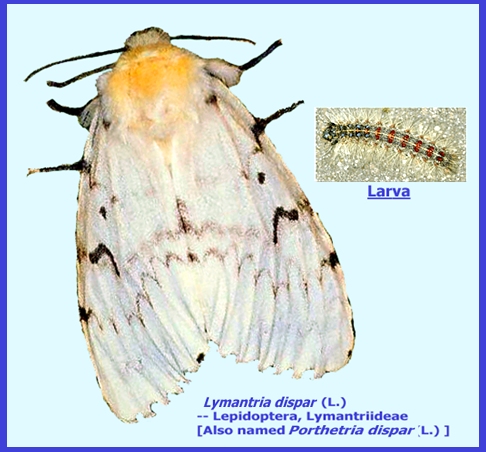
GYPSY MOTH Lymantria dispar (L.) -- Lepidoptera, Lymantriideae [Also named Porthetria dispar (L.) ] (Contacts) ----- CLICK on Photo to enlarge &
search for Subject Matter with Ctrl/F. GO TO ALL: Bio-Control Cases
Biological
Control A
biological control project was organized by the U. S. Department of Agriculture,
Bureau of Entomology in 1905 and extensive foreign exploration for
parasitoids and predators was carried out in Europe, Japan, North Africa and
Asia at various intervals since that time (Doane & McManus 1981). This was the first major classical
biological control project against a forest insect, directed by Dr. L. O.
Howard, Chief of the Bureau of Entomology.
DeBach (1974) revealed that a large number of young American
entomologists were employed on the gypsy moth project, some becoming famous
later on, e.g., P. H. Timberlake (uncle of President Richard Nixon), H. S.
Smith, W. R. Thompson and J. D. Tothill.
The gypsy moth project has revealed that (1) insect disease was
recognized as an important biological control factor, (2) the sequence theory
of natural enemies was introduced by W. F. Fiske, (3) a number of future
important contributors to biological control were trained on the project (H.
S. Smith, W. R. Thompson and W. D. Tothill), (4) sleeve cages were invented
as well as other equipment and techniques that are still in use today and (5)
L. O. Howard and W. F. Fiske were the first to clearly distinguish between
those causes of mortality that act in relation to the density of the
population and those that do not. L.
O. Howard also stimulated the Canadian interest in biological control in the
early 1900's by making available facilities and scientific assistance from
the Melrose Highlands Parasite Laboratory of the U. S. Bureau of Entomology.
Early importations of natural enemies occurred between 1905-14 and
again between 1922-33. While some
collections were made in Japan, attention focused on Europe where temporary
field laboratories were placed wherever gypsy moth outbreaks were sufficient
to permit the rearing of parasitoids from a large number of hosts. Frequent shipments of parasitoids and
predators were made to the gypsy moth laboratory at Melrose Highlands,
Massachusetts and this resulted in the liberation of >690,000 living
insects of more than 45 species during this period (Dowden 1962). The enormous importation and multiple
release program enabled two larval/pupal predators, two egg parasitoids, six
larval parasitoids and one pupal parasitoid to become established in the New
England states. The two egg
parasitoids were also subject to either large scale rearing releases in the
case of Ooencyrtus kuwanae (How.), or to large
scale relocation releases in the case of Anastatus
disparis Ruschka. Most of the establishments occurred
rapidly after the initial field releases but the tachinids Parasetigena silvestris (R.-D.) and Exorista larvarum (L.) were not recovered until 1937 and 1940
respectively and the chalcidid Brachymeria
intermedia (Nees) was only
recovered in 1965.
Biological control by established parasitoids and predators in New
England was limited and large scale aerial applications of DDT were used
until the early 1960's. Since 1960
renewed interest in the search for additional natural enemies has extended explorations
in Europe, Japan, Morocco, India, Iran and Korea (Doane & McManus
1981). Since 1963 the USDA
Agricultural Research Service Beneficial Insects Research Laboratory has
continued to receive gypsy moth natural enemies in their quarantine facilities
and have been able to distribute more than 200,000 individuals of about 60
species to other State and Federal facilities for culture, study and field
release. From 1966 until 1971, the
Gypsy Moth Methods Improvement Laboratory at Otis Air Force Base in Massachusetts
was charged with the development of rearing procedures for the imported
natural enemies. From 1963-71 in
conjunction with the New Jersey Department of Agriculture about 7 million
parasitoids of 17 species were reared and released in the forests of New
Jersey and Pennsylvania. Then from
1971-77 a Gypsy Moth Parasite Distribution Program was established in which
the New Jersey Dept. of Agriculture and the University of Maryland reared and
released an additional two million parasitoids of 18 species throughout the
New England states. Since the late
1970's more new parasitoids and a predator from Japan and Korea and from the
Indian gypsy moth, Lymantria
obfuscata Walk., have been
imported (Coulson et al. 1986). More
than 100,000 individuals of nine new species or strains have been released in
the field in Delaware, Massachusetts and Pennsylvania.
Although much knowledge of the biology and rearing methods of the
imported parasitoids was gained during this massive program of importation,
propagation and release, it has resulted in the addition of only a single
pupal parasitoid, Coccygomimus
disparis (Vier.) to the
complex of 10 species established during the initial importation
program. This has prompted Tallamy
(1983) to compare the establishment of gypsy moth parasitoids with island
biogeography theory, suggesting that a dynamic equilibrium now exists between
further introductions and the extinction of established parasitoids. In the last 30 years two of the
parasitoids that were initially established, Anastatus disparis
and Exorista larvarum have become very rare,
while two pupal parasitoids Brachymeria
intermedia and C. disparis have become established. However, the main reasons for the failure
to establish additional parasitoids in recent years are the parasitoids'
requirements for suitable alternative overwintering hosts for their second
generation each year and the fact that several of the parasitoid species
released during the 1960's were not closely associated with gypsy moth as a
principal host in their areas of origin (Dahlsten & Mills 1999).
The failure of the established natural enemies to control expanding
outbreaks of the gypsy moth encouraged attempts during the 1970's to augment
the impact of previously established species. Through inundative releases of Cotesia melanoscelus
(Ratz.), Weseloh & Anderson (1975) were able to show significantly
increased rates of parasitism but this had little influence on foliage
protection or egg mass counts for the following generation. On the other and several other inundative
releases of this and other species failed to provide any evidence of
increased parasitism in comparison to control plots (Doane & McManus
1981). The combined release of
parasitoids and pathogens has been used as a method of augmentation. Wollam & Yendol (1976) were able to
show a synergistic effect of the release of C. melanoscelus
in plots treated with a double application of low concentration Bacillus thuringiensis over plots treated with each of these
natural enemies alone. The resultant
reduction in defoliation and subsequent egg mass densities has more recently
been attributed to the retarding effect of B. thuringiensis
on host larval growth which exposes the younger larvae to parasitism for a
longer period of time (Weseloh et al. 1983).
A similar effect of C.
melanoscelus in conjunction
with viral treatments is unlikely to occur since this parasitoid avoids
oviposition in moribund host larvae (Versoi & Yendol 1982). Augmentation
Augmentation through use of microbial pathogens has been of
considerable importance against gypsy moth with significant advances in
recent years. Early trials with B. thuringiensis in the 1960's were not effective in
providing foliage protection; but the discovery of improved strains (Dubois
1985b) and successive improvements in formulation and application technology
during the late 1970's and early 1980's led to greater success. The results of aerial applications during
the 1970's remained highly variable but a recommendation of double application
of low concentrations was developed and used operationally for the first time
on a large scale in 1980. This also
met with limited success but further experimental work in the early 1980's
(Dubois 1985a) indicated that the use of higher concentrations and acrylamide
stickers could provide not only good foliage protection but also could reduce
subsequent egg mass densities significantly with a single application. This development reduced the cost of B. thuringiensis applications and has been used operationally
with success on 40-70% of the 1.3-1.5 million ha. of hardwood forest treated
since 1983. Virus
Deployment
Many field trials have been conducted with virus sprays against gypsy
moth both in North America and Europe (Cunningham 1982). An NPV virus strain (Hamden standard)
isolated from a natural epizootic in Connecticut in 1967 forms the basis for
the commercially produced "Gypchek" that was registered for use
against gypsy moth in North America in 1978.
However, early trials of the baculovirus produced erratic results and
while continued improvements in formulation and application have produced
more positive results, it has never been accepted for operational use
(Podgwaite 1985). Reasons for this
are the relatively low virulence of the virus, its rapid degradation on
foliage in the field and the more recent successes with the use of B. thuringiensis. Conclusions
Dahlsten & Mills (1999) point out that the gypsy moth program has
been spectacular in both the scale and the continued enthusiasm with which it
has been conducted, but that the results have been disappointing and serve as
a good example of the failure of classical biological control in situations
where the introduced pest is also severe in its region of origin. Therefore the search for natural enemies
in areas where gypsy moth is not a pest, in non-outbreak populations or from
related non-pest Lymantria
species may prove to be a better strategy.
For further details on biological control efforts and biologies of
host and natural enemies, please see the following (Fiske 1910, Howard 1910,
Howard & Fiske 1911, Burgess 1915, Burgess & Collins 1915, Culver
1919, Tothill 1919, Crossman 1922, 1925; Escaleva 1926, Webber & Schaffner
1926, Muesebeck & Dohanian 1927, Burgess & Crossman 1929, Lepiney
1933, Schaffner 1934, Baeta-Neva & Azeveda 1944, Templado 1957, Hitchcock
1959, Tadic & Bin…ev 1959, Dowden 1961a,b; Tadic 1962, Salatic
1963, Bjegovic 1964, Leonard 1966, 1967; Clausen 1978) REFERENCES: [Additional references may be found at: MELVYL Library ] Baeta
Neves, C. M. & F. A. e Silva.
1944. Nota sobre a aplicacao da
luta biologica na companha da Lymantria. Bol. Junta Nac. Cortica (Lisbon) 63: 101-03. Bellows, T. S. & T. W. Fisher (eds.). 1999. Handbook
of Biological Control: Principles and
Applications. Academic Press, San
Diego, New York. 1046 p. Bjegovic, P.
1964. The dependence of the
sex ratio of Anastatus disparis Ruschka on the phase
of embrionic development of the host.
Zast. Bilja 15: 569-76. Burgess, A. F.
1915. Report on the gypsy moth
work in New England. U. S. Dept.
Agric. Bull. 204. 32 p. Burgess, A. F. & C. W. Collins. 1915.
The Calosoma beetle (Calosoma sycophanta) in New England. U. S. Dept. Agric. Bull. 251.
40 p. Burgess, A. F. & S. S. Crossman. 1929.
Imported insect enemies of the gypsy moth and the brown-tail moth. U. S. Dept. Agric. Tech. Bull. 86. 147 p. Clausen, C.
P. 1978. Lymantriidae. In: C. P. Clausen (ed.), Introduced Parasites
and Predators of Arthropod Pests and Weeds: A World Review. U. S. Dept. Agric., Agric. Handbk. No.
480. 545 p. Coulson, J. R., R. W. Fenster, P. W. Schaefer,
L. R. Ertle, J. S. Kelleher, & L. D. Rhoads. 1986. Exploration for
and importation of natural enemies of the gypsy moth, Lymantria dispar
(L.) (Lepidoptera: Lymantriidae), in North America: an update. Proc. Ent.
Soc. Wash. 88: 461-75. Crossman, S. S. 1922. Apanteles melanoscelus, an imported parasite of the gypsy moth. U. S. Dept. Agric. Bull. 1028. 25 p. Crossman, S. S. 1925. Two impoirted egg
parasites of the gypsy moth, Anastatus
bifasciatus Fonsc. and Schedius kuvanae Howard. J.
Agric. Res. 30: 643-75. Culver, J.
J. 1919. A study of Compsilura concinnata, an imported tachinid parasite of the gypsy
moth and the brown-tail moth. U. S.
Dept. Agric. Bull. 776. 27 p. Cunningham, J. C. 1982. Field trials with
baculoviruses: control of forest
insect pests, p. 335-386. In: E. Kurstak (ed.), "Microbial and Viral Pesticides. Marcel Dekker, Inc., New York. 720 p. Dahlsten, D.
L. & N. J. Mills. 1999.
Biological Control of Forest Insects.
In: Bellows, T. S.
& T. W. Fisher (eds.), Handbook of
Biological Control: Principles and
Applications. Academic Press, San
Diego, New York. 1046 p DeBach, P. 1974. Biological Control by Natural
Enemies. Cambridge University Press,
London & New York. 323 p. Doane, C. C. & M. L. McManus. 1981.
The gypsy moth: research
toward integrated pest management.
USDA Forest Service Tech. Bull. 1584.
757 p. Dowden, P. B.
1961a. The persistence of
gypsy moth parasites in heavy sprayed areas of Cape Cod, Msssachusetts. J. Econ. Ent. 54: 873-75. Dowden, P. B.
1961b. The gypsy moth egg
parasite Ooencyrtus kuwanai in southern Connecticut
in 1960. J. Econ.
Ent. 54: 876-78. Dowden, P. B.
1962. Parasites and predators
of forest insects liberated in the United States through 1960. USDA, Forest Service, Agric. Handbook No.
226, 70 pp. Dubois, N. R.
1985a. Recent field studies on
the use of Bacillus thuringiensis to control the
gypsy moth (Lymantria dispar L.). Proc. Symposium Microbial Control of
Spruce Budworms and Gypsy Moths. USDA
For. Serv. GTR-NE-100. p. 83-85. Dubois, N. R.
1985b. Selection of new more
potent strains of Bacillus thuringiensis for use against
gypsy moth and spruce budworm. Proc.
Symposium Microbial Control of Spruce Budworms and Gypsy Moths, USDA For.
Serv. GTR-NE-100. p. 99-102. Escalera,
F. M. de la. 1926. Un neuvo ensayo para combatir en Argelia
la plaga de Lymantria dispar (Lep.). 3rd Internatl. Cong. Ent. Proc. 2: 414-16. Fiske, W. F.
1910. Parasites of the Gypsy
and Brown-tail Moths Introduced Into Massachusetts. Wright & Potter Printing Co., Boston. 56 p. Hitchcock, S. W. 1959. Number of fall
generations of Ooencyrtus kuwanae (How.) in gypsy moth
eggs. J. Econ. Ent. 52: 764-65. Howard, L. O.
1910. Technical results from
the gypsy moth laboratory. I. The
parasites reared or supposed to have been reared from the eggs of the gypsy
moth. U. S. Dept. Agric. Bur. Ent.
Tech. Ser. 19, pt. 1. 12 p. Howard, L. O. & W. F. Fiske. 1911.
The importation into the United States of the parasites of the gypsy
moth and the brown-tail moth. U. S.
Dept. Agric. Bur. Ent. Bull. 91: 344
p. Leonard, D. E.
1966. Brachymeria intermedia
(Nees) (Hymenoptera: Chalcididae) established in North America. Ent. News 77: 25-7. Leonard, D. E.
1967. Parasitism of gypsy moth
in Connecticut by Brachymeria
intermedia. J. Econ. Ent. 60: 600-01. Lepiney, J.
de. 1933. Le role de la direction des eaux et forets du Maroc et de
l'Institut Scientifique Cherifien dans la lutte biologique entreprise contre Lymantria dispar a laaide de Schedius
kuwanae. 5th Internatl. Cong. Ent. Proc. (1932) 5: 807-12. Muesebeck, C. F. W. & S. M. Dohanian. 1927.
A study in hyperparasitism, with particular reference to Apanteles melanoscelus (Ratzeburg).
U. S. Dept. Agric. Dept. Bull. 1487.
35 p. Podgwaite, J. D. 1985. Gypchek: past and future strategies for use. Proc. Symposium: Microbial Control of Spruce Budworms and Gypsy Moths. USDA For. Serv. GTR-NE-100. p. 91-93. Salatic, S.
1963. Results of
investigations of some factors of effectiveness of gypsy moth egg
parasites. Zastita Bilja,
Belgrade 14: 693-99. Schaffner, J.
V., Jr. 1934.
Introduced parasites of the brown-tail and gypsy moths reared from
native hosts. Ann. Ent. Soc.
Amer. 27: 585-92. Tadic,
M. 1962. Numerical
relationship between Anastatus
disparis R. and Ooencyrtus kuwanae How. in certain localities of Yugoslavia. Agron. Glasnik 5-7: 548-52. Tadic, M. & B. Bin…ev. 1959. Gubar.
Resultati rada na njegovom prou…avanju i
suzbyanju kod nas u toku 1958 Godine.
Plant Protect. 1959: 51-59. Tallamy, D. W.
1983. Equilibrium biogeography
and its application to insect host-parasite systems. Amer. Nat. 121: 244-54. Templado,
J. 1957. Datos sobre Ooencyrtus
kuwanai How. (Calcidido
parásito de Lymantria dispar L.) en España. Inst. Biol. Appl. Pub. 25:
119-29. Tothill, J. D.
1916. The introduction and
establishment in Canada of the natural enemies of the brown-tail and gypsy
moths. Agric. Gaz.
Canada 3: 111-16. Versol, P.
L. & W. G. Yendol. 1982.
Discrimination by the parasite, Apanteles
melanoscelus, between
healthy and virus-infected gypsy moth larvae. Environ. Ent. 11:
42-45. Webber, R. T.
& J. V. Schaffner, Jr. 1926.
Host relations of Compsilura
concinnata Meigen, an
important tachinid parasite of the gypsy moth and the brown-tail moth. U. S. Dept. Agric. Dept. Bull. 1363. 31 p. Weseloh. R.
& J. Anderson. 1975.
Inundative release of Apanteles
melanoscelus against the
gypsy moth. Environ. Ent. 4: 33-36. Weseloh, R. M., T. G. Andreadis, R. E. B.
Moore, J. F. Anderson, N. R. Dubois & F. B. Lewis. 1983.
Field confirmation of a mechanism causing synergism between Bacillus thuringiensis and the gypsy moth parasitoid, Apanteles melanoscelus. J.
Invert. Path. 41: 99-103. Wollam, J. D. & W. G. Yendol. 1976.
Evaluation of Bacillus
thuringiensis and a
parasitoid for suppression of the gypsy moth. J. Econ. Ent. 69:
113-18. |