FILE: <ch-58.htm> GENERAL INDEX [Navigate to MAIN MENU ]
|
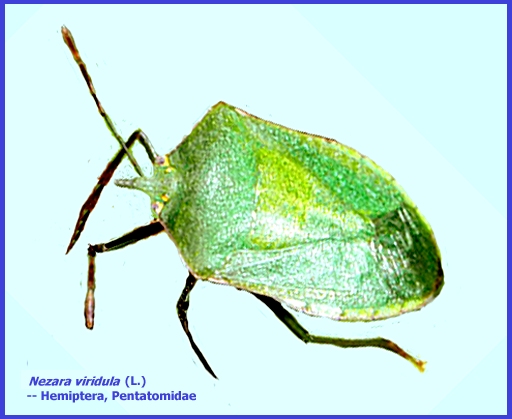
GREEN VEGETABLE BUG (= Southern Green Stinkbug) Nezara viridula (L.) -- Hemiptera, Pentatomidae (Contacts) ---- CLICK on Photo to enlarge & search for Subject Matter with Ctrl/F. GO TO ALL: Bio-Control Cases
Nezara viridula
was first recorded in Australia in 1913 and has since been the subject of
several successful biological control projects, mainly involving colonization
of the egg parasitoid Trissolcus
basalis ,<PHOTO>, imported from Egypt and Pakistan. The early history of control by importation
of natural enemies was recorded by Clausen (1978), Caltagirone (1981) and
Wilson (1960). Kogan et
al. (1999) updated this history
and assessed factors that may have led to the successful control of the pest
in Australia.
The pest spread to the Ord Valley in northwestern Australia in 1974,
over a decade after the last introduction of parasitoids from Pakistan to
other parts of Australia. Within two
years it had become a severe pest due to its polyphagous habit that enables
it do damage many vegetable and field crops.
Damage was so severe in sorghum that fields had to be abandoned. The parasitoid, T basalis
was reared in an insectary and ca. 44,100 were released in fields in the Ord
Valley. The host population began to
decline due to parasitism a few months later and good control was obtained
(Strickland 1981). Subsequent
observations indicated that the parasitoids were usually present regardless
of the level of abundance of the host population. Conditions that helped to maintain populations of stinkbugs at
low levels and prevented their upsurge following their decline were explained
by (1) the prevailing cropping system in the Ord Valley involved diverse
plant species that were infested by the stink bug at different population
levels. The parasitoids, therefore,
were able to move from centers of high host population to centers of low host
populations, thereby maintaining an overall low equilibrium position
throughout the entire spectrum of crops; and (2) in addition to N. viridula, T.
basalis attacked several
other locally occurring pentatomids and thus had a continuous supply of hosts
(Strickland 1981).
The success of T. basalis as the parasitoid of
very mobile and polyphagous pest is attributable to a combination of the
characteristics of its own host range and the characteristics of the feeding
range of its host species. That
combination guaranteed an environment that continually provided fresh adult
parasitoids capable of keeping the pest a low population levels. As N.
viridula is a major pest of
many short term crops in most parts of the world, efforts to control it by
means of natural enemies continue.
According to Jones (1988), African and Asian egg parasitoids in the
genera Trissolcus, Telenomus, and Gryon and six New World
tachinid adult parasitoids deserve consideration in biological control. The tachinids are Trichopoda pennipes
(F.), T. pilipes (F.), T. giacomellii (Blanchard), T. gustavoi
(Mallea), Eutrichopodopis nitens Blanchard, and Ectophasiopis arcuata (Bigot).
Simmonds (1976) elaborated on the introduction of pentatomid egg
parasitoids from Pakistan into Australia in 1961 for biological control of Nezara viridula. After
the parasitoids from Pakistan had been bred in the laboratory in Australia
for some time and then certain species released, a much better biological
control of Nezara was
obtained than previously, which was attributed to the fact that the Pakistan
strain of Asolcus (Trissolcus) basalis was much more effective
in some areas than the strains that had previously been introduced and
established in Australia (Ratcliffe 1965).
This successful strain was then sent from Australia to
California. It seems that the evidence
for the success of a Pakistan strain is circumstantial and it is even more
puzzling because A. basalis is not thought to have
been present in the material sent to Australia, and was not either recorded
from Pakistan.
For additional details on biological control efforts and biologies of
hosts and natural enemies, please see the following (Newman & O'Connor
1934, Noble 1937, Kamal 1938, Lever 1941b, 1943a; Jenkins 1948, Cumber 1949,
1951, 1953, 1964, O'Connor 1950, Everett 1958, Wilson 1961, Davis 1964, 1967;
Davis & Krauss 1965, Ratcliffe 1965, Ganesalingham 1966, Kiritani 1966,
Shahjahan 1968). REFERENCES: [Additional references may be found at: MELVYL
Library ] Caltagirone,
L. E. 1981. Landmark examples
in classical biological control. Ann.
Rev. Ent. 26: 213-32. Clausen, C. P.
1978. Introduced Parasites and
Predators of Arthropod Pests and Weeds:
A World Review. U. S. Dept.
Agric., Agric. Handbk. 480. 545 p. Cumber, R. A.
1949. The green vegetable bug Nezara viridula. New Zealand
J. Agric. Res. 79: 563-64. Cumber, R. A.
1951. The introduction into
New Zealand of Microphanurus
basalis Woll. (Scelionidae:
Hym.), egg-parasite of the green vegetable bug, Nezara viridula
L. (Pentatomidae). New Zealand J.
Sci. Technol. 32 (B): 30-7. Cumber, R. A.
1953. The establishment in New
Zealand of Microphanurus basalis Woll. (Scelionidae:
Hym.), egg-parasite of the green vegetable bug, Nezara viridula
L. (Pentatomidae). New Zealand J. Sci. TEchnol. 34 (B): 267-69. Cumber, R. A.
1964. The egg-parasite complex
(Scelionidae: Hymenoptera) of shield bugs (Pentatomidae, Acanthosomidae:
Heteroptera) in New Zealand. New
Zealand J. Sci. 7: 536-54. Davis, C. J.
1964. The introduction,
propagation, liberation, and establishment of parasites to control Nezara viridula variety smaragdula
(Fabricius) in Hawaii (Heteroptera: Pentatomidae). Hawaii. Ent. Soc. Proc. 18:
369-75. Davis, C. J.
1967. Progress in the
biological control of southern green stink bug, Nezara viridula
variety smaragdula
(Fabricius) in Hawaii (Heteroptera: Pentatomidae). Mushi 39: 9-16. Davis, C. J.
& N. L. H. Krauss. 1965.
Recent introductions for biological control in Hawaii--X. Hawaii. Ent. Soc. Proc. 19: 87-90. Everett, P.
1958. The green vegetable
bug. New Zealand J. Agric. 97: 469, 471-72. Ganesalingam,
V. K. 1966. Some environmental
factors influencing parasitization of the eggs of Nezara viridula
L. (Pentatomidae) by Telonomus
basalis Wollaston
(Hymenoptera: Scelionidae). Ceylon J.
Sci., Biol. Sci. 6: 1-14. Hokkanen, H.
1986. Polymorphism, parasites
and the native area of Nezara
viridula (Hemiptera,
Pentatomidae). Ann. Ent.
Fennici 52: 28-31. Jenkins, C. F.
H. 1948. Biological control
in Western Australia. Roy. Soc. West. Austral. J. 32 (1945-46): 1-17. Jones, W.
A. 1988. World review of the
parasitoids of the southern green stink bug, Nezara viridula
(L.) (Heteroptera: Pentatomidae).
Ann. Ent. Soc. Amer. 81:
262-73. Kamal, M.
1938. The cotton green bug, Nezara viridula L. and its important egg-parasite, Microphanurus megacephalus (Ashmead)
(Hymenoptera: Proctotrupidae). Roy.
Ent. Soc. d'Egypte 21: 175-207. Kiritani, K.
1966. The biology and control
of the southern green stink bug, Nezara
viridula L. Kusunoki-Noho (Japan) 20: 1-21. Kogan, M., D. Gerling & J. V. Maddox. 1999.
Enhancement of Biological Control in Transient Agricultural
Environments. In: Bellows, T. S. & T. W. Fisher (eds.), Handbook of Biological Control: Principles and Applications. Academic Press, San Diego, New York. 1046 p Lever, R. J. A. W. 1941. Entomological
Notes. Fiji Dept. Agric. Agric. J.
12: 45-50. Levern, R. J. A. W. 1943. Division of
Entomology. Annual Report for
1942. Fiji Dept. Agric. Agric. J.
14: 83-5. Newman, L. J. & B. A. O'Connor. 1934.
Green tomato bug. West. Austral.
Dept. Agric. J.
11: 101-12. Noble, N. S.
1937. An egg parasite of the
green vegetable bug. Agric. Gaz. N.
S. Wales, Misc. Publ. 3094: 337-41. O'Connor, B. A. 1950. Trichopoda pennipes F. in Fiji and the British Solomon Islands. Fiji Dept. Agric., Agric. J. 21: 63-71. Ratcliffe, F. N. 1965. Biological
control. Austral. J. Sci. 28: 237-40. Shahjahan, M.
1968a. Superparasitization of
the southern green stink bug by the tachinid parasite Trichopoda pennipes
pilipes and its effect on
the host and parasite survival. J. Econ.
Ent. 61: 1088-1091. Simmonds, F. J. 1972. Approaches to
biological control problems.
Entomophaga 17: 251-. Simmonds, F. J. 1976. Some recent
puzzles in biological control.
Entomophaga 21: 327-32. Strickland, G. R. 1981. Integrating
insect control for Ord soybean production.
J. Agric. West. Australia 22:
81-82. Wilson, F.
1960. A review of the biological
control of insects and weeds in Australia and Australian New Guinea. Commonwealth Inst. Biol. Control Tech.
Commun. 1. 102 p. Wilson, F.
1961. Adult reproductive
behavior in Asolcus basalis (Hymenoptera:
Scelionidae). Austral. J. Zool.
9: 737-51. Yukawa, J. & K. Kiritani. 1965.
Polymorphism in the southern green stink bug. Pac. Insects 7: 639-42. |