FILE: <ch-56.htm> GENERAL INDEX
[Navigate to
MAIN MENU ]
|
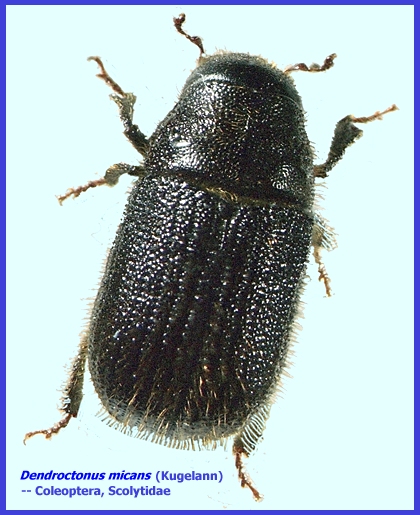
GREATER EUROPEAN SPRUCE BEETLE Dendroctonus micans (Kugelann)--
Coleoptera, Scolytidae (Contacts) ---- CLICK on Photo to enlarge & search for Subject Matter with Ctrl/F. GO TO ALL: Bio-Control Cases This bark beetle
differs from the more aggressive North American Dendroctonus species in that it attacks its host tree in
low numbers, killing the bark in patches.
Successive attacks over a period of five to eight years may be
necessary to kill a tree except during beetle outbreaks (Grégoire 1985). The beetle shows kin-mating, gregarious
larvae and apparently lacks associated pathogenic fungi that are
characteristic of many Scolytidae. Dendroctonus micans has very few natural
enemies which may be due to its unique biology that seems to protect the
beetles from competitors and generalist natural enemies by the defenses of
its living host (Everaerts et al. 1988). One specific
predator Rhizophagus grandis Gyllenhal is very
abundant in areas where the bark beetle has been present for long periods of
time. This rhizophagid beetle is
believed to be responsible for maintaining the low, stable D. micans population in these areas (Kobakhidzi 1965,
Grégoire 1976, Moeck & Safranyik 1984). A massive
biological control project was initiated against D. micans
in Georgia S.S.R. in 1963 (Kobakhidze 1965).
The spruce beetle had extended its range into Georgia following World War
II in timber imported from the north.
A predator relocation program was planned as the predator did not
follow its host. Rhizophagus grandis
was released in large numbers as larvae and adults on spruce trees infested
by D. micans (Kokakhidze et al. 1968). Effective control apparently has been achieved (Grégoire et al.
1987, Dahlsten & Mills 1999). First observed in
the Massif Central of France in the early 1970's, D. micans
was targeted for biological control in a program funded by the European
Economic Community in 1983. Its main
thrust was to establish the predator, R.
grandis (Grégoire et al.
1987). A similar program was
initiated in 1983 in Great Britain (Evans 1985, Evans & King 1987). Evaluations are still in progress, but
knowledge that the predator is attracted to the frass of three North American
Dendroctonus species (Miller
et al. 1987) suggests its possible use against species other than D. micans (Dahlsten & Mills 1999). REFERENCES: [Additional references may be found at: MELVYL
Library ] Dahlsten, D. L. & N. J. Mills. 1999. Biological Control
of Forest Insects. In: Bellows, T. S. & T. W. Fisher (eds.), Handbook of Biological Control:
Principles and Applications.
Academic Press, San Diego, New York.
1046 p. Evans, H. F. 1985. Great spruce bark beetle, Dendroctonus micans: an exotic pest new to Britain. Antenna 9: 117-21. Everaerts, C., J.-C. Grégoire & J. Merlin. 1988.
The toxicity of spruce monoterpenes to bark beetles and their
associates. In: W.
J. Mattson et al. (eds.),
Mechanisms of Woody Plant Resistance to Insects and Pathogens. Springer-Verlag, New York. 416 p. Grégoire, J.-C. 1976. Note sur deux ennemis
naturels de Dendroctonus micans Kug. en Belgique. Bull. Ann. Soc. r. belge Entomol.
112: 208-12. Grégoire, J.-C., M. Balsier, J. Merlin &
Y. Naccache. 1987.
Interactions between Rhizophagus
grandis (Coleoptera:
Rhizophagidae) and Dendroctonus
micans (Coleoptera:
Scolytidae) in the field and laboratory.
Their application for the biological control of D. micans
in France. Proc. Symposium on
Potential for Biological Control of Dendroctonus
and Ips Bark Beetles. Ann. Meeting Ent. Soc. Amer., 9 Dec. 1986.
Reno, Nevada (in press). Kobakhidze, D. N.
1965. Some results and
prospects of the utilization of beneficial entomophagous insects in the
control of insect pests in Georgian SSR (USSR). Entomophaga 10: 323-30. Moeck, H. & L. Safranyik.
1984. Assessment of predator
and parasitoid control of bark beetles.
Canadian Forestry Service, Pacific Forest Research Center. Information Report BC-X-248. 24 p. |