FILE: <ch-54.htm> GENERAL INDEX
[Navigate to
MAIN MENU ]
|
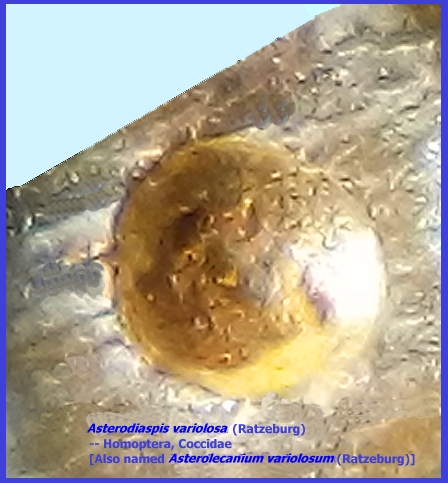
GOLDEN OAK SCALE Asterodiaspis variolosa
(Ratzeburg) -- Homoptera, Coccidae [Also named Asterolecanium variolosum
(Ratzeburg)] (Contacts) ---- CLICK on Photo to enlarge & search for Subject
Matter with Ctrl/F.
GO TO
ALL: Bio-Control
Cases
For greater details
of the biological control efforts, and biologies of hsots and natural
enemies, please see the following (Howard 1898, Gourlary 1935, Clark 1936,
Evans 1939, Parr 1940, Russell 1941, Craighead 1950, Dowden 1950, Pritchard
& Ceer 1950, Wilson 1960, Gonzalez & Rojas 1966). REFERENCES: [Additional references may be found at: MELVYL
Library ] Clark, A. F. 1936. Biological control of forest insect
pests. New Zealand J. Sci. &
Tech. 18: 585-88. Clausen, C. P. 1978
(ed.). Introduced parasites and
predators of arthropod pests and weeds:
A world review. USDA ARS
Agriculture Handbook No. 480. 455 p. Craighead, F. C.
1950. Insect Enemies of
Eastern Forests. U. S. Dept. Agric.
Misc. Publ. 657. 379 p. Dahlsten, D. L. & R. W. Hall. 1999. Biological control
of insects in outdoor urban environments In: Bellows, T. S. & T. W. Fisher (eds.), Handbook of Biological Control:
Principles and Applications.
Academic Press, San Diego, New York.
1046 p. Dowden, P. B. 1950. Bees, wasps, ants and parasites. In: F. C. Craighead (ed.), Insect Enemies of
Eastern Forests. U. S. Dept. Agric.
Misc. Publ. 657: 591-637. Evans, J. W. 1939. Oak Insects. Tasmanium J. Agric. 10:
199-205. Gonzalez, R. H. & S. P. Rojas. 1966.
Estudio analítico del control biológico de plagas agrícolas en
Chile. Agric. Tech. 26: 133-47. Gourlary, E. S.
1935. Parasites of the golden
oak-scale. The establishment in New
Zealand of Habrolepis dalmanni Westwood. New Zealand J. Sci. TEch. 16: 216-35. Howard, L. O. 1898. Two beneficial insects introduced from
Europe. U. S. Dept. Agric. Bull. 17
(n.s.): 13-16. Johnson, W. T. & H. H. Lyon.
1976. Insects that Feed on Trees
and Shrubs. Comstock Publ. Assoc.,
Cornell Univ. Press, Ithaca, NY. 464
p. Parr, T. 1940. Asterolecanium
variolosum Ratzeburg, a
gall-forming coccid, and its effect upon the host trees. Yale Forest. School Bull. 46: 1-49. Pritchard, A. E. & R. E. Beer. 1950. Biology and
control of Asterolecanium
scales on oaks in California. J. Econ.
Ent. 43: 494-97. Russell, L. M. 1941. A classification of the scale insect genus
Asterolecanium. U. S. Dept. Agric. Misc. Pub. 424. 322 p. Wilson, F. 1960. A review of the Biological Control of
Insects and Weeds in Australia and Australian New Guinea. Commonwealth Inst.
Biol. Control, Tech. Commun. 1. 102
p. |