FILE: <ch-48.htm> GENERAL INDEX [Navigate to MAIN MENU ]
|
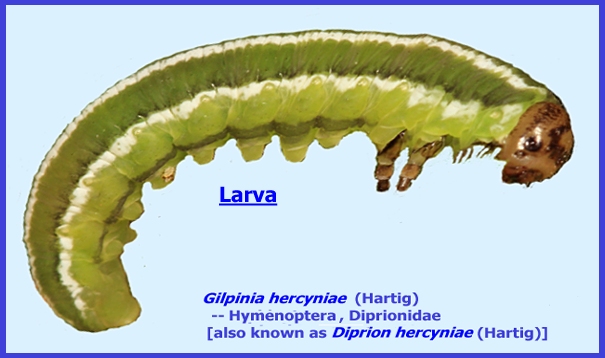
EUROPEAN SPRUCE SAWFLY Gilpinia hercyniae (Hartig) -- Hymenoptera, Diprionidae [Also known as Diprion hercyniae (Hartig)] (Contacts) ---- CLICK on Photo to enlarge & search for Subject Matter with Ctrl/F. GO TO ALL: Bio-Control Cases
One of the most extensive projects undertaken in classical biological
control was begun against European spruce sawfly in 1933. Gilpinia
hercyniae was not at first
distinguished from G.
polytomum (Htg.) and the
Farnham House Laboratory in England (now known as CIBC) was engaged to make
large scale parasitoid collections from the latter species in Europe. Initial studies revealed that apart from
the egg parasitoids, all other parasitoids develop so as to overwinter in the
host cocoon. This simplified
parasitoid collections in Europe to those stages of development. A team of about 30 persons collected
>1/2 million cocoons of G.
polytomum in Europe for
shipment to Canada during 1932-40.
Additionally more >1/2 million eggs and 31 million cocoons of other
spruce and pine feeding sawflies were shipped to supplement the numbers of
the less host specific parasitoid species available for field release (Morris
et al. 1937, Finlayson & Finlayson 1958). There were 96 species of primary and secondary parasitoids
obtained from these cocoon collections at the Belleville Laboratory in Canada
and a multiple introduction program involving two egg parasitoids and 25
larval and cocoon parasitoids was initiated in 1933-51. The importation of a wide variety of parasitoids
from diverse hosts permitted the inclusion of several sawfly pests as
additional targets for some of the releases (McGugan & Coppel 1962).
The addition of an elaborate controlled environment quarantine
building was made at Belleville in 1936 allowed the mass rearing of several
of the imported European parasitoids.
Dahlbominus
fuscipennis, a
gregarious ectoparasitoid of prepupae, readily attacked cocoons in the
laboratory and was selected along with several other species for a massive
program of mass rearing for release.
The mass-rearing peaked in 1940 when a total of 221.5 million D. fuscipennis was released and by the end of the program in
1951 a total of 890 million directly imported or laboratory reared
parasitoids had been liberated (McGugan & Coppel 1962).
Only 5 species of parasitoids out of 27 released became established
over more than several generations, although four additional species were
recovered during the years shortly after release. Three of the five species, D.
fuscipennis, Exenterus amictorius (Panz.) and E. confusus Kerr, were widely
established only during the outbreak and have since not been recovered from G. hercyniae.
Although E. amictorius had little impact,
the other two species achieved variable but appreciable levels of parasitism
and have been credited with the decline of the outbreak in at least some
areas. Two other parasitoids, Exenterus vellicatus Cush. and Drino bohemica Mesn., never became
important until the collapse of the outbreak but have replaced the three
species present during the outbreak to maintain host population at low,
non-damaging densities.
The epizootic of European spruce sawfly began to decline in 1939-40,
which coincided in the southern part of the range with the occurrence of a
nuclear polyhedrosis virus, Borrelinavirus hercyniae. This virus is thought to have been
accidentally imported and released in Canada along with the parasitoid
(Dahlsten & Mills 1999). It
spread rapidly to produce virus epizootics throughout most of the outbreak
range and by 1943 host population densities had declined to very light
infestations. Unlike other diprionid
sawflies, G. hercyniae larvae are not
gregarious and the rapid spread and subsequent impact of the virus was
attributed to its virulence (Bird & Elgee 1957). More recent studies in the Great Britain,
where G. hercyniae was accidentally
introduced from the European continent in 1968, indicate that birds play an
important role in virus transmission (Entwistle 1976). The importance of D. bohemica,
E. vellicatus and the NPV virus in maintaining the spruce
sawfly at low population densities in Canada has been inadvertently
demonstrated through chemical spray treatments aimed against spruce
budworm. Both in the early 1960's and
again in the 1970's sawfly population levels increased immediately following
the cessation of a 2-3 year spray treatment, due to the detrimental effects
of the spray on natural enemies, but declined after several generations as a
result of increased parasitism and the reappearance of the virus (Neilson et
al. 1971, Magasi & Syme 1961, Dahlsten & Mills 1999).
Dahlsten & Mills (1999) pointed to several interesting features of
this successful biological control program.
First the success of the accidental introduction of the virus provides
to date the most outstanding example of the use of a pathogen in classical
biological control. Its ability to
control the sawfly population in the absence of parasitoids has been
demonstrated (Bird & Burk 1961, Entwistle 1976) and in Canada it has persisted
in the forest environment since the initial introduction despite the low host
densities (Magasi & Syme 1981).
The multiple introduction program of parasitoids resulted in the
establishment of the two more effective and specific species, despite the release
of a wide range of potential competitors.
However, the continuous and large scale release of poorly adapted
parasitoids, which were later recovered only from other sawfly hosts, was
successful in inducing significant levels of mortality prior to the
introduction of the virus.
For greater detail on the hosts, natural enemies and biological
control please refer to the following (Webber 1932, Morris & Cameron
1935, Morris 1937, 1942; Baird 1939, 1940; Cushman 1940, Balch et al. 1941,
Peirson 1941, Reeks 1937, 1941, 1952, 1953; Peirson & Nash 1940, Wilkes
1942, Balch & Bird 1944, Daviault 1944, Dirks 1944, Briand 1949,
Schaffner & Middleton 1950, Balch 1960, Griffiths 1961, Turnbull &
Chant 1961, Dowden 1962, Graham & Jones 1962, Martineau 1963, Neilson
& Morris 1964, McLeod & Desalliers 1966, Rose & Sippell 1966). REFERENCES: [Additional references may be found at: MELVYL
Library ] Baird, A. B.
1939. Biological control of
insect pests in Canada with special reference to the European spruce sawfly Gilpina polytoma Htg. Ent.
Soc. Ontario, 70th Ann. Rept. (1939):
51-56. Baird, A. B.
1940. A review of the spruce
sawfly parasite situation. Pulp and
Paper Mag., Canada. Ann. Meeting,
Woodlands Sect., Canad. Pulp Assoc. Proc., Jan 1939: 43-4. Balch, R.
E. 1960. The approach to
biological control in forest entomology.
Canad. Ent. 92: 297-310. Balch, R. E. & F. T. Bird. 1944.
A disease of the European spruce sawfly, Gilpinia hercyniae
(Htg.), and its place in natural control.
Sci. Agric. (Ottawa) 25:
65-80. Balch, R. E., W. E. Reeks & S. G.
Smith. 1941. Separation of the spruce sawfly from Gilpinia polytoma (Hts.) (Diprionidae: Hymenoptera) and evidence of
its introduction. Canad. Ent.
73: 198-203. Bird, F. T. & J. M. Burk. 1961.
Artificially disseminated virus as a factor controlling the European
spruce sawfly, Diprion herycinae (Htg.), in the
absence of introduced parasites.
Canad. Ent. 92: 228-38. Bird, F. T. & D. E. Elgee. 1957.
A virus disease and introduced parasites as factors controlling the
European spruce sawfly, Diprion
hercyinae (Htg.) in central
New Brunswick. Canad. Ent. 89: 371-78. Briand, L. J.
1949. Notes on the spruce
sawfly (Gilpinia hercyniae Htg.) and parasitism
in the Park Reserve, Quebec, area.
Quebec Soc. Protect. Plants Ann., 30th Rept. (1945-47): 180-81. Cushman, R. A.
1940. A review of the
parasitic wasps of the ichneumonid genus Exenterus
Hartig. U. S. Dept. Agric. Misc.
Publ. 354. 14 p. Dahlsten, D.
L. & N. J. Mills. 1999.
Biological Control of Forest Insects.
In: Bellows, T. S.
& T. W. Fisher (eds.), Handbook of
Biological Control: Principles and
Applications. Academic Press, San
Diego, New York. 1046 p. Daviault, L.
1944. Nouvelles observations
sur la mouche a scie europeene de l'epinette dans les forets du nord du
St-Laurent. Quebec Soc. Protect.
Plants Ann. Rept. (1936-43): 39-43. Dirks, C.
O. 1944. Population studies
of the European spruce sawfly in Maine as affected by natural enemies. J. Econ. Ent. 37: 238-42. Dowden, P. B.
1962. Parasites and predators
of forest insects liberated in the United States through 1960. U. S. Dept. Agric. Agric. Handb. 226. 70 p. Entwistle, P.
F. 1976. The development of
an epizootic of a nuclear polyhedrosis virus disease in European spruce
sawfly, Gilpinia hercyinae. Proc. 1st Intern. Colloq. Invert. Pathol.,
Kingston, Canada. p. 184-88. Finlayson, L. R. & T. Finlayson. 1958.
Notes on parasites of Diprionidae
in Europe and Japan and their establishment in Canada on Diprion hercyinae
(Htg.) (Hymenoptera: Diprionidae).
Canad. Ent.
90: 557-63. Graham, A. R. & P. A. Jones. 1962.
Parasites and predators released against forest insects in Canada,
1910-58. Appendix I. In a Review of the Biological Control
Attempts Against Insects and Weeds in Canada. Commonwealth Inst. Biol. Control. Contrib., Tech. Commun.
2: 129-75. Griffiths, K. J. 1961. The life history
of Aptesis basizina (Grav.) on Neodiprion sertifer (Geoff.) in southern Ontario. Canad. Ent. 93: 1005-10. Magasi, L. P. & P. D. Syme. 1981.
Chapter 52. Gilpinia hercyinae (Hartig), European spruce sawfly (Hymenoptera:
Diprionidae), p. 295-97. In: J. S. Kelleher & M. A. Hulme (eds.), Biological Control
Programmes Against Insects and Weeds in Canada 1969-1980. Commonwealth Agric. Bureau, London,
England. 410 p. Martineau, R.
1963. Natural factgors
regulating populations of the European spruce swafly, Diprion hercyniae
(Hts.) in southern Quebec. Canad.
Ent. 95: 317-26. McGugan, B. M. & H. C. Coppel. 1962.
A review of the biological control attempts against insects and weeds
in Canada. II. Biological control of forest insects,
1910-1958. Commonwealth Inst. Biol.
Control Tech. Comm. No. 2: 35-216. McLeod, J. H.
& G. Desalliers. 1966.
Notes on Exenterus amictorius Panzer, an
introduced parasite not established on the Swaine jack-pine sawfly, Neodiprion swainei Midd.
Canad. Dept. Forest., Bimo. Prog. Rept. 22: 1-4. Morris, K. R. S. 1937. The prepupal
stage in Ichneumonidae, illustrated by the life-history of Exenterus abruptorius Thb.
Bull. Ent. Res. 28: 525-34. Morris, K. R. S. & E. Cameron. 1935.
The biology of Microplectron
fuscipennis Zett., a
parasite of the pine sawfly (Diprion
sertifer Geoff.). Bull. Ent. Res. 26: 407-18. Morris, K. R. S., E. Cameron & W. F.
Jepson. 1937. The insect parasites of the spruce sawfly
(Diprion polytomum Htg.) in Europe. Bull. Ent. Res. 28: 341-93. Morris, R. F.
1942. Preliminary notes on the
natural control of the European spruce sawfly by small mammals. Canad. Ent. 74: 197-202. Neilson, M. M. & R. F. Morris. 1964.
The regulation of European spruce sawfly numbers in the Maritime
Provinces of Canada from 1937 to 1963.
Canad. Ent. 96: 773-94. Neilson, M. M., R. Martineau & A. M.
Rose. 1971. Chapter 39. Diprion hercyniae (Hartig), European spruce sawfly (Hymenoptera:
Diprionidae), p. 136-43. In: Biological Control Programmes Against Insects and Weeds in
Canada, 1959-1968. Commonwealth Inst.
of Biol. Control, Tech. Comm. No. 4.
266 p. Peirson, H. B.
1941. Control work on European
spruce sawfly in 1940. Maine Forest
Commr. Bien. Rept. 23. 10 p. Peirson, H. B. & R. W. Nash. 1940.
Control work on European spruce sawfly in 1939. Maine Forest Serv. Bull. 12. 19 p. Reeks, W. A.
1937. Notes on the biology of Microplectron fuscipennis Zett., as a cocoon
parasite of Diprion polytomum Hartig. Canad. Ent. 69: 185-87. Reeks, W. A.
1941. On the taxonomic status
of Gilpinia polytoma (Htg.) and G. hercyniae (Htg.) (Hymenoptera: Diprionidae). Canad. Ent. 73: 177-88. Reeks, W. A.
1952. Establishment of Exenterus spp. (Hymenoptera: Ichneumonidae),
parasites of the European spruce sawfly, near points of liberation. Canad. Ent. 84: 76-86. Reeks, W. A.
1953. The establishment of
introduced parasites of the European spruce sawfly (Diprion hercyniae
(Htg.)) in the Maritime Provinces.
Canad. J. Agric. Sci. 33:
405-29. Rose, A. H. & W. L. Sippell. 1966.
Distribution of cocoon parasites of the European pine sawfly, Neodiprion sertifer (Geoffroy) in southern Ontario. Canad. Ent. 98: 40-5. Schaffner, J.
V., Jr. & W.
Middleton. 1950. The sawflies and horntails. In: F. C. Craighead (ed.), Insect Enemies of
Eastern Forests. U. S. Dept. Agric.
Misc. Publ. 657: 522-91. Turnbull, A. L. & D. A. Chant. 1961.
The practice and theory of biological control of insects in
Canada. Canad. J. Zool. 39: 697-753. Webber, R. T.
1932. Sturmia inconspicua
Meigen, a tachinid parasite of the gypsy moth. J. Agric. Res. 45:
193-208. Wilkes, A.
1942. Notes on the laboratory
propagation of three European species of Exenterus
(Ichneumonidae), parasitic on sawflies.
Ent. Soc.Ontario 72nd Ann. Rept. 1941: 41-4. |