FILE: <ch-44.htm> GENERAL INDEX
[Navigate to
MAIN MENU ]
|
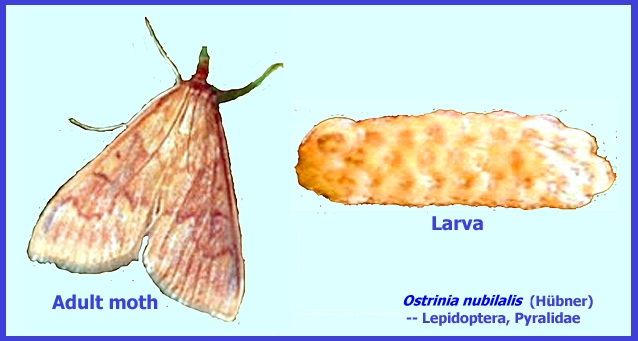
EUROPEAN CORNBORER Ostrinia nubilalis (Hübner) --
Lepidoptera, Pyralidae (Contacts) ---- CLICK on Photo to enlarge & search for Subject Matter with Ctrl/F. GO TO ALL: Bio-Control Cases
Explanations to explain the decline of the tachinid center around
competition from the microsporidian Nosema pyrausta. Presently the only parasitoid commonly
found in the Midwest is the braconid Macrocentrus grandii
(Goidanich), which is infected by N.
pyrausta and high levels of
mortality result (Andreadis 1980, 1982; Siegel et al. 1986). In Illinois in 1982 and 1983, M.
grandii parasitized an
average of 19.5% of first generation corn borer larvae, but only an average
of 5% of second generation larvae .
This is believed due to the fact that first generation borer
populations usually have a lower prevalence of Nosema than second generation populations, and thus the
parasitoid may avoid the disease by parasitizing primarily first generation
larvae (Kogan et al. 1999).
Paillot (1927) first described N.
pyrausta from European corn
borers collected in France, and the pathogen was first found by Steinhaus
(1951) in the United States in larval European corn borers from the Midwest. It now infects corn borers throughout most
of their range, and a high prevalence (up to 100%) have been reported from
many states (Hill & Gary 1979, Andreadis 1984, Siegel et al. 1987, Kogan
et al. 1999). This microsporidian
infects most body tissues, and infectious spores are passed in the feces of
infected larvae. Horizontal
transmission occurs when healthy larvae ingest sufficient numbers of spores,
usually in larval tunnels contaminated by frass from infected larvae. Although some disease-induced mortality
occurs when larvae are infected by oral ingestion of spores, the most
dramatic mortality occurs when transmission is transovarial (Windels et al.
1976). Such larvae experience 30-80
percent higher mortality than healthy larvae (Kramer 1959, Windels et al.
1976, Siegel et al. 1987). Crashes
usually occur after several years of rising corn borer populations and when
the prevalence of Nosema
nears 100 percent. Because horizontal
transmission of infection in corn borer populations depends on the
probability of healthy larvae inhabiting a corn stalk with infected larvae,
the initial infection level of transovarially (vertical infection) infected
larvae and the larval population density are two of the most important
variables affecting infection levels in corn borer populations (Maddox
1987).
Although in many areas of the United States N. pyrausta
is the most important biological mortality factor in corn borer populations, it
has little promise as a microbial insecticide because it is already widely
distributed. During some years the
fungus Beauveria
bassiana causes
considerable larval mortality in central Iowa and west central Illinois
(Kogan et al. 1999).
For historical review and details on biologies of host and natural
enemies, please see the following (Ellinger & Sachtleben 1928, Zwölfer
1948, Jones 1929, Parker et al. 1929, Thompson 1929, Goidanich 1931, Parker
1931, Cartwright 1933, Parker & Smith 1933, Smith 1932, Vance 1932, Clark
1934, Baker & Bradley 1940, Wishart 1943, 1944, 1947; Arbuthnot 1944,
1950; Arbuthnot et al. 1949, Swezey 1946, Baker et al. 1949, Blikenstaff et
al. 1953, Peterson 1955, Baker 1958, Rolston et al. 1958, Jarvis & York
1961, McLeod 1962, Franklin & Holdaway 1966). REFERENCES: [Additional references may be found at: MELVYL
Library ] Andreadis, T. G. 1980.
Nosema pyrausta infection in Macrocentrus grandii, a braconid parasite of
the European corn borer, Ostrinia
nubilalis. J. Invertebr. Path. 35: 229-33. Andreadis, T. G. 1982.
Impact of Nosema pyrausta on field populations
of Macrocentrus grandii, an introduced parasite
of the European corn borer, Ostrinia
nubilalis. J. Invertebr. Path. 39: 298-302. Andreadis, T. G. 1984.
Epizootiology of Nosema
pyrausta in field
populations of the European corn borer (Lepidoptera: Pyralidae). Environ. Ent. 13: 882-87. Arbuthnot, K. D. 1944.
Strains of the European corn borer in the United States. U. S. Dept. Agric. TEch. Bull. 869. 20 p. Arbuthnot, K. D. 1950.
Status of European corn borer parasites in the United States. J. Econ. Ent. 43: 422-26. Arbuthnot, K. D., D. W. Jones, S.
W. Carter & R. W. Evans.
1949. The field status of
parasites of the European corn borer at the close of 1948. U. S. Dept. Agric., Bur. Ent. & Plant
Quar., Insect Pest Survey, Spec. Supp. 7.
25 p. Baker, W. A. 1958.
Parasites of the European corn borer in the United States. 10th Internatl. Congr. Ent. Proc.,
Montreal, Canada (1956) 4: 478-592. Baker, W. A. & W. G.
Bradley. 1940. The colonization of imported parasites of
the European corn borer in the United States. 6th Pacific Sci. Cong. Proc. (1939) 4: 325-33. Baker, W. A., W. G. Bradley &
C. A. Clark. 1949. Biological control of the European corn
borer in the United States. U. S.
Dept. Agric. Tech. Bull. 983. 185 p. Blinkenstaff, C. C., K. D.
Arbuthnot & H. M. Harris.
1953. Parasites of the European
corn borer in Iowa. Iowa State Col.
J. Sci. 27: 335-79. Burbutis, P. P., N. Erwin & L. R. Ertle. 1981. Reintroduction and establishment of Lydella thompsoni and notes on other parasites of the European
corn borer in Delaware. Environ. Ent.
10: 779-81. Caffrey, D. J. & L. H.
Worthley. 1927. A progress report on the investigations of
the European corn borer. USDA Bull.
No. 1476. Cartwright, W. B. 1933.
Observations on the European corn borer and its major parasites in teh
Orient. U. S. Dept. Agric. Cir.
289. 13 p. Clark, C. A. 1934.
The European corn borer and its controlling factors in the
Orient. U. S. Dept. Agric. Tech.
Bull. 455. 37 p. Ellinger, T. & H. Sachtleben.
1928. Notes on the central European parasites of
Pyrausta nubilalis Hb. Internatl. Corn Borer Invest. Sci. Rept.
1927-28: 109-34. Franklin, R. T. & F. G.
Holdaway. 1966. A relationship of the plant to parasitism
of European corn borer by the tachinid parasite Lydella grisescens. J. Econ. Ent. 59: 440-41. Goidanich, A. 1931. Gli insetti predatori e parassiti della Pyrausta nubilalis Hübn. Bol. Lab.
Ent. (Bologna)
4: 77-218. Hill, R. E. & W. J. Gary. 1979.
Effects of the microsporidium Nosema
pyrausta on field
populations of European corn borers in Nebraska. Environ. Ent. 8: 92-95. Hill, R. E., D. P. Carpino & Z.
B. Mayo. 1978. Insect parasites of the European corn
borer, Ostrinia nubilalis in Nebraska from
1958-1976. Environ. Ent. 7: 249-53. Jarvis, J. L. & G. T.
York. 1961. Population fluctuations of Lydella
grisescens, a parasite of
the European corn borer. J. Econ.
Ent. 54: 213-14. Jones, D. W. 1929.
Imported parasites of the European corn borer in America. U. S. Dept. Agric. TEch. Bull. 98. 27 p. Kogan, M., D. Gerling & J. V.
Maddox. 1999. Enhancement of
Biological Control in Transient Agricultural Environments. In: Bellows, T. S. & T. W. Fisher (eds.), Handbook of Biological Control:
Principles and Applications.
Academic Press, San Diego, New York.
1046 p Kramer, J. P. 1959.
Some relationships between Perezia
pyraustae Paillot (Sporozoa:
Nosematidae) and Pyrausta nubilalis (Hübner)
(Lepidoptera: Pyralidae). J. Insect
Pathol. 1: 25-33. Maddox, J. V. 1987.
Protozoan Diseases, p. 417-52.
In: J. R. Fuxa & Y. Tanada (eds.),
Epizootiology of Insect Diseases.
John Wiley & Sons, Inc., New York. 555 p. McLeod, J. H. 1962. A
review of the biological control attempts against insects and weeds in
Canada. Part I. Biological control of pests of crops, fruit
trees, ornamentals and weeds in Canada up to 1959. Commonwealth Inst. Biol. Control, Tech. Commun. 2: 1-33. Paillot, A. 1927.
Sur deux protozaires nouveaux parasites des chenilles de Pyrausta nubilalis Hb. C. R. Acad. Sci. 185: 673-75. Parker, H. L. 1931.
Macrocentrus gifuensis Ashmead, a
polyembryonic braconid parasite in the European corn borer. U. S. Dept. Agric. Tech. Bull. 230. 62 p. Parker, H. L. & H. D.
Smith. 1933. Eulophus
viridulus Thoms., a parasite
of Pyrausta nubilalis Hübn. Ann. Ent. Soc. Amer. 26:
21-37. Parker, H. L., A. M. Vance, H. D.
Smith & W. Gamkrelidge.
1929. Pyrausta nubilalis
Hübn. in Europe: notes on infestation
and parasitism from 1926 to 1928. J. Econ.
Ent. 22: 688-93. Peterson, G. D., Jr. 1955.
Biological control of the European corn borer on Guam. J. Econ. Ent. 48: 683-85. Rolston, L. H., C. R. Neiswander,
K. D. Arbuthnot & G. T. York.
19548. Parasites of the
European corn borer in Ohio. Ohio
Agric. Expt. Sta. Bull. 819. 36
p. Siegel, J. P., J. V. Maddox & W. G. Ruesink. 1986. The impact of Nosema pyrausta on a braconid Macrocentrus
grandii in central
Illinois. J. Invertebr.
Path. 47: 271-76. Siegel, J. P., J. V. Maddox & W. G. Ruesink. 1987. Survivorship of the
European corn borer, Ostrinia
nubilalis (Hübner)
(Lepidoptera: Pyralidae) in central Illinois. Environ. Ent. 16:
1071-75. Smith, H. D. 1932.
Phaeogenes nigridens Wesmael, an important
ichneumonid parasite of the pupa of the European corn borer. U. S. Dept. Agric. Tech. Bull. 331. 45 p. Steinhaus, E. A. 1951.
Report on diagnoses of diseased insects, 1944-50. Hilgardia 20: 629-678. Swezey, O. H. 1946.
Insects of Guam. II. Lepidoptera: Geometridae, Arctiidae,
Agrotidae and Pyralidae of Guam.
Bernice P. Bixhop Mus. Bull. 189:
185. Thompson, W. R. 1929.
The natural control of Pyrausta
nubilalis Hb. in
Europe. Cong. Ent. Zool. (1927)
10: 1183-95. Vance, A. M. 1932.
The biology and morphology of the braconid Chelonus annulipes
Wesm., a parasite of the European corn borer. U. S. Dept. Agric. Tech. Bull. 294. 48 p. Windels, M. B., H. C. Chiang &
B. Furgaia. 1976. Effects of Nosema pyrausta
on pupal and adult stages of the European corn borer, Ostrinia nubilalis. J. Invertebr. Path. 27: 239-42. Wishart, G. 1943.
Important developments in the corn borer parasite situation. Ent. Soc. Ontario 73rd Ann. Rept. 1942: 26-30. Wishart, G. 1944.
An increase in the multiple generation of the European corn borer in
Ontario and its relation to parasite establishment. Ent. Soc. Ontario 74th Ann. Rept. 1943: 11-13. Wishart, G. 1947.
Further observations on the changes taking place in the corn borer
population in western Ontario. Canad.
Ent. 79: 81-3. Zwölfer, W. 1928.
Corn borer controlling factors and measures in southern GErmany. Internatl. Corn Borer Invest., Sci. Rept.
1927-28: 135-42. |