FILE: <ch-43.htm> GENERAL INDEX
[Navigate to
MAIN MENU ]
[For educational
purposes only; do not review, quote or abstract]
|
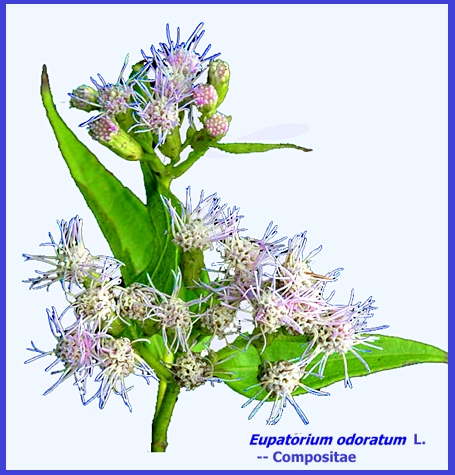
EUPATORIUM SHRUBBY WEED, Eupatorium odoratum L. -- Compositae (Contacts) This is a neotropical shrubby weed which became
established in many areas of the Old World tropics. Investigations by the West Indian Station of the Commonwealth
Institute of Biological Control revealed several possibly useful
host-specific phytophagous insects.
One leaf-feeding arctiid, Ammalo insulata
(Walker), that causes severe defoliation in Trinidad and South America seemed
most promising. The larvae are
nocturnal in their feeding and thus are protected from predaceous birds,
etc., but they may become infected with a virus disease spread by a nocturnal
tachinid parasitoid (Bennett & Cruttwell 1973). The virus is apparently foliage-borne, so by rearing material
from eggs sent to India this was easily eliminated for supplying virus free
material of Ammalo to those
countries interested in utilizing it against Eupatorium (Simmonds 1976). The arctiid was tried out in the field in Karnataka, India;
Sabah, Malaysia; Takoradi, Ghana and in Nigeria. It was also tested in Sri Lanka. In India and West Africa there was no establishment as it
appears that predators (ants) quickly removed all young larvae. In one small area only in Sabah, at Papar
road near Kota Kinabalu, a small population of Ammalo persisted in a restricted area on either side of a
stretch of road ca. 100 m. long.
Within this area a number of ovipositing moths and feeding larvae
could be found at night, but damage to Eupatorium
was restricted to a small area which tends to shift from time to time around
the general area. In other release
sites no establishment occurred. In
Sri Lanka releases made at the end of 1973 were followed by considerable
damage to Eupatorium that
was growing in some areas under coconut palms. At most other areas where releases were made no establishment
occurred. Later, a large area of ca.
1,000 ha. was defoliated and establishment seemed to have occurred on one
other area. Investigations showed that releases of Ammalo larvae results in
defoliation of Eupatorium,
but there is no more oviposition by Ammalo,
nor does it move to a new area, and the fate of the pupae and adults
resulting from the released larvae is unknown. Although it is understandable that in West Africa and in India,
predators, particularly ants, are able to prevent establishment of Ammalo, the explanation of why
similar elimination has not occurred in one small area of Sabah and in a much
larger area of Sri Lanka, which may be deficient in the regulatory predators,
is unknown. REFERENCES: [Additional references may be found at: MELVYL
Library ] Bennett, F. D. & R. E. Cruttwell. 1973. Insects attacking
Eupatorium odoratum in the neotropics. I. Ammalo insulata (Walk.) [Lep.: Arctiidae], a potential biotic
agent for the control of Eupatorium
odoratum L. [Compositae]. Tech. Bull. Commonw. Inst. Biol. Contr.
16: 105-. Simmonds, F. J.
1972. Approaches to biological
control problems. Entomophaga
17: 151-. Simmonds, F. J. 1976. Some recent
puzzles in biological control.
Entomophaga 21: 327-32. |