FILE: <ch-32.htm> GENERAL INDEX [Navigate to MAIN MENU ]
|
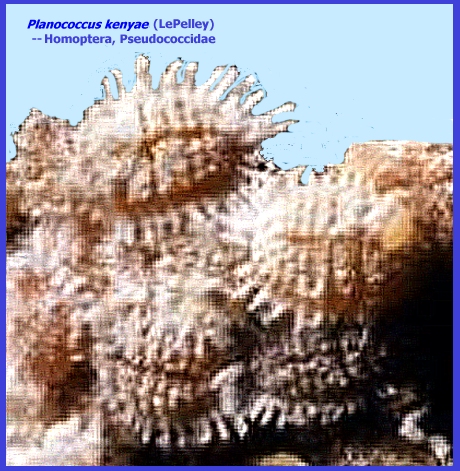
COFFEE MEALYBUG Planococcus kenyae (LePelley) -- Homoptera, Pseudococcidae (Contacts) ----- CLICK on Photo to enlarge &
search for Subject Matter with Ctrl/F. GO TO ALL: Bio-Control Cases Another parasitoid,
Leptomastix
dactylopii, of the
citrus mealybug was received later in large numbers from the University of
California at Riverside, but it would not successfully reproduce on the
coffee mealybug. Later when the
mealybug was considered to be Pseudococcus
lilacinus, other natural
enemies were sought, not only from other mealybug species but especially from
P. lilacinus. A major
effort was made by Dr. R. H. LePelley to obtain parasitoids of P. lilacinus in the Orient, its presumed native home, and to
import and colonize these in Kenya.
During 1936-7 he explored many countries and, particularly from the
Philippine Islands and Java, successfully shipped large numbers of
parasitoids and predators to A. R. Melville in Kenya. But none of the parasitoids obtained
attacked the coffee mealybug in Kenya.
Some of the predators were cultured and liberated but none are known
to have become established. It became evident
during LePelley's trip that the coffee mealybug was sa species distinct from P. lilacinus and since must of the world had been searched
most probably was native to Africa somewhere outside of Kenya. Mr. Harold Compere was then exploring for
black scale parasitoids in Africa for the University of California in 1937,
when he visited Melville in Nairobi while LePelley was still abroad. Compere recalled that he had seen the
coffee mealybug in Uganda and told Melville that it was rare there (DeBach
1974). Following LePelley's return
from the Orient, staff became available for searching in Uganda and this time
A. R. Melville did the exploring with LePelley in charge of receiving,
quarantine, culture and colonization aspect.
Melville went to Uganda early in 1938 and quickly found the mealybug
and sent parasitoids to Nairobi.
LePelley successfully cultured 9 species of primary parasitoids,
destroying several hyperparasitoids in the shipments. Due to a lack of insectary space, the five
most promising parasitoids were emphasized and the other four dropped, with
the idea that they could be reacquired if necessary. However, such never proved to be the
case. A species of Anagyrus nr. kivuensis was colonized in June
1938 and during September-December, 1938, 15,000 more parasitoids were
liberated. From 1939-1941 about an
additional 200,000 were liberated each year and the whole of the mealybug
infested area was colonized. Of the five
colonized species, three were established, but one, Anagyrus sp. nr. kivuensis
Compere is credited with the outstanding results that occurred. According to LePelley it possessed all the
chief attributes of an outstanding parasitoid: vigorous, hardy, adaptable, mates readily, excellent
searcher. It appeared capable of
maintaining itself on very low and scattered mealybug infestations. The establishment of the parasitoids
rapidly reduced the population of mealybugs.
By 1941 losses in coffee plantations were reduced by 92% and became
less and less over the years (also see Kirkpatrick 1927, Anderson 1930, 1931,
1932; James 1929, 1930, 1933; Wilkinson 1929, 1935, 1936; LePelley &
Melville 1939a,b; LePelley 1937, 1943a,b, 1959; Melville 1938, 1946; Heinrich
1965). REFERENCES: [Additional references may be found at: MELVYL
Library ] Anderson, T. J. 1930. Annual report of
the senior entomologist. Kenya Dept.
Agric. Ann. Rept. 1929: 433-63. Anderson, T. J. 1931. Annual report of
the senior entomologist. Kenya Dept.
Agric. Ann. Rept. 1930: 190-205. Anderson, T. J. 1932. Entomological
section annual report. Kenya Dept.
Agric. Ann. Rept. 1931: 99-117. DeBach,
P. 1974. Biological Control
by Natural Enemies. Cambridge
University Press, London & New York.
323 p. Heinrich, W.
O. 1965. Some aspects of
biological control of coffee diseases.
Diologico 31: 57-62. James, H.
C. 1929. Biological control
in Kenya colony with special reference to the problem of the common coffee
mealybug, Pseudococcus lilacinus Ckll. Kenya Dept. Agric. Bull. 7E. 5 p. James, H. C.
1930. Methods for the
biological control of the common coffee mealybug. Kenya Dept. Agric. 16 p. James, H. C.
1933. Taxonomic notes on the
coffee mealybugs of Kenya Colony.
Bull. Ent. Res. 24: 429. Kirkpatrick,
T. W. 1927. Biological control of
insect pests, with particular reference to the control of the common coffee
mealy bug in Kenya Colony. South and
East Africa Agric. Conf. Proc. 1926:
184-96. LePelley, R.
H. 1937. Entomological work
on coffee mealybug investigations. Dr.
Le Pelley's report on work in the Orient.
Kenya Dept. Agric. Ann. Rept. 1937:
46-101. LePelley, R.
H. 1943a. The biological
control of a mealybug on coffee and other crops in Kenya. Emp. J. Expt. Agric. 11(42): 78-88. LePelley, R.
H. 1943b. The establishment
of a new species of Anagyrus
in Kenya. Bull. Ent. Res. 34: 131-33. LePelley, R.
H. 1959. Agricultural
Insects of East Africa. East Africa
High Comm., Kenya. 307 p. LePelley, R. H. & A. R. Melville. 1939a.
Entomological work on coffee.
Kenya Dept. Agr. Rept. (1937)2:
46-54. LePelley, R. H. & A. R. Melville. 1939b.
Entomological work on coffee.
Kenya Dept. Agr. Rept. (1938) 2:
34-41. Melville, A. R. 1938. Kenya coffee
mealybug research. East African
Agric. J. 3: 411-22. Melville, A. R. 1946. Report of the
Entomologist. Kenya Dept. Agr. Ann.
Rept. 1945: 51-54. Wilkinson, H.
1929. Annual report of the
entomologist, 1928. Kenya Dept.
Agric. Ann. REpt. 1928: 172-86. Wilkinson, H.
1935. Progress report on
coffee mealybug. Coffee Board Kenya
Monthly Bull. 1: 13, 16. Wilkinson, H.
1936. Report of the
entomological section. Kenya Dept.
Agric. Rept. 1935: 60-70. |