FILE: <ch-31.htm> GENERAL INDEX [Navigate to MAIN MENU ]
|
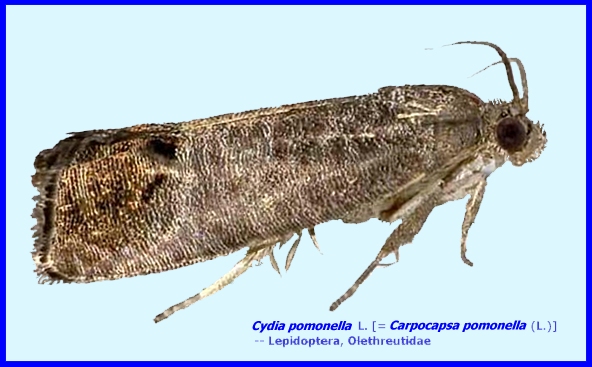
CODLING MOTH Cydia pomonella L. [= Carpocapsa pomonella (L.)]-- Lepidoptera, Olethreutidae (Contacts) ----- CLICK on Photo to enlarge &
search for Subject Matter with Ctrl/F. GO TO ALL: Bio-Control Cases
Efforts to introduce parasitoids into the United States and Canada
were made during 1904-1921, but initial results were not spectacular, even
though Ascogaster
quadridentata Wesn.,
imported from Europe, did become established in eastern North America (Boyce
1948, Johannsen 1957, McLeod 1954, Smith & Vosler 1914). No other foreign parasitoids were ever
established in California (Riley & Howard 1892, Nel 1942, Janjua et al.
1958, Wilson 1960, Valentine 1967, Clausen & Oatman 1978).
Chemical pesticides have been widely used to control codling moth
(Barnes 1959, Madsen & Morgan 1970), however there has been a gradual
interest to reduce population densities with classical biological
control. The excessive use of
insecticides against this insect has been responsible for secondary and sporadic
pest outbreaks in many areas (Croft & Hoyt 1983), and thereby interfering
with integrated pest management.
Although early reports indicated the presence of many useful predators
and parasitoids, the heavy dependency on pesticide use has encumbered
biological control progress (Brodie 1907, Rosenberg 1934, Boyce 1941,
Simmonds 1944, Croft & AliNiazee 1999).
Croft & AliNiazee (1999) indicate that conservation and management
of endemic parasitoids such as Trichogramma
spp. has been implemented in codling moth control strategy in several
countries of western Europe and North America. The Soviet Union is particularly active in using inundative
releases of Trichogramma
against codling moth on large acreage (see Croft & AliNiazee 1999), and
their research has stressed development of methods for parasitoid mass
production and release. In Germany
Stein (1960) reported nearly a 50%
reduction in damage by codling moth when Trichogramma
spp. were released against first generation populations. In North America there has been less use
of these parasitoids, however. In
Ontario Trichogramma
minutum Riley was
reported to be an important natural enemy of codling moth (Boyce 1941)
providing >50% parasitism ins some years which resulted in reduced larval
densities. Other
larval parasitoids of potential are Macrocentrus delicatus
Cress, M.
instabilis Mues., M. ancylivorous Rohwer, Phanerotoma fasciata Prov., Pimpila pterelas
Auett. and Pristomerus
vulnerator Grav.
(Simmonds 1944, Putman 1963, Labanowski 1981, Subinprasert 1987), and Liotryphon caudatum (N. Mills, pers.
commun.). Ascogaster was accidentally introduced from Europe to
North America, and is the most important larval parasitoid of codling moth,
causing ca. 25% parasitism in some areas.
With early season releases, higher parasitism can be attained in
eastern Washington State (J. J. Brown, pers. commun.), and in Austria (Rupf
1976, Rupf & Russ 1976). Pupal
parasitoids including Dibrachys
cavus (Wlk.), Eupelmus cyaniceps Ashm., Pimpla annulipes Brulle and Eurytoma sp.,
are not considered very important in natural control (Putnam 1963, Clausen
1978).
Predaceous insects and birds also are important natural control agents
that suppress codling moth in Europe and North America (Putnam 1963, Glen
& Milsom 1978, Solomon et al. 1976).
Among these Terebroides
corticalis Melsch, the
ant Solenopsis
molesta (Say), some
carabid and staphylinid beetles , and the spider Agelena naevia Walck, feed on
larvae. However the most effective
predators are woodpeckers Dendrocopos pubescens
L. and D.
villosus L. (MacLellan 1959,
Croft & AliNiazee 1999). Solomon et
al. (1976) reported that in
Wales, woodpeckers and blue tits, Paarus caevunlens
L. and P. major L. were important
predators. In Oregon a large number
of predaceous insects, including mirids Deraeocoris sp. and Phytocoris sp.
were generally present in apple orchards throughout the growing season (Croft
& AliNiazee 1999). MacLellan
(1962) considered several mirid species important egg and larval predators in
Nova Scotia.
It has been found that certain sprays of lead arsenate and sulfur
fungicides inhibits oviposition of Ascogaster
quadridentata (Cox &
Daniel 1935, Boyce 1941), and organophosphate, carbamate and pyrethroid insecticides
are thought to severely interfere with natural enemy performance (Croft &
Hoyt 1983). The use of these
insecticides early in the season at petal fall and first cover for control of
leafrollers, aphids, scale insects and some moth species coincides with the
general increase of most parasitic and predaceous insects in commercial
orchards (Croft & AliNiazee 1999).
Such sprays disrupt biological control of primary and secondary pests
such as codling moth and leafrollers.
Recently the use of Bacillus
thuringiensis, a codling
moth granulosis virus, and juvenile hormone related pesticides and chitin
synthesis inhibitors such as diflubenzeron have introduced a new diversity of
materials with greater selectivity to a broad range of these natural enemies
(Westigard 1979) (also see Cushman 1913, Boyce 1936, Naphtali 1941, and Lloyd
1944).
Larvae of Chrysoperla
carnea (Steph.) and C. rufilabris Burm. have been
found to attack the eggs of codling moth (Putman 1963). Food sprays may be used to increase the
effectiveness of these species (Hagen et al 1971).
Of especial interest is the apparent absence of codling moth from the Owen's
Valley of eastern California (E. R. Oatman & E. F. Legner,
unpublished). An isolated area where
apples have been grown for over 100 years (e.g., the Japanese Internment
camp of Manzanar at Lone Pine).
But to date (2019) codling moth has not been reported attacking apples
anywhere in that area. REFERENCES [Additional references may be
found at: MELVYL
Library ] Barnes, M. M.
1959. Deciduous fruit insects
and their control. Ann. Rev. Ent.
4: 343-62. Boyce, H. R.
1936. Laboratory breeding of Ascogaster carpocapsae Vier. with notes on biology and larval
morphology. Canad. Ent. 68: 241-46. Boyce, H. R.
1941. Biological control of
codling moth in Ontario. Annual Rept.
Ent. Soc. Ontario 71: 40-44. Boyce, H.
R. 1948. Native and imported
parasites of the codling moth, Carpocapsa
pomonella L. in
Ontario. Quebec Soc. Prot. Plants,
30th Rept. (1945-47): 96-100. Brodie, W.
1907. Parasitism of Carpocapsa pomonella. Annual
Rept. Ent. Soc. Ontario 37:
5-15. Clausen, C.
P. (ed.). 1978.
Introduced Parasites and Predators of Arthropod Pests and Weeds: A World Review. U. S. Dept. Agric. 545
p. Clausen, C. P. & E. R. Oatman. 1978.
Lepidoptera, p. 211-13. In: C. P. Clausen (ed.), Introduced Parasites and Predators of
Arthropod Pests and Weeds: A World Review.
U. S. Dept. Agric. Res. Svc. Handb. 480. 545 p. Coutin, R. & A. Colombin. 1960.
Les principaux parasites de Laspeyresia
pomonella L. dans le bassin
parisien. Rev. Pathol. Veg. Ent. Agric. Fr. 39: 35-45. Cox, J. A. & D. M. Daniel. 1935.
Ascogaster carpocapsae Vier. in relation
to arsenical sprays. J. Econ.
Ent. 28: 113-20. Croft, B. A. & S. C. Hoyt (eds.). 1983.
Integrated Management of Insect Pests of Pome and Stone Fruits. Wiley Intersci., New York. 456 p. Croft, B. A. & M. T. AliNiazee. 1999.
Biological control in deciduous tree fruit crops. In: Bellows, T. S. & T. W. Fisher (eds.), Handbook of Biological Control:
Principles and Applications.
Academic Press, San Diego, New York.
1046 p Croft, B. A. &
H. W. Riedl. 1987.
Chemical control and resistance to pesticides in the codling moth, Cydia pomonella. Chapter
2.1.6. In: L. P. S. van
der Geest & H. H. Evenhius (eds.), "Tortricoid Pests. Elsevier, Amsterdam. Cushman, R. A.
1913. The calliephialtes
parasite of the codling moth. J.
Agric. Res. 1: 211-37 Eady, R. D. & J. A. J. Clark. 1964.
A revision of the genus Macrocentrus
(Curtis) (Hym., Braconidae) in Europe with descriptions of four new
species. Ent. Gaz.
15(3): 97-127. Essig, E. O. 1931. A History of
Entomology. MacMillan, New York. 1059 p. Ferro, D. N., R. R. Sluss & T. P.
Bogyo. 1975. Factors contributing to the biotic
potential of the codling moth, Laspeyresia
pomonella L., in
Washington. Environ.
Ent. 4(3): 385-91. Glen, D. M.
& D. E. Curtis. 1978.
Pupal parasites of codling moth.
In: E. Dickler (ed.), The Use of Integrated
Control and the Sterile Insect Technique for Control of the Codling
Moth. Mitt. Biol. Bundesanst. Land Forstwirtsch.
180: 95-6. Glenn, C. A.
& N. F. Milson. 1978.
Survival of mature larvae of codling moth (Cydia pomonella)
on apple trees and the ground. Ann. Appl. Biol. 90: 133-46. Hagen, K. S.,
E. F. Sawall, Jr. & R. L.
Tassan. 1971. The use of food sprays to increase
effectiveness of entomophagous insects.
Proc. Tall Timbers Conf. Ecol. Anim. Control by Habitat Management
2: 59-81. Jaques, R.
P & C. R. MacLellan. 1965.
Fungal mortality of overwintering larvae of codling moth in apple
orchards in Nova Scotia. J.
Invertebr. Path. 7: 291-96. Janjua, N. A., M. M. Nasir & G. U.
Chaudhry. 1958. The codling moth, Cydia pomonella
(L.) in Baluchistan. Biol. Soc.
Pakistan Monog. 2. 122 p. Jaynes, H.
A. & P. E. Marucci. 1947.
Effect of artificial control practices on the parasites and predators
of the codling moth. J. Econ.
Ent. 40: 9-25. Johannsen, C. A. 1957. History of
biological control of insects in Washington.
Northwest Sci. 31: 57-92. Kahrer, A.
von. 1982. Untersuchungen über die Biologie von Elodia morio
(Fall.) (Tachinidae). Dissertation University of Vienna,
Austria. Labanowski,
G. S. 1981. Pathogens and
parasites recovered from the hibernating larvae of the codling moth, Laspeyresia pomonella (L.) (Lepidoptera,
Tortricidae). Polskie Pismo
Entomologiczne, Bull. Entomol. de Pologne 51: 163-70. Lehmann,
W. 1968. Beitrag zur Kenntnis der Parasiten von Laspeyresia pomonella
(L.). Arch. Pflanzenschutz. 4(2):
t131-41 Lloyd, D. C.
1944. A study of the codling
moth and its parasites in California.
Sci. Agric. (Canada) 24:
456-73. Lloyd, D. C.
1960. Memorandum on natural
enemies of the codling moth, Cydia
pomonella (L.). Commonw. Inst. Biol. Contr.
Mimeo. 40 p. Madsen, H. F.
& C. V. G. Morgan. 1970.
Pome fruit pests and their control.
Ann. Rev. Ent. 15: 295-320. MacLellan, C. R. 1958. Role of
woodpeckers in control of the codling moth in Nova Scotia. Canad. Ent. 90: 18-22. MacLellan, C. R. 1959. Woodpeckers as
predators of the codling moth in Nova Scotia. Canad. Ent. 91: 673-80. MacLellan, C. R. 1962. Mortality of
codling moth eggs and young larvae in an integrated control orchard. Canad. Ent. 94: 655-66. MacLellan, C. R. 1971. Woodpecker
ecology in the apple orchard environment.
Proc. Tall Timbers Conf. Ecol. Anim. Control Habitat Management
2. Tallahassee, Florida, 1970. p. 273-84. McLeod, J.
H. 1954. Statuses of some
introduced parasites and their hosts in British Columbia. Proc. Ent. Soc. Brit. Columbia 50: 19-27. Naphtali, D. K. 1941. The introduction
of two European parasites of the codling moth, Carpocapsa pomonella
L., into Canada. Ent. Soc. Ontario
Ann. Rept. 71: 44-7. Nel, R. G.
1942. Biological control of
the codling moth in South Africa. J.
Ent. Soc. S. Africa 5: 118-37. Putman, W. L.
1963. The codling moth, Carpocapsae pomonella (L.) (Lepidoptera:
Tortricidae): A Review with special
reference to Ontario. Proc. Ent. Soc.
Ontario 93: 22-59. Riley, C. V. & L. O. Howard. 1892.
Raphidia in New Zealand.
Insect Life 4: 339. Rosen, H.
von. 1977. Versuche mit gezielter
Schädlingsbekämpfung im Apfelbau in Mittelschweden während der Jahre
1973-1976. Acta agric. Scand. 27: 49-57. Rosenberg, H. T. 1934. The biology and
distribution in France of the larval parasites of Cydia pomonella. Bull. Ent. Res. 25: 201-56. Rupf, von
O. 1976. Untersuchungen über die Freilassung von Ascogaster quadridentatus
Wesm. [Braconidae] im Hinblick auf eine integrierte Bekämpfung des
Apfelwicklers (Laspeyresia pomonella L.) in Osterreich
(vorläufige Mitteilung). Sund. aus
Land- u. Forstwirtsch. Forsch. in Osterreich 7: 179-87. Rupf, von O.
& K. Russ. 1976. Beobachtungen über die Zucht und die
Parasitierungsleistung von Ascogaster
quadridentatus Wesm.
(Hymenoptera: Braconidae), einem wichtigen Parasiten des Apfelwicklers (Laspeyresia pomonella L.). Z. angew. Zool. 63: 367-72. Russ, K. &
O. Rupf. 1975.
Influence of parasites and pathogenes on the hibernating population of
codling moth (Laspeyresia pomonella L.) in Austria. Proc. Symp. Sterility Principle for Insect
Control (Innsbruck). IAEA, Vienna,
1974. p. 557-63. Shenefelt, R. D. 1969. Braconidae
I. In: C. Ferriere
& J. van der Vecht's-Gravenhage (eds.), Hymenopterorum Catalogus. p.
1-176. Shenefelt, R. D. 1970. Braconidae
3. In: C. Ferriere
& J. van der Vecht's-Gravenhage (eds.), Hymenopterorum Catalogus. p.
307-428. Simmonds, F. J. 1944. Observations on
the parasites of Cydia pomonella L. in southern
France. Sci. Agric. Canada 25: 1-30. Smith, H. S. & E. J. Vosler. 1914.
Calliephialtes in
California. Calif. State Comm. Hort.,
Mon. Bull. 3: 195-211. Solomon, M. E. & D. M. Glen. 1979.
Prey density and rates of predation by tits (Parus spp.) on larvae of codling moth (Cydia pomonella) under bark.
J. Appl. Ecol. 16: 49-59. Solomon, M.
E., D. M. Glen, D. A. Kendall & N. F. Milsom. 1976. Predation of overwintering larvae of
codling moth (Cydia pomonella (L.) by birds. J. Appl. Ecol. 13: 341-52. Stairs, G. R.
1985. Predation on
overwintering codling moth populations by birds. Ornis Scand. 16(4):
323-24. Stein, W. 1960.
Versuche zur biologischen bekämpfung des apfelgruttung Trichogramma. Entomophaga 5: 237-47. Stenmark,
A. 1977. Försök med feromonpreparat för nagra vecklararter i Svenska
fruktodling. Växskyddsnotiser 41(2): 34-38. Subinprasert, S. 1987. Natural enemies
and their impact on overwintering codling moth populations (Laspeyresia pomonella L.) (Lep.,
Tortricidae) in south Sweden. J.
Appl. Ent. 103: 46-55. Valentine, E. W. 1967. A list of the
hosts of entomophagous insects of New Zealand. N. Zeal. J. Sci. 10:
1100-1210. Wilson, F.
1960. A review of the
biological control of insects and weeds in Australia and Australian New
Guinea. Commonw. Inst. Biol. Contr.
Tech. Commun 1: 102 p. Westigard, P. H. 1979. Codling
moth: Control on pear with
diflubenzuron and effects on nontarget pest and beneficial species. J. Econ. Ent. 75: 552-54. Zech, E.
von. 1959. Beitrag zur Kenntnis einiger in Mitteldeutschland aufgetretener
Parasiten des Apfelwicklers (Carpocapsa
pomonella L.). Z. angw. Ent. 44: 203-20. |