FILE: <ch-3.htm> `GENERAL INDEX [Navigate to MAIN MENU ]
|
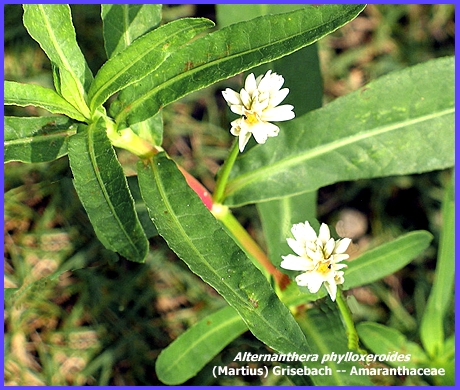
ALLIGATOR WEED Alternanthera phylloxeroides (Martius)
Grisebach -- Amaranthaceae (Contacts) CLICK on Photo to enlarge &
search for Subject Matter with Ctrl/F. GO TO ALL: Bio-Control Cases
Because of problems
encountered with alligatorweed control, and as part of an expanded aquatic
weed control program, the United States Army Corps of Engineers sought the
assistance of the U. S. Department of Agriculture, Agricultural Research
Service to assess the potential for biological control of this noxious
plant. In 1960, G. B. Vogt explored
in Argentina and adjacent countries to the north in search of phytophagous
arthropods and plant pathogens of alligatorweed. He reported over 40 species of natural enemies attacking
alligatorweed, three of which he considered particularly important: Amynothrips
andersoni O'Neill
(Thysanoptera: Phlaeothripidae), Agasiceles
hygrophila Selman & Vogt (Coleoptera:
Chrysomelidae), and Vogtia malloi Pastrana (Lepidoptera:
Phycitinae). In 1962, the U. S.
Department of Agriculture established a laboratory near Buenos Aires,
Argentina, to study the biologies and host plant relationships of these
biological control agents (Coulson 1977) (also see Fuller 1961, Anonymous
1962, Hawkes et al. 1967, Zeiger 1967, Maddox & Resnik 1968). Following are some of the attributes of the
several species found by C. F. Vogt: Agasiceles hygrophila adults feed on the submerged leaves and stems
of alligatorweed. The eggs are laid
in clusters on the undersides of the young leaves of this plant. Developing larvae feed on the leaves and
stems, and third or final instar larvae tunnel into the hollow stems to
pupate. Adults later chew through the
stem wall and the life cycle is repeated.
As many as five generations per year occur in Argentina (Maddox
(1968). Feeding by beetles destroys
both leaves and stems, the latter becoming waterlogged after repeated
perforations with adult emergence holes, causing the mats to sink. Vogtia malloi
is a nocturnal moth that oviposits on terminal leaves. Larvae tunnel into stems, and may later
exit at irregular intervals, reenter and thereby damage a number of stems as
they pass through five instars.
Pupation is inside the hollow stem, and there are 3-5 generations per
year. Extensive stem collapse results
from the feeding of V. malloi and it develops
satisfactorily on both rooted and free floating plants (O'Neill 1968, Maddox
et al. 1971). The small (2.2 mm) Amynothrips
andersoni feed among the
bracts of the young buds or in the leaf axils. Larvae complete their development in about 30 days, and their
are 3-5 generations annually. These
thrips overwinter primarily as adults, and their feeding scars the leaf
surface and stunts stem growth
(Maddox et al. 1971). These three
fleabeetles were imported to the United States during 1964-70 from Argentina
(Coulson 1977). They are now
established in the southeastern United States. Agasiceles hygrophila gave
moderately good initial control in many coastal areas of the SE USA, but it
has subsequently exhibited intolerance to extremes in temperature and
humidity. Early season supplemental
releases of adult fleabeetles have enhanced their impact in the climatically
extreme areas. IN the states of
Florida, Louisiana and Texas, biological control of alligatorweed is
successful. Vogtia malloi
reduced the weed mats by 70-80% in coastal areas of Mississippi, but control
there is not altogether satisfactory (Julien 1987). The introduction of
A. hydrophila into the SE United States in 1964 was the first
use of an insect as an aquatic noxious plant control agent. The success of this effort has reduced
skepticism on the us of monophagous natural control agents (Andrés &
Bennett 1975). The initial
establishment of natural enemies on waterways associated with the St. Johns
River in Florida occurred within 15 months of initial release, while it took
much longer at other release sites.
The different rates of control may relate to the carbohydrate reserves
in the alligatorweed mat stems, the growth rate of the plant itself and the
length of the growing season (Andrés & Bennett 1975, Coulson 1977). Australia, Thailand
and New Zealand also received fleabeetles from colonies that became
established in the United States, with the beetles having become established
in all three countries. A fourth
species, Disonycha argentinenesis Jacoby was
introduced to Australia in 1980 and New Zealand in 1982 directly from Brazil,
but failed to become established. Agasicles hygrophila spread quickly through the infestations of
alligatorweed in Australia and provided substantial control of this aquatic
pest within 14 months. Vogtia malloi impact on alligatorweed there is confounded with
injury caused by Agasicles. This moth is completely ineffective in
terrestrial terrain (Julien 1987). REFERENCES: [ Additional
references may be found at: MELVYL
Library ] Anonymous. 1962. Alligatorweed controlled by insects? Agric. Res. 10: 8-9. Andrés, L. A. & F. D. Bennett. 1975. Biological
control of aquatic weeds. Ann. Rev.
Ent. 20: 31-46. Coulson, J. R. 1977. Biological control of alligatorweed,
1959-1972. A review and
evaluation. U. S. Dept. Agric. Tech.
Bull. No. 1547. 98 p. Fuller, T. C. 1961. New weed problems. Calif. State Dept. Agric. Bull. 50: 20-8. Goeden, R. D. & L. A. Andrés. 1999. Biological
control of weeds in terrestrial and aquatic environments. In: Bellows, T. S. & T. W. Fisher (eds.), Handbook of Biological Control:
Principles and Applications.
Academic Press, San Diego, New York.
1046 p Hawkes, R. B., L. A. Andrés & W. H. Anderson. 1967.
Release and progress of an introduced flea beetle, Agasicles n. sp., to control alligatorweed. J. Econ. Ent. 60: 1476-77. Julien, M. H. (ed.). 1987. Biological control
of weeds: a world catalogue of agents
and their target weeds, 2nd ed.
Commonw. Agric. Bur. Int., Wallingford, U.K. 150p. Maddox, D. M. 1968. Bionomics of an alligatorweed fleabeetle, Agasicles sp., in
Argentina. Ann. Ent. Soc.
Amer. 61: 1299-1305. Maddox, D. M. & M. E. Resnik. 1968. Radioisotopes--a
potential means of evaluating the host specificity of phytophagous
insects. J. Econ.
Ent. 61: 1499-1502. Maddox, D. M., L. A. Andrés, R. D. Hennessey, R. D. Blackburn
& N. R. Spencer. 1971. Insects to control alligatorweed, an
invader of aquatic ecosystems in the United States. BioScience 21: 985-91. O'Neill, K. 1968. Amynothrips andersoni, a new genus and
species injurious to alligatorweed.
Proc. Ent. Soc. Wash. 70:
175-83. Zeiger, C. F. 1967. Biological control of alligatorweed with Agasicles n. sp. in
Florida. Hyacinth Control J. 6: 31-4. |