FILE: <ch-26.htm> GENERAL INDEX [Navigate to MAIN MENU ]
|
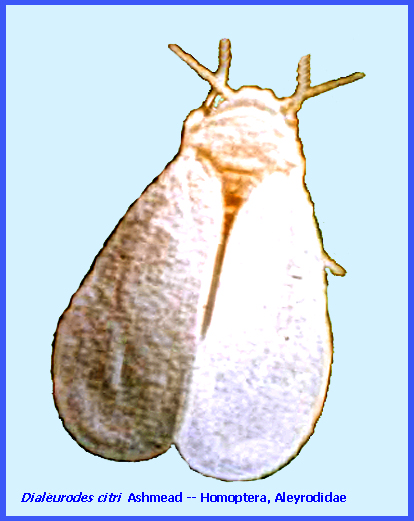
CITRUS WHITEFLY Dialeurodes citri Ashmead -- Homoptera, Aleyrodidae (Contacts) ----- CLICK on Photo to enlarge & search for Subject Matter with Ctrl/F. GO TO ALL: Bio-Control Cases
Biological control attempts were begun in 1910 when the U. S.
Department of Agriculture sent R. S. Woglum to Asia for natural enemies
(Woglum 1913). After 16 months of
exploration, Woglum returned to Florida with cultures of Encarsia (= Prospaltella)
lahorenesis (Howard) and a
coccinellid, Serangium flavescens (Motschulsky), which
he had found in Pakistan. The
cultures were lost due to the lack of suitable host stages for
reproduction. No attempts were made
to require these natural enemies until 1968 when E. lahorensis
was introduced into California by DeBach & Warner (1969). Additional material was obtained from
Florida, Hong Kong, India and Japan, which resulted in the establishment of a
Encarsia sp. from India and
a coccinellid Delphastus pusillus (LeConte) from Florida
(Rose & DeBach 1981). Encarsia lahorensis was shown to be capable of rapid suppression of
D. citri being very efficient at low host densities. However, it was slow to disperse. The Encarsia
sp. from India, although less responsive to host density increases, possessed
superior dispersal qualities. Encarsia lahorensis was then established in Florida in 1977 (Sailer
et al. 1984). Complete biological
control was obtained. Substantial
biological control was reported in Italy where E. lahorensis
was established in 1975 (Viggiani & Battaglia 1983). This parasitoid was also established in
Sardinia, Corfu and Israel, but results were not reported (Kennett et al.
1999). In the Soviet Union E. lahorensis failed to establish, but some biological
control success was obtained with an introduced parasitic fungus (Aschersonia spp.) and the
coccinellid Serangium parcesetosa Sicard, from India
(Shenderovskaya 1976) (also see Morrill & Back 1911, and Clausen 1978). REFERENCES: [Additional references may be
found at: MELVYL
Library ] DeBach, P.
& S. C. Warner. 1969.
Research on biological control of whiteflies. Citrograph 54: 301-03. Clausen, C.
P. 1978. Aleyrodidae. In: C. P. Clausen (ed.), Introduced Parasites
and Predators of Arthropod Pests and Weeds:
a World Review. U. S. Dept.
Agric., Agric. Handbk. No. 480. 545
p. Kennett, C. E., J. A. McMurtry & J. W.
Beardsley. 1999. Biological control in subtropical and
tropical crops. In: Bellows, T. S. & T. W. Fisher (eds.), Handbook of Biological Control: Principles and Applications. Academic Press, San Diego, New York. 1046 p Morrill, A. W. & E. A. Back. 1911.
White flies injurious to citrus in Florida. U. S. Dept. Agric., Bur. Ent. Bull. 92. 109 p. Rose, M. & P. DeBach. 1981.
Citrus whitefly parasites established in California. Calif. Agric. 35(7-8): 21-3. Sailer, R. I., R. E. Brown, B. Munir & J.
C. E. Nickerson. 1984. Dissemination of the citrus whitefly
(Homoptera: Aleyrodidae) parasite Encarsia
lahorensis (Howard)
(Hymenoptera: Aphelinidae) and its effectiveness as a control agent in
Florida. Bull. Ent. Soc. Amer.
30(2): 36-9. Shenderovskaya,
L. P. 1976. Introduced insect
enemies and microorganisms. Zasch. Rast.
3: 52-3. Viggiani, G.
& D. Battaglia. 1983.
Experiments on the biological control of Dialeurodes citri
(Ashm.) using Encarsia lahorensis (How.) at fruit-farm
level, and present status of the parasite in Campania and other areas. XIII Congresso Nazionale Italiano di Ent.
p. 181-89. Woglum, R. S.
1913. Report of a trip to
India and the Orient in search of the natural enemies of the citrus white
fly. U. S. Dept. Agric. Bur. Ent.
Bul. 120. 58 p. |