FILE: <ch-25.htm> GENERAL INDEX [Navigate to MAIN MENU ]
|
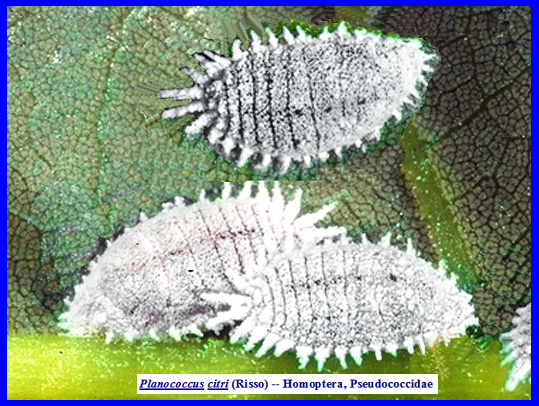
CITRUS MEALYBUG Planococcus citri (Risso) -- Homoptera, Pseudococcidae (Contacts) ----- CLICK on Photo to enlarge &
search for Subject Matter with Ctrl/F. GO TO ALL: Bio-Control Cases
Smith &
Armitage (1920, 1931) developed a method for mass production of the mealybug
on etiolated potato sprouts, which they adapted to mass culture of Leptomastidea abnormis. Later the same technique was applied to
mass culture of Cryptolaemus
(Kennett et al. 1999). Sixteen
insectaries were formed during 1916-30 for the propagation of Cryptolaemus (Fisher
1963). Although millions of Cryptolaemus were colonized
each year, the number of insectaries was reduced to four by 1963, which was
believed due to the successful biological control of the more serious
citrophilus mealybug in 1930 (Kennett et al. 1999). In 1934 another
parasitoid, Leptomastix
dactylopii Howard, was
introduced from Brazil (Compere 1939), and Pauridia peregrina Timberlake was
brought in from southern China in 1950 (Flanders 1951). However, neither species was established
(Clausen 1956). These two parasitoids
were then periodically colonized, in addition to Cryptolaemus, which gradually reduced the frequency of P. citri outbreaks (DeBach & Hagen 1964). Anagyrus pseudococci
(Girault) and other mealybug parasitoids were introduced during 1950-56, but
all failed to establish (Bartlett & Lloyd 1958). In other parts of
the world biological control of citrus mealybug varied. Kennett et al. (1999) report that in Western Australia, where P. citri and other mealybug species were serious pests of
citrus, highly successful control was obtained simply by transferring Cryptolaemus from New South
Wales (Wilson 1960). In other areas,
results following introduction of Cryptolaemus
have generally followed the patter shown in California, with failure of the
beetle to become permanently established attributed to its inability to
overwinter (Wood 1963, Rosen 1967, Argyriou 1969, Beingolea 1969, Greathead
1976). The beetle established only in
more tropical climates such as Florida and Hawaii and in some Mediterranean
countries (Muma 1955, Greathead 1976).
Reports from Spain (Gomez-Clemente 1954) and Italy (Mineo 1967) point
to the production and periodic colonization of Cryptolaemus giving some success. Parasitoid introductions were of course
also made into other countries, but with limited success (Zinna 1960,
Bartlett 1978, Luck 1981). Beingolea
(1969) reported that Arthopoideus
peregrina effective
controlled P. citri in Perus, however. The parasitoids L. abnormis,
A. pseudococci and L.
dactylopii were considered
important in the successful control of citrus mealybug in Chile (also see
Branigan 1916, Armitage 1920, Marchal 1921, 1922; Poutiers 1922, Speare 1922,
Bodenheimer & Guttfeld 1929, Bishop 1931, Essig 1931, Swezey 1931, Myers
1932, Watson 1932, Constantino 1935, Stepanov 1935, Marchal & Pussard
1938, Quayle 1938, Ferriera 1939, Gomez Clemente 1928, 1929, 1932, 1951;
Mason 1941, Joubert 1943, Durán 1944, Bachthaler 1955, Muma 1954, Marcovitch
1954, Beingolea 1957, Simmonds 1957, Wille 1958, Bennett & Hughes 1959,
Rivnay 1960, 1968; Rozanova & Loseva 1963, Szent-Ivany 1963, Liotta 1965,
Liotta & Mineo 1965, Gonzalez & Rojas 1966, Rosen & Rössler 1966,
McKenzie 1967). REFERENCES: [Additional references may be
found at: MELVYL
Library ] Argyriou, L. C. 1969. Biological
control of citrus insects in Greece.
Proc. 1st Intern. Citrus Symp., Riverside, Calif. 2: 817-22. Armitage, H.
M. 1920. Report of the biological
control work directed against the mealybugs.
Calif. Dept. Agric.Monthly Bull. 9:
441-51. Bachthaler,
G. Uber die einburgerung des
schlidlausparasiten (Leptomastix
dactylopii) und anderer
nützlinge im spanisch zitrusanbau.
Pflanzenschutz 7: 23-25. Bartlett, B.
R. 1978. Coccidae. In: C. P. Clausen (ed.), Introduced Parasites
and Predators of Arthropod Pests and Weeds.
U. S. Dept. Agric. Agric. Handbk. No. 480, Washington, D.C. 545 p. Bartlett, B. R. & D. C. Lloyd. 1958.
Mealybugs attacking citrus in California--a survey of their natural
enemies and the release of new parasites and predators. J. Econ. Ent. 51: 90-93. Beingolea,
G. O. 1957. Una evaluación aproximada de la eficiencia de los enemigos
biológicos de Pseudococcus citri Risso, en algodonero.
(Peru) Lima Estac. Expt. Agric. Molina, Informe Mens. 31: 23-5. Beingolea, O.
1969. Biological control of
citrus pests in Peru. Proc. 1st
Intern. Citrus Symp., Riverside, Calif. 2:
827-38. Bennett, F. D. & I. W. Hughes. 1959.
Biological control of insect pests in Bermuda. Bull. Ent. Res. 50: 423-36. Bishop, H. J.
1931. Biological control of
the citrus mealybug. Farming in South
Africa 64. 7 p. Bodenheimer,
F. S. & M. Guttfeld. 1929. Uber die Möglichkeiten einer biologischen
Bekämpfung von Pseudococcus citri Risso. (Rhy., Cocc.) in
Palastina. Ztschr. f. angew. Ent.
15: 67-136. Branigan, E.
J. 1916. A satisfactory
method of rearing mealybugs for use in parasite work. Calif. State Hort. Comm., Monthly Bull.
5: 304-06. Clausen, C.
P. 1915. Mealybugs of citrus
trees. Calif. Agric. Exp. Sta. Bull.
258, p. 19-48. Clausen, C. P.
1956. Biological Control of
Insect Pests in the Continental United States. U. S. Dept. Agric. Tech. Bull. No. 1139. 151 p. Clausen, C.
P. 1978. Biological control
of citrus insects. Chapter 6, Vol.
IV. In: The Citrus
Industry. Univ. of Calif. Div. Agric.
Sci., Berkeley, Calif. 362 p. Compere,
H. 1939. Mealybugs and their
insect enemies in South America.
Univ. Calif. Publs. Ent. 7:
57-73. Constantino,
G. 1935. Un enemico del cotonello degli agrumi: Cryptolaemus
montrouzieri Muls. Acireale R. Staz. Sper. di Fruttic. e Agrumic. Bol. (n.s.) 6. 7 p. DeBach, P.
& K. S. Hagen. 1964. The
conservation and augmentation of natural enemies. In: P. DeBach (ed.), Biological Control of
Insect Pests and Weeds. Reinhold
Publ. Corp., New York. 844 p. Durán, M.
L. 1944. Enemigos naturales del genero Pseudococcus establecidos en Chile. (Agric. Tech. Santiago, Chile 4: 102. Essig, E.
O. 1931. A History of
Entomology. MacMillan Co., New
York. 1029 p. Ferriera,
L. 1939. A luta contra o Pseudococcus
citri Risso e o problema
geral de luta biologica. Palestras
Agron. 2: 17-47. [in Italian]. Fisher, T. W.
1963. Mass culture of Cryptolaemus and Leptomastix--natural enemies of
citrus mealybug. Calif. Agric. Exp.
Sta. Bull. 797. 39 p. Flanders, S.
E. 1951. Citrus
mealybug. Four new parasites studied
in biological control experiments. Calif.
Agric. 5(7): 11. Gomez-Clemente,
F. 1928. Acclimatación en España de "Cryptolaemus montrouzieri"
Muls., para combatir el "Cotonet" del Naranjo (Pseudococcus citri
Risso). Bol. Patol. Veg. Ent. Agr.
3: 106-23. Gomez-Clemente,
F. 1929. El Cryptolaemus
montrouzieri Muls., parásito
del Pseudococacus citri Risso. Estac. Reg. Patol. Veg., Valencia. 45 p. Gomez-Clemente,
F. 1951. Experiments on the
acclimatization of L. dactylopii, a parasite of Planococcus citri. Bol. Patol. Veg. Ent. Agric. 18:
21-8. [in Spanish]. Gomez-Clemente,
F. 1954. The present
situation in the biological control of some citrus scales (Planococcus citri and Icerya purchasi). Bol. Patol. Veg. Ent. Agric. 19: 19-35. Gonzalez,
R. 1969. Biological control of
citrus pests in Chile. Proc. 1st
Intern. Citrus Symp., Riverside, Calif. 2:
839-47. Gonzalez,
R. H. & S. P. Rojas. 1966. Estudio analítico del control biológico de
plagas agrícolas en Chile. Agric. Tech. 26: 133-47. Greathead, D. J. 1976. A review of
biological control in western and southern Europe. Tech. Comm. No. 7, CIBC.
Commonw. Agr. Bur., Farnham Royal, Slough, England. 182 p. Joubert, C. J.
1943. The introduction into
the Union of South Africa of some natural enemies of mealy bugs. J. Ent. Soc. South AFrica 6: 131-36. Kennett, C., J. A. McMurtry & J.
Beardsley. 1999. Subtropical and tropical crops. In: Bellows, T. S. & T. W. Fisher (eds.), Handbook of Biological Control:
Principles and Applications.
Academic Press, San Diego, New York.
1046 p Liotta, G.
1965. Acclimatation de Cryptolaemus montrouzieri Muls. en Sicile et
lutte biologique contre Pseudococcus
citri R. 12th Intern. Cong. Ent. Proc. 567. Liotta, G.
& G. Mineo. 1965. Prove di "lotta biologica
artificiale" control lo Pseudococcus
citri R. (Cotonello degli
agrumi). Bol. Inst. Ent. Agric. Osserv. Fitopat.,
Palermo (1963-64)5: 129-42. Luck, R. F.
1981. Parasitic insects
introduced as biological control agents for arthropod pests. Handbk. Pest Management in Agric. 2: 125-284.
CRC Press, Inc., Boca Raton, Florida. Marchal,
P. 1921. Utilisation des coccinelles contre les insectes nuisibles aux
cultures dans le midi de la france. C. R. Hebdom. Acad. Sci., Paris 172: 105-07. Marchal, P.
1922. Utilisation d'une
coccinelle australienne (Cryptolaemus
montrouzieri Muls.) dans la
lutte contre les cochenilles blanches et son introduction en france. Ann. du Serv. des Epiphyt. 8: 1-2. Marchal, P. & R. Pussard. 1938.
Acclimatation de Cryptolaemus
montrouzieri Muls. C. R. Acad. Agric. Fr. 24: 972-76. Marcovitch, S.
1954. The insect pest
situation in Israeli agriculture. J. Econ.
Ent. 47: 19-23. Mason, F. R.
1941. Notes on mealybugs and
ther parasites. In: Ann. Rept. Dept.
Agric. & Fisheries (Palestine) for the year ended Mar. 31, 1941: 4-15.
Jerusalem. McKenzie,
H. L. 1967. Mealybugs of
California. Univ. of California
Press, Berkeley & Los Angeles.
526 p. Mineo, G.
1967. on Cryptolaemus montrouzieri
Muls. (Observations on morphology and bionomics). Bool. 1st Ent. Agric. Fitopath. Palermo 6: 99-143. Muma, M. H.
1954. Lady beetle predators of
citgrus mealybugs. Citrus Mag., Apr.
1954: 16-17. Muma, M. H.
1955. Factors contributing to the
natural control of citrus insects and mites in Florida. J. Econ. Ent. 48: 432-38. Myers, L. E.
1932. Two economic greenhouse
mealybugs of Mississippi. The citrus
mealybug and the Mexican mealybug. J. Econ.
Ent. 25: 891-96. Poutiers,
R. 1922. L'acclimatation de Cryptolaemus
montrouzieri Muls. dans le
midi de la france. Ann. des
Epiphyt. 8: 3-18. Quayle, H. J.
1938. Insects of Citrus and
Other Subtropical Fruits. Comstock
Publ. Co., Ithaca, New York. 583 p. Rivnay, E.
1960. Notes on parasites of Planococcus citri Risso in Israel. Ktavin 10: 223-24. Rivnay, E.
1968. Biological control of
pests in Israel (a review 1905-1965).
Israel J. Ent. 3: 1-156. Rosen, D.
1967. Biological and
integrated control of citrus pests in Israel. J. Econ. Ent. 60:
1422-27. Rosen, D.
& Y. Rössler. 1966.
Studies on an Israel strain of Anagyrus
pseudococci (Girault)
(Hymenoptera: Encyrtidae). I. Morphology of the adults and developmental
stages. Entomophaga
11: 269-77. Rozanova,
A. A. & V. G. Loseva. 1963.
The vine mealybug and its parasites.
Zashch. Rast. pt. 3: 53. [in Russian]. Simmonds, F. J. 1957. A list of the
Coccidae of Bermuda and their parasites.
Bermuda Dept. Agric., Agric. Bull. 30. 12 p. Smith, H. S.
1917. On the life history and
successful introduction into the United States of the Sicilian mealybug
parasite. J. Econ.
Ent. 10: 262-68. Smith, H. S. & H. M. Armitage. 1920.
Biological control of mealybugs in California. Bull. Calif. Dept. Agric. 9: 103-58. Smith, H. S. & H. M. Armitage. 1931.
The biological control of mealybugs attacking citrus. Calif. Agric. Exp. Sta. Bull. 509. 74 p. Speare, A. T.
1922. Natural control of the
citrus mealybug in Florida. U. S.
Dept. Agric. Bull. 1117. 18 p. Stepanov, E. M. 1935. The biological
method of controlling pests of plants in Abkhazia. Rev. Appl. Ent. (A), 24.
674. Swezey, O. H.
1931. Records of introduction
of beneficial insects into the Hawaiian Islands. In: F. X. Williams (ed.), Handbook of the
Insects and Other Invertebrates of Hawaiian Sugar Cane Fields. Hawaii. Sugar Planters' Assoc. Expt.
Sta. 400 p. Szent-Ivany, J. J. H. 1963. A biological
control experiment against coffee mealybug in the Wau Valley. Highlands Quart. Bull. New Guinea 4: 8-9. Watson, J. R.
1932. Report of the Department
of Entomology. Florida Agric. Expt.
Sta. Ann. Rept. 1930-1931: 70-80. Wille, J.
E. 1958. El control biológico de los insectos agrícolas en el Peru. 10th Intern. Congr. Ent. Proc. (1956): 4: 519-23. Wilson, F.
1960. A review of the
biological control of insects and weeds in Australia and Australian New
Guinea. Tech. Commun. No. 1, CIBC.
Commonw. Agric. Bur., Farnham Royal, Slough, England. 102 p. Wood, B. J.
1963. Imported and indigenous
natural enemies of citrus coccids and aphids in Cyprus, and an assessment of
their potential value in integrated control programmes. Entomophaga 8: 66-82. Zinna,
G. 1960. Esperimenti di lotta biologica controil cotonello degli agrumi
(Pseudococcus citri (Risso)) nell'Isola di
Procida mediante l'impiego di due parassiti esotica, Pauridia peregrina
Timb. e Leptomastix dactylopii How. Boll. Lab. Ent. Agric. "Filippo Silvestri." Portici 28: 257-84. |