FILE: <ch-22.htm> GENERAL INDEX [Navigate to MAIN MENU ]
|
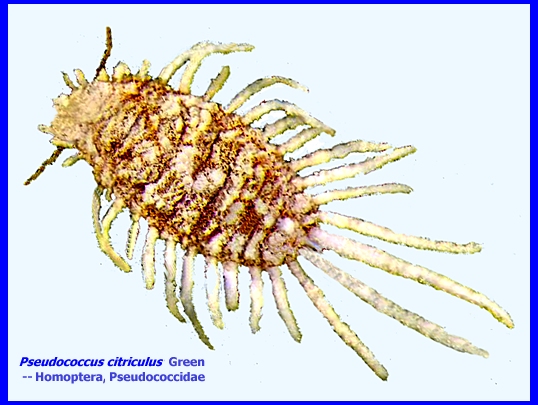
CITRICULUS MEALYBUG Pseudococcus citriculus Green -- Homoptera, Pseudococcidae (Contacts) ------ CLICK on Photo to enlarge &
search for Subject Matter with Ctrl/F. GO TO ALL: Bio-Control Cases
Insecticides
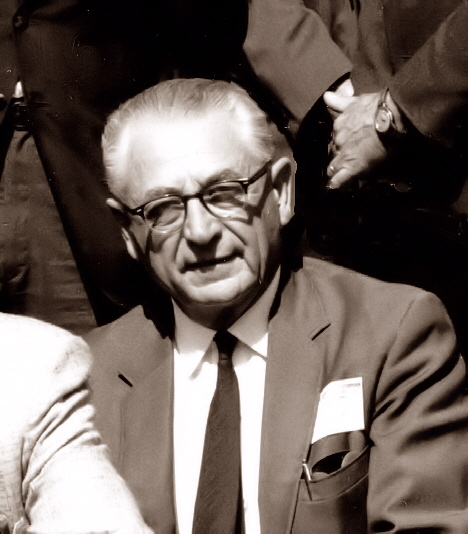
and oil sprays failed to control the mealybug. Although Israel Cohen <PHOTO>, Director of
biological control insectaries in Israel, was not trained as an entomologist,
he had studied agriculture at the University of California during the period
when another very serious mealybug pest, Pseudococcus
fragilis has been completely
controlled there by introduced parasitoids, and he was convinced that their
hope in Israel lay in a similar direction (DeBach 1976). He sent samples of their new mealybug to
various experts who identified it erroneously as P. comstocki. He then wrote to various entomologists to
ascertain where parasitoids of this Comstock mealybug might be obtained. Japan was suggested as the native home but
certain parasitoids were also known to be present in the eastern United
States where P. comstocki had become
established. About this time Dr. I.
Carmon, the citriculturist of the Experiment Station at Rehovot, Israel was
about to journey to the United States.
Cohen suggested that he route his return trip via Japan and search for
parasitoids there. Cohen raised funds
to cover the extra cost and contracted USDA and University of California
entomologists to help and advise Dr. Carmon.
Carmon then collected and sent parasitoids of P. comstocki
to Israel in two airmail shipments in December 1939. DeBach (1976) stated that this apparently
represents the first lengthy intercontinental transport of natural enemies by
air. Additionally, Carmon personally
returned by boat in 1940 with many pupae of the various Japanese parasitoids
of P comstocki.
Meanwhile, Cohen had a special temporary laboratory/insectary
constructed and invited Dr. E. Rivnay to direct it.
Dr. Rivnay sorted out the various primary parasitoids and
hyperparasitoids received from Japan and determined that Clausenia purpurea
Ishii was the most effective. The
hyperparasitoids were eliminated. Clausenia purpurea was cultured and 100
specimens colonized under a tent on one tree in April 1940. It became established immediately and
spread rapidly. Mass production was
started later in 1940 so as to distribute the parasitoid. Trees which received 25 parasitoids in
1940 showed marked decreases in the mealybug infestation by August 1941, and
in a short time control was complete and has remained so ever since (DeBach
1976).
One of the most interesting parts of this story, as related by DeBach
(1976) was that the pest was later found to be P. citriculus
rather than P. comstocki. This was learned because a Japanese
parasitoid, Alloptropa
burrelli Muesebeck, which
had been established on P. comstocki in the United States
would not develop in the presumed P.
comstocki in Israel, thereby
indicating the Israeli mealybug to be a different species. Therefore, the pest was controlled with a
mixture of skill and luck by a parasitoid of another mealybug species. DeBach (1976) states that this illustrates
very strikingly the point that effective natural enemies may sometimes be obtained
where least expected, and it also shows that personal initiative as well as
support by government and industry of a biological control effort is of prime
importance. Neither Cohen nor Carmon
were entomologists, yet between them they collaborated to import a parasitoid
responsible for one of the world's great biological control successes (Rivnay
1968). Also please refer to the
following references for notations on
citriculus mealybug (Goncalves 1940, Klein & Perzelan 1940, Rivnay 1942,
1946; Rivnay & Perzelan 1943, Mason 1943, Haeussler & Clancy 1944,
Bodenheimer 1951, Murakami et al. 1967, Rosen 1967). REFERENCES: [Additional references may be
found at: MELVYL
Library ] Bodenheimer, F. S. 1951. Citrus Entomology in the Middle East. Junk Publ, The Hague. 663 p. DeBach, P.
1976. Biological Control by Natural
Enemies. Cambridge University Press,
London & New York. 323 p. Goncalves, C. R. 1940.
Observacoes sobre Pseudococcus
comstocki (Kuw. 1902)
atacando citrus no baixada fluminense.
Rodriguesia 4: 179-98. [in Portuguese]. Haeussler, G. J. & D. W. Clancy. 1944. Natural enemies
of Comstock mealybug in the Eastern States.
J. Econ. Ent. 37: 503-09. Klein, H. Z. & J. Perzelan. 1940. A contribution to
the study of Pseudococcus comstocki in Palestine. Hadar 13: 107-110. Murakami, Y., R. Morimoto & H.
Kajita. 1967.
Possibilities of biological control of Pseudococcus comstocki
in Japan. Mushi 39: 85-96. Rivnay, E. 1942. Clausenia
purpurea Ishii, a parasite
of Pseudococcus comstocki Kiuw. Introduced into Palestine. Bull. Soc. Fouad Ier Ent. 26: 1-19. Rivnay, E. 1943. A study of the efficiency of Sympherobus amicus Navas in controlling Pseudococcus citri Risso on citrus in
Palestine. Bull. Soc. Fouad Ier Ent.
27: 57-77. Rivnay, E. 1946. The status of Clausenia purpurea
Ishii and its competition with other parasites of Pseudococcus comstocki
Kuw. in Palestine. Bull. Soc. Fouad
Ier Ent. 30: 11-19. Rivnay, E. 1968. Biological control of pests in
Israel. Israel J.
Ent. 3(1): 1-156. Rivnay, E. & J. Perzelan.
1943. Insects associated with Pseudococcus spp. (Homoptera)
in Palestine, with notes on their biology and economic status. J. Ecn. Soc. South Africa 6: 9-28. Rosen, D. 1967. Biological and integrated control of
citrus pests in Israel. J. Econ.
Ent. 60: 1422-27. |