FILE: <ch-2.htm> GENERAL INDEX [Navigate to MAIN MENU ]
|
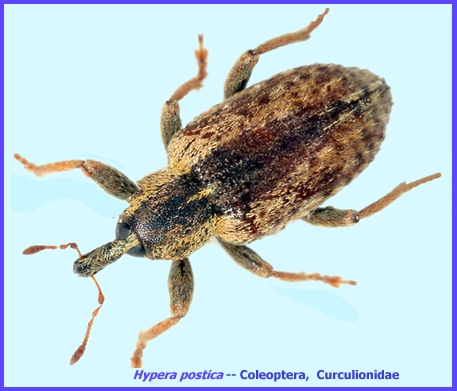
ALFALFA WEEVIL Hypera postica (Gyllenhal) -- Coleoptera, Curculionidae CLICK on Photo to enlarge &
search for Subject Matter with Ctrl/F. GO TO ALL: Bio-Control Cases
There is one generation per year and
winter is spent as aestivating adults and as eggs. Eggs hatch in spring about the time that alfalfa begins to
grow. In the Midwest, larval feeding
continues through May when pupation occurs.
After emergence adults leave the field for available cover where they
undergo summer aestivation. In autumn
adults return to the field and begin laying eggs (Manglitz & App 1957). Parasitoids were
first introduced from Europe into the United States in 1911, and by 1919 they
were well established in many areas of the western United States (Chamberlin
1924). Bathyplectes
curculionis (Thomson) is the most widely distributed and
most successful introduced parasitoid in the Midwestern U. S. During the 1960's and 1970's, both B.
curculionis and B. anurus (Thomson) were released in
Illinois by USDA personnel and are now found in most midwestern populations
of the weevil (Dysart & Day 1976) (also see Michelbacher 1940a,b; Hamlin
et al. 1949, Poinar 1963, Dysart & Puttler 1965, Streams & Fuester
1967, Hagen & Mangalitz 1967, Brunson & Coles 1968). A
fungal disease of alfalfa weevil larvae was found in Ontario, Canada in 1973
(Harcourt et al,. 1974), and was similar to that reported active on
cloverleaf weevil, Hypera punctata (Arthur)
by Arthur (1886). The fungus is
believed to be Erynia phytonomi
(Thomson) and actually differs from that attacking cloverleaf weevil. It was found to spread rapidly out of
Ontario to other portions of North America (Muka 1976, Puttler et al. 1978,
Barney et al 1980, Los & Allen 1983, Nordin et al. 1983). It is now considered to be the major
naturally occurring biological control agent of the alfalfa weevil throughout
most of its range (Carruthers & Soper 1987). A similar fungus causes comparable mortality in Hypera variabilis in Israel
(Ben Ze'ev & Kenneth 1982). Erynia phytonomi overwinters in the soil as thick-walled
resting spores that germinate in springtime to produce germ conidia, which
infect weevil larvae. Conidia produced by infected larvae are responsible for the
horizontal transmission of the disease (Ben Ze'ev & Kenneth 1982). Younger larvae tend to produce conidia and
older larvae resting spores (Barney et al. 1980). Brown & Nordin (1982) developed a detailed model of this
disease and estimated that the first incidence occurs in Kentucky after an
accumulation of 220 to 290 degree days.
Then the alfalfa weevil population has to reach a threshold density in
order to allow for sufficient horizontal transmission for an epizootic. Brown & Nordin (1982) estimated this
threshold to be 1.7 weevil larvae per stem.
Mortality rates caused by the fungus are often quite high (30-70%) at
the time of peak larval occurrence and often 100% later in the season (Morris
1985). It is restricted in
effectiveness as a biological control agent because it often appears late
relative to currently recommended harvest dates (Ambrust et al. 1985). Brown & Nordin (1982) proposed using
computer-directed harvest dates that are earlier than normally
recommended. The microenvironment in
windrows promotes an earlier than normal epizootic and reduces the need for
insecticides. The appearance of
the fungus as a major mortality factor after the two above mentioned
parasitoids were established poses the question of how these all will now
coexist, especially as they attack the larval stage. About five days elapse from infection to
death in diseased larvae and parasitized larvae die within 10 days. Such time periods suggest that an alfalfa
weevil larva infected and parasitized simultaneously would probably die from
the fungus before the parasitoid completed its development. Field studies indicate that the disease
has a negative impact on the two parasitoids (Los & Allen 1983, Loan
1981, Morris 1985). REFERENCES: [Additional
references may be found at: MELVYL
Library ] Arthur, J. C. 1886. A new larval Entomophthora. Bot. Gaz. 11: 14. Barney, R. J., P. L. Watson, K. Black, J. V.
Maddox & E. J. Armbrust.
1980. Illinois distribution of
the fungus Entomophthora phytonomi (Zygomycetes:
Entomophthoraceae) in larvae of the alfalfa weevil (Coleoptera:
Curculionidae). Great Lakes Entomol. 13: 149-50. Ben-Ze'ev, I,
& R. G. Kenneth. 1982. Zoophthora
phytonomi and Conidiobolus osmodes (Zygomycetes: Entomophthoraceae), two pathogens of Hypera species (Coleoptera:
Curculionidae) coincidental in time and place. Entomophaga
25: 171-86. Bissell, T.
L. 1952. U. S. Bur. Entomol. Plant Quarantine Coop.
Econ. Insect Rept. 2: 4. Brown, G. C. & G. L. Nordin. 1982.
An epizootic model of an insect-fungal pathogen system. Bull. Math. Biol. 44: 731-40. Brunson, M.
H. & L. W. Coles. 1868. The introduction, release and recovery of
parasites of the alfalfa weevil in the eastern United States. U. S. Dept. Agric. Prod. Res. Rept.
101. 12 p. Burton, V. E., C. G. Summers, K. S. Hagen &
V. M. Stern. 1987. Insects and mites, p. 1-13. In: IPM Manual Group, Univ. Calif., Davis,
Alfalfa Pest Management Guidelines. Burton, V. E., C. G. Summers, K. S. Hagen &
V. M. Stern. 1989. Alfalfa pest management guidelines
1989. Univ. Calif., UCPMG Publ. No.
2. 14 p. Carruthers, R. I. & R. S. Soper. 1987.
Fungal diseases, p. 357-416. In: J. R. Fuxa & Y. Tanada (eds.), Epizootiology of Insect
Diseases. John Wiley & Sons, New
York. Chamberlin, T. R. 1924. Introduction of
parasites of the alfalfa weevil into the United States. USDA Dept. Circ. 301. 9 p. Cothran, W. R. & C. G. Summers. 1971.
Biology and control of the Egyptian alfalfa weevil, Hypera brunneipennis (Boh.) in California. Proc. Alfalfa Prod. Symp, Fresno, CA., Dec
7-8, 1971. p. 59-62. Cothran, W. R. & C. G. Summers. 1972.
Sampling for the Egyptian alfalfa weevil: a comment on the sweep-net method. J. Econ.
Ent. 65: 689-91. Cothran, W. R., C. G. Summers & D.
Gonzalez. 1971. Egyptian alfalfa weevil-- population and
ecology research. Calif. Agr. 25(5):
5. Cothran, W. R., C. G. Summers & C. E.
Franti. 1975. Sampling for the Egyptian alfalfa
weevil: comparison of two standard
sweepnet techniques. J. Econ. Ent. 68:
563-4. Dysart, J. R. & W. H. Day. 1976.
Release and recovery of introduced parasites of the alfalfa weevil in eastern
North America. Agric. Res. Ser., USDA Prod. Res. Rep.
167: 61 p. Dysart, R. J. & B. Puttler. 1965.
The alfalfa weevil parasite Bathyplectes
curculionis in Illinois and
notes on its dispersal. J. Econ. Ent. 58:
1154-55. Gutierrez, A.
P., J. U. Baumgaertner & C. G. Summers. III. A case
study in an alfalfa ecosystem. Canad. Ent. 116:
950-63. Hagen, A. F.
& G. R. Manglitz. 1967. Parasitism of the alfalfa weevil in the
western plains states from 1963 to 1966.
J. Econ.
Ent. 60: 1663-66. Hamlin, J. C.,
F. V. Lieberman, R. W. Bunn, W. C. McDuffie, R. C. Newton & L. J.
Jones. 1949. Field studies of the alfalfa weevil and
its environment. U. S. Dept. Agric.
Tech. Bull. 975. 84 p. Harcourt, D. G., J. C. Guppy, D. M. MacLeod
& D. Tyrrell. 1974. The fungus Entomophthora phytonomi
pathogenic to the alfalfa weevil, Hypera
postica. Canad. Ent. 106: 1295-1300. Lamp, W. D., K. V. Yeargan, R. F. Norris, C. G.
Summers & D. G. Gilchrist.
1986. Miltiple pest
interactions in alfalfa, p. 345-64. In: R. E. Frisbie & P. L. Adkisson (eds.), Integrated Pest
Management on Major Agricultural Systems, Texas A. & M. Univ., College
Sta., TX. Lehman, W. F., C. G. Summers & V. L.
Marble. 1990. Notice of release of UC 73 germplasm with
resistance to Egyptian alfalfa weevil, Hypera
brunneipennis
(Boheman). Crop Sci. Loan, C.
1981. Suppression of the fungi
Zoophthora spp. by
captafol: a technique to study
interaction between disease and parasitism in the alfalfa weevil, Hypera postica (Coleoptera: Curculionidae). Proc. Ent. Soc. Ont. 112: 81-82. Los, L. M.
& W. A. allen. 1983. Incidence of Zoophthora phytonomi
(Zygomycetes: Entomophthorales) in Hypera
postica (Coleoptera:
Curculionidae) larvae in Virginia.
Environ. Ent. 12: 1318-21. Manglitz,
G. R. & B. A. App. 1957. Biology and seasonal development
of the alfalfa weevil in Maryland. J.
Econ. Ent. 50: 810-13. Michelbacher,
A. E. 1940a. Effect of Bathyplectes curculionis
on the alfalfa-weevil population in loland middle California. Hilgardia 13: 81-99. Michelbacher,
A. E. 1940b. Further notes on Bathyplectes curculionis
in lowland middle California. J. Econ. Ent. 33:
892-95. Morris, M. J.
1985. Influence of the fungal
pathogen, Erynia sp.
(Zygomycetes: Entomophthorales), on larval populations of the alfalfa weevil,
Hypera postica (Gyllenhal) (Coleoptera: Curculionidae) in
Illinois. M. S. Thesis, University of
Illinois, Urbana. 47 p. Muka, A.
A. 1976. A disease of the alfalfa weevil in New
York. proc. Forage Insect Res. Conf. 18:
28-29. Nordin, G. L.,
G. C. Brown & J. A. Millstein. 1983. Epizootic phenology of Erynia disease of the alfalfa
weevil, Hypera postica (Gyllenhal)
(Coleoptera: Curculionidae) in Central Kentucky. Environ. Ent. 12:
1350-55. Poinar, G. O., Jr. 1963. Hymenopterous
parasites of the alfalfa weevil, Hypera
postica, in New York. J. Econ. Ent. 56: 533-34. Puttler, B., D. L. Hostetter, S. H. Long &
R. E. Pinnell. 1978. Entomophthora
phytonomi, a fungal pathogen
of the alfalfa weevil in the mid-great plains. Environ. Ent. 7:
670-71. Streams, F. A. & R. W. Fuester. 1967.
Biology and distribution of Tetrastichus
incertus, a parasite of the
alfalfa weevil. J. Econ. Ent. 60:
1574-79. Summers, C. G.
1976. Population dynamics of
selected arthropods in alfalfa:
influence of two harvesting practices. Environ. Ent. 5:
103-10. Summers, C. G.
1989. Insect pests of forage
alfalfa. Proc. 1989 Alfalfa Symp.,
Univ. Nevada,
Reno. Special Publ. 89-1. p. 134-46. Summers, C. G., R. L. Coviella & W. R.
Cothran. 1975. The effect on selected entomophagous
insects of insecticides applied for pea aphid control in alfalfa. Environ. Ent. 4: 612-4. Summers, C. G., R. E. Garrett & F. G.
Zalom. 1984. New suction device for sampling arthropod
populations. J. Econ. Ent. 77:
817-23. Titus, E. G.
1907. A new pest on the
alfalfa. Desert Farmer 3: 7. Titus, E. G.
1910. The alfalfa leaf
weevil. Utah Agric. Expt. Sta. Bull.
110: 72 p. |