FILE: <ch-18.htm> GENERAL INDEX [Navigate to MAIN MENU ]
|
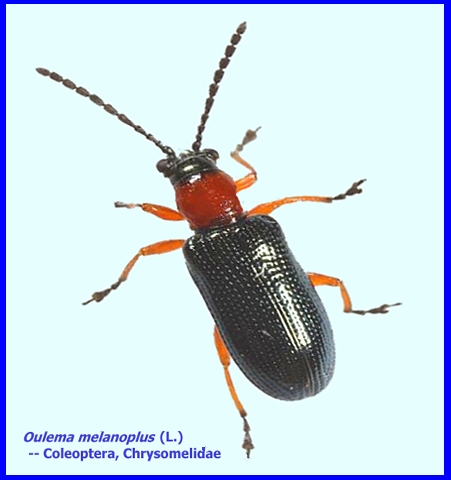
CEREAL LEAF BEETLE Oulema melanoplus (L.) --
Coleoptera, Chrysomelidae (Contacts) ------ CLICK on Photo to enlarge &
search for Subject Matter with Ctrl/F. GO TO ALL: Bio-Control Cases
The cereal leaf
beetle has one generation per year and overwinters as unmated adults (Castro
et al. 1965). With the spread of the
beetle out of control, research was initiated in several areas, including
sterile male techniques, behavioral control by means of attractants and
biological control by means of imported natural enemies. Clausen (1978) summarized the biological
control program. Initiated in 1963,
the search for natural enemies concentrated in France, Italy and
Germany. From 1964 to 1967 five
parasitoids were imported and four to become established were Tetrastichus julis (Walk.), Diaparis carinifer (Thomsen), Lemophagus curtus Tow. and Anaphes flavipes (Foerster) (Haynes
& Gage 1981). Mass releases of A. flavipes were conducted in the absence of more efficient
natural enemies. Releases were made
in Indiana in 1966 and the parasitoid was recovered at most sites later in
the same season (Anderson & Paschke 1968). As the beetle was not easily reared in the laboratory, cultures
of the parasitoid were maintained on beetles collected in the field. These beetles were also used in the screening
of wheat, oats, and barley lines and varieties for resistance against the
beetle. A parasitoid nursery was
established in Niles, Michigan for the redistribution of parasitoids reared
on field-infested populations. Populations were
observed to decline since 1971, with causes for the decline being attributed
to a combination of such factors as weather-related mortality, mortality due
to introduced parasitoids, genetic changes in beetle populations and changes
in overwintering habitat (Haynes & Gage 1981). Although sporadic outbreaks may require treatment, populations of
the beetle seem to have generally abated.
This history suggests that immigrant pests, after an initial period of
explosive expansion, may follow a pattern of adaptation within the
agroecosystem that results in an equilibrium state not as detrimental to the
crop. REFERENCES: [Additional references may be
found at: MELVYL
Library ] Anderson, R. C. & J. D. Paschke. 1968. The biology and
ecology of Anaphes flavipes (Hymenoptera:
Mymaridae), an exotic egg parasite of the cereal leaf beetle. Ann. Ent. Soc. Amer.
61: 1-5. Castro, T. R., R. F. Ruppel & M. S.
Gomulinski. 1965.
Natural history of the cereal leaf beetle in Michigan. Michigan State Univ. Agr. Expt. Sta.
Quart. Bull. 47: 623-53. Clausen, C. P. 1978. Introduced Parasites and Predators of
Arthropod Pests and Weeds: A World
Review. U. S. Dept. Agric., Agric.
Handbk. 480. 545 p. Haynes, D. L. & S. H. Gage. 1981. The cereal leaf beetle
in North America. Ann. Rev. Ent.
26: 259-87. |