FILE: <ch-17.htm> GENERAL INDEX [Navigate to MAIN MENU ]
|
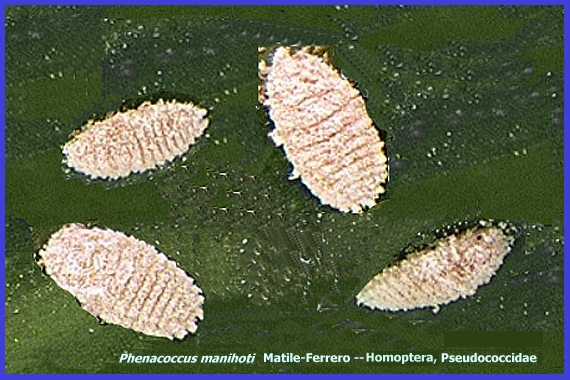
CASSAVA MEALYBUG Phenacoccus manihoti Matile-Ferrero -- Homoptera, Pseudococcidae (Contacts) ------ CLICK on Photo to enlarge &
search for Subject Matter with Ctrl/F. GO TO ALL: Bio-Control Cases
Mealybugs of the
genus Phenacoccus have been
recorded in association with cassava in South America and Africa. Penaacoccus
gossypii Towns. & Cock, P. grenadensis Green & Laing, and P. madeirensis
Green are polyphagous, but P
manihoti Matile-Ferrero
appears specific to cassava and the only species capable of producing severe
distortion of leaves. Another South
American species was separated from P.
manihoti and described as P. herreni Cox & Williams (Cox & Williams 1981). Mealybug damage seems to be a recent
phenomenon, but one that is increasing in areas where it had not previously
been found (Bellotti et al. 1985).
This new pest status results from an imbalance between the mealybug,
the local cassava land race and the existing natural enemies. The situation was particularly acute in
Africa. Phenacoccus manihoti
was first discovered in Zaire in 1973 and spread into almost all other
cassava growing areas of the continent.
The estimated losses caused by this species and another explosive
pest, cassava green spider mites, Mononychellus
spp., were estimated at $2.0 billion per year, and the pests affected an area
about 5.5 million ha. (Neuschwander et al. 1984).
Control of the
mealybug with natural enemies was attempted following its recognition as an
immigrant species (Cox & Williams 1981).
Surveys for native natural enemies associated with P. manihoti in Gabon revealed that various guilds have
incorporated the immigrant in their host or prey range, but none were greatly
efficient (Boussienguet 1986). The
list included two primary parasitoids, four hyperparasitoids, nine predators
and eight parasitoids of the predatory species (Neuenschwander et al.
1987). Extensive explorations for
natural enemies were conducted in South America. Between 1977 and 1981 the Commonwealth Institute of Biological
Control in collaboration with the International Institute For Tropical
Agriculture surveyed the tropical areas of central and northern South America
and found that the parasitoids Aenasius
vexans
Kerrich, Apoanagyrus
diversicornis (Howard), and Anagyrus
spp. seemed to be specific to the cassava mealybug (Cox & Williams
1981). In 1980 a species of Diomus (Coccinellidae)
was imported and released in experimental fields (IITA 1981, 1985), and one
year later the encyrtid Epidinocarsis
lopezi (DeSantis),
collected in Paraguay by M. Yaseen, was imported to Nigeria and released at
two sites. The parasitoids were
established and recovered from parasitized mealybugs. (Lema & Herren 1985, Kogan et al.
1999).
The spread
of E. lopezi was spectacular; by December of 1985 it had become
established over 650,.000 km2 in 13 African countries
(Neuenschwander et al. 1987).
Exclusion experiments and continuous monitoring demonstrated the
efficiency of the parasitoid in regulating P. manihoti
populations in Africa. IITA (1985)
reported that a significant reduction in population levels of the cassava
mealybug had been observed in all regions colonized by E. lopezi. In those areas, the mealybug was recorded
at populations of 10-20 per terminal cassava shoot. Prior to the establishment of the parasitoid peak populations
in excess of 1,500 per shoot were common (IITA 1985). The successful importation and
establishment of E. lopezi gave further impetus to
the biological control program at IITA, and additional species of parasitoids
and predators are being released experimentally with various degrees of
success (IITA 1987b, Kogan et al. 1992). Detailed biological studies have been
conducted on the coccinellid Hyperaspis raynevali
Mulsant (Kiyindou & Fabres 1987), and the entomophthoraceous fungus Neozygites fumosa (Speare) Remaudiere
& Keller (Le Ru 1986). This
successful biological control program of cassava mealybug in Africa is
probably one of the best demonstrations of the potential of this tactic for
IPM in short term crops. However,
other tactics are being used against this and other cassava pests, including
breeding of plant resistance, cultural control and the selective use of
pesticides (Cock & Reyes 1985). REFERENCES: [Additional references may be
found at: MELVYL
Library ] Bellotti, A. C. & A. van Schoonhoven. 1985.
Cassava pests and their control, p. 343-92. In: J. H. Cock & J. A. Reyes (eds.),
Cassava: Research, Production and Utilization. CIAT, Cali, Colombia. 745 p. Bellotti, A. & A. van Schoonhoven. 1978. Mite and insect pests
of cassava. Ann. Rev. Ent. 23: 39-67. Bellotti, A. C., J. A. Reyes, J. M. Guerrero & A. M.
Varela. 1985. The mealybug and cassava green spider mite
complex in the Americas: Problems of
and potential for biological control, p. 393-439. In: J. H. Cock & J. A. Reyes (eds.),
Cassava: Research, Production and Utilization. CIAT, Cali, Colombia. 745 p. Cock, J. H. 1985. Cassava:
A basic energy source in the tropics, p. 1-29. In: J. H. Cock & J. A. Reyes (eds.),
Cassava: Research, Production and Utilization. CIAT, Cali, Colombia. 745 p. 745
p. Cock, J. H. & J. A. Reyes (eds.) 1985. Cassava: Research, Production and Utilization. Preliminary Ed. Centro Internacional de Agricultura Tropical (CIAT), Cali,
Colombia. 745 p. Cox, J. M. & D. J. Williams.
1981. An account of cassava
mealybugs (Hemiptera: Pseudococcidae) with description of a new species. Bull. Ent. Res. 71: 247-58. IITA. 1981. Cassava mealybug - Biological control, p.
40-43. In: Research
Highlights For 1980. Intern. Inst.
Trop Agric., Ibadan, Nigeria. 64 p. IITA. 1985. Dissemination, dispersal, and impact of E. lopezi - A natural enemy of the cassava mealybug, p.
35-39. In: Research
Highlights For 1984. Intern. Inst.
Trop. Agric., Ibadan, Nigeria. 114
p. Kiyindou, A. & G. Fabres. 1987.
Etude de la capacite d'accroissement chez Hyperaspis raynevali
(Col.: Coccinellidae) predateur introduit au Congo pour la regulation des
populations de Phenacoccus manihoti (Hom.:
Pseudococcidae). Entomophaga 32: 181-89. Kogan, M., D. Gerling & J. V. Maddox. 1992. Enhancement of Biological Control in
Transient Agricultural Environments In: Bellows, T. S. & T. W. Fisher (eds.), Handbook of Biological Control:
Principles and Applications.
Academic Press, San Diego, New York.
1046 p. Lema, K. M. & H. R. Herren. 1985. Release and
establishment in Nigeria of Epidinocarsis
lopezi, a parasitoid of the
cassava mealybug, Phenacoccus
manihoti. Ent. Exp. Appl. 38: 171-76. Le Ru, B. 1986. Epizootiology of the entomophthoraceous
fungus Neozygites fumosa in a population of the
cassava mealybug, Phenacoccus
manihoti (Homoptera:
Pseudococcidae). Entomophaga 31: 79-90. |