FILE: <ch-15.htm> GENERAL INDEX
[Navigate to
MAIN MENU ]
|
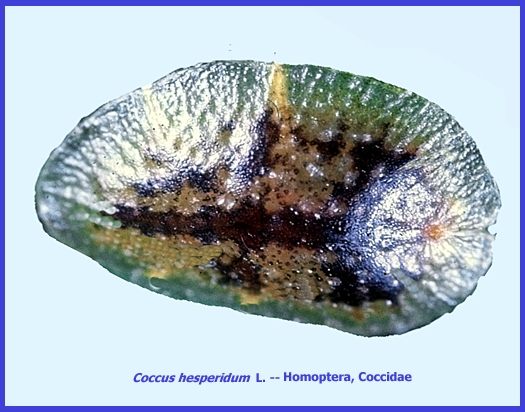
BROWN SOFT SCALE Coccus hesperidum L. -- Homoptera, Coccidae (Contacts) ------ CLICK on Photo to enlarge &
search for Subject Matter with Ctrl/F. GO TO ALL: Bio-Control Cases
There has been realtively little attention paid to biological control
of th is scale, largely because it is usually only a minor pest. The earliest efforts were made during the
the early 1900's when several species of parasitoids were introduced into
Western Australia (Wilson 1960).
Although results were rarely reported, it seems that the scale there
is kept under substantial control by both native and imported
parasitoids. During the 1950's brown
soft scale became a pest in Texas, and various parasitoids were introduec in
1954-1960's, but none of the five species released were established (Dean
1955, Hart et al. 1969). Dean (1955)
attributed the failure of resident natural enemies to provide control to the
activity of ants, but later studies showed that the drift of pesticides from
adjoining crops was the principal cause (Hart et al. 1969) (also see Coquillett
1893, G. Compere1902, 1904; H. Compere 1926, 1929, 1931, 1937; Quayle 1911,
1938, Miller et al. 1936, Rivnay 1944, 1968; Bartlett & Ewert 1951,
Clausen 1956, Dean & Bailey 1966, Bartlett & Ball 1966). REFERENCES: [Additional references may be found at: MELVYL
Library ] Bartlett, B. R. & J. C. Ball. 1966.
The evolution of host suitability in a polyphagous parasite with
special reference to the role of parasite egg encapsulation. Ann. Ent. Soc. Amer. 9: 42-5. Bartlett, B.
R. & W. H. Ewart. 1951.
Effect of parathion on parasites of Coccus hesperidum. J. Econ. Ent. 44: 344-47. Beingolea, O.
1969. Biological control of citrus
pests in Peru. Proc. 1st Intern.
Citrus Symp., Riverside, Calif. 2:
827-38. Clausen, C.
P. 1956. Biological control
of insect pests in the continental United States. U. S. Dept. Agric. Tech. Bull. 1139. 151 p. Compere,
G. 1902. Entomologists'
report. Introduction of
parasites. West. Austral.
Dept. Agric. J.
6: 237-40. Compere, G.
1904. Black scale parasite Scutellista cyanea). West Austral. Dept. Agric. J. 10:
94. Compere, H.
1926. Descriptions of new
coccid-inhabiting chalcidoid parasites (Hymenoptera). Calif. Univ. Pub. Ent. 4: 1-32. Compere, H.
1929. Description of a new
species of Coccophagus
recently introduced into California.
Calif. Univ. Publ. Ent. 5:
1-4. Compere, H.
1931. A discussion of the
parasites of Saissetia oleae (Bern) collected in
Eritrea. Calif. Univ. Publ. Ent.
5: 247-55. Coquillet, D. W. 1893. Report on some of
the beneficial and injurious insects of California. U. S. Dept. Agric. Div. Ent. Bull. 30: 9-33. Dean, H. A.
1955. Factors affecting
biological control of scale insects on Texas citrus. J. Econ. Ent. 48: 444-47. Dean, H. A. & J. C. Bailey. 1960.
Introduction of beneficial insects for the control of citrus scale
insects and mites. Rio Grande
Val. Hort. Soc.
J. 14: 40-6. Hart, W. G., S. Ingle & M. Garza. 1969.
Current status of brown soft scale in citrus groves of the Lower Rio
Grande Valley. Ann. Ent. Soc.
Amer. 62: 855-58. Kennett, C.
E., J. A. McMurtry & J. W. Beardsley.
1999. Biological control in subtropical and
tropical crops. In: Bellows, T. S. & T. W. Fisher (eds.), Handbook of Biological Control: Principles and Applications. Academic Press, San Diego, New York. 1046 p Miller, D., A. F. Clark & L. J.
Dumbleton. 1936. Biological control of noxious insects and
weeds in New Zealand. New Zeal. J.
Sci. Technol. 18: 579-93. Prinsloo, G. L. 1984. An illustrated
guide to the parasitic wasps associated with citrus pests in the Republic of
South Africa. Sci. Bull. Dept. Agric.
Republic of South Africa No. 402. 119
p. Quayle, H. J.
1911. The black scale. Calif. Agric. Expt. Sta. Bull. 223: 149-201. Quayle, H. J.
1938. Insects of Citrus and
Other Subtropical Fruits. Comstock
Publ. Co., Ithaca, New York. 583 p. Rivnay, E.
1944. The economic status of Coccus hesperidum L. and its parasites in Palestine. Bull. Soc. Fouad Ier Ent. 27: 57-77. Rivnay, E.
1968. Biological control of
pests in Israel (a review 1905-1965).
Israel J. Ent. 3: 1-156. Wilson, F.
1960. A review of the
biological control of insects and weeds in Australia and Australian New
Guinea. Tech. Commun. No. 1, CIBC.
Commonw. Agric. Bur., Farnham Royal, Slough, England. 102 p. |