FILE:
<ch121.htm> GENERAL INDEX Also Please see <navelora.htm> [Navigate
to MAIN MENU ]
|
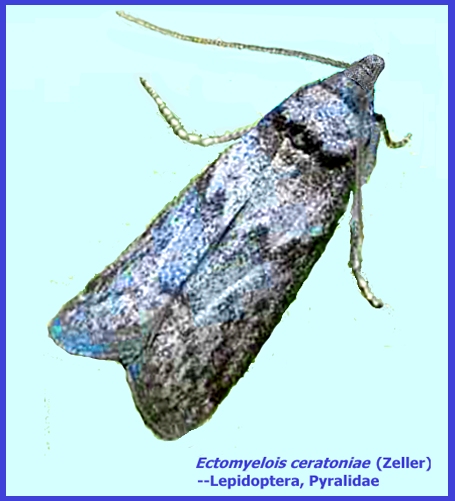
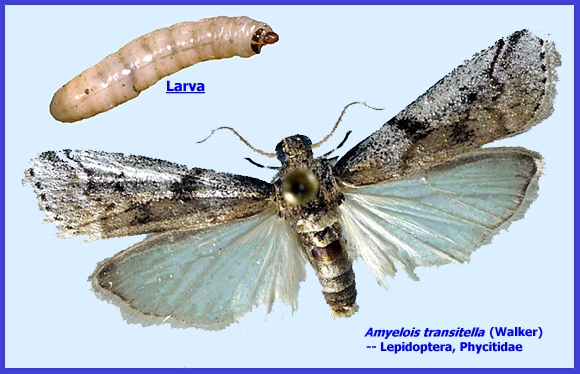
CAROB MOTH Ectomyelois ceratoniae (Zeller) -- Lepidoptera,
Pyralidae & NAVEL ORANGEWORM Amyelois transitella
(Walker) -- Lepidoptera, Phycitidae (Contacts) ----- CLICK on Photo to
enlarge & search for Subject Matter with Ctrl/F. GO TO ALL: Bio-Control
Cases Although carob moth,
Ectomyelois ceratoniae, has been a serious pest of almonds, dates and
other crops in Mediterranean countries for many decades, the origin of this
insect is probably in west-central Africa.
The Cameroon area is a most likely place. In North America, carob moth has invaded and become a pest on
tamarind in Florida and dates in California.
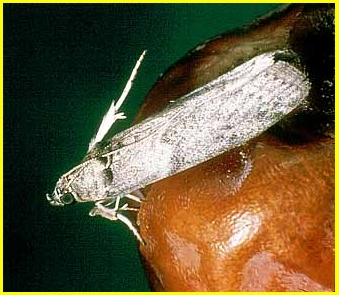
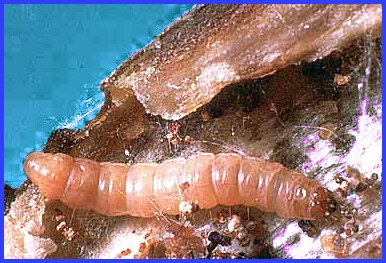
The external
morphology of this insect may be viewed at Adult
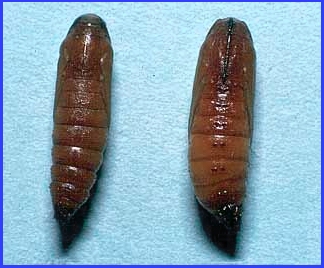
Moth and Larva. The carob moth Pupa on the right is compared to that of the
navel orangeworm (Amyelois transitella
(Walker)).
There has been a successful establishment
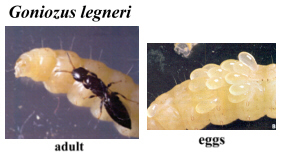
of Goniozus legneri Gordh on carob moth, Ectomyelois ceratoniae
(Zeller) attacking almonds in Israel, Egypt and Iran. Dr. Shmuel Gothilf who obtained the
parasitoids from Dr. E. F. Legner in California performed the research in
Israel A detailed scientific account
was submitted for publication but was never published with the unexpected
demise of Dr. Gothilf. In his
manuscript, Dr. Gothilf recorded the establishment and spread over all of
Israel of G. legneri, and it was expected that population densities of
the carob moth along with the peach twig borer would be gradually reduced,
perhaps to non-economic levels. . It would be interesting to survey
neighboring countries, Syria, Jordan, and Lebanon, for the existence of G.
legneri. However, Dr. Ahmed
el-Heneidy of Egypt informed Dr. Legner that G. legneri was
established on carob moth in his area.
In South California, carob moth infests the seedpods of an array of
ornamental trees and commercial dates south of 35 deg. N. Lat. Goniozus legneri
was released by the thousands in carob moth infested date groves in the
Coachella Valley in 1986 and 1987.
These groves received no insecticide treatment during the release
period. However, as the infestations
became very severe, many of the release sites began to sustain dusting
treatments with Malathion, which precluded post release surveys. Attention
was then focused on alternate carob moth host plants, such as almonds, pecans
and pomegranates. Establishment of G.
legneri was thereby established for the area on these alternate host
plants. Gradually some of the groves
were sold to commercial golf and housing developments. By 2005, one organic grower with 20 acres
of dates (Herrera grove) began to produce a high quality pest free crop of
severa datel varieties without the use of insecticides. Thus, a natural balance between the carob
moth, navel orangeworm and G. legneri probably accounts for this
reduction of infestation on dates.
Because the fruit of date palms is annually harvested from the
commercial groves, the parasitoid has many alternate host plants on which to
carry over into the next season.
Studies are continuing to further evaluate this interaction. Goniozus legneri --The
discovery of Goniozus legneri <PHOTO>
in South America involved making initial contact with Dr. José Pastrana of
the University of Buenos Aires.
Arrangements were made for Dr. Legner to meet with Dr. Pastrana in
Punta del Este, Uruguay in 1977. The
navel orangeworm was not a common insect at higher latitudes in South
America, and Dr. Pastrana only recalled having studied it in his collections
from central Argentina. He advised
Dr. Legner to travel to Concordia, Argentina to inquire there (also see efl210, efl258). In Concordia, Dr. Aquiles
Silveira-Guido accompanied Dr. Legner, where both of them searched through
collections in the experiment station there.
A dusty room, filled to the ceiling with wooden insect collection
boxes, was searched intensively.
Several specimens of the navel orangeworm were found from collections
made in 1938, and from the host coral tree, Erythrinia crista-galli.
This knowledge enabled a further search in the wild on this host tree. Subsequently, collections were
continued in Argentina and Uruguay with the aid of Dr. Silveira-Guido. Goniozus
legneri turned out to be the most frequently collected parasitoid from
navel orangeworm and the imported carob moth, Ectomyelois ceratoniae, with other parasitoid species of only ca.
5% occurrence being Temelucha sp, Coccygonimus sp. and Venturia canescens (Graven-Stein), Bracon
sp. & Copidosoma sp. Cultures sent to Riverside, California
were attempted, but only G. legneri
succeeded. Collections were also made from Texas
where it was found that Pentalitomastix
(Copidosoma) plethorica parasitized navel orangeworm on Nonpareil almonds
as far north as Brownwood (33 deg. N. lat.) and on Texas ebony and western
soapberry seeds along the Gulf of Mexico coast and throughout south
Texas. At the latitude of Corpus
Christi, another parasitoid, a biparental strain of Goniozus emigratus was found attacking this host at low densities
in all seasons on western soapberry and Texas ebony. Although identified as G. emigratus by Gordh & Hawkins
(1981), its biparental behavior and fecundity differed significantly from the
uniparental Hawaiian form to indicate its possible sibling status. RESULTS & CONCLUSIONS
Establishment of Goniozus legneri occurred quickly following
liberations in California, Egypt and Israel in almond orchards. The parasitoid then spread to neighboring
countries, such as Iran. Carob moth
populations also descended to low levels.
In California an infestation of carob moth in date groves was not
controlled by G. legneri, however,
as relative humidity levels there were believed to be too low for
parasitoid survival. REFERENCES: Abbas, M.S.T.,
Shidi, R.H., Jumah, S. and Al-Khatry, S.A.
2008. Utilization of Goniozus
sp. (Hym.: Bethylidae) as a bio-control agent against the lesser date moth, Batreachedra
amydaraula (Meyrick) (lep.: Batrachedridae) in date palm orchards in
Sultanate of Oman. Egyptian Journal of Biological Pest Control 18:47-50. Abbas,
M.S.T., Al-Khatry, S.A., Shidi, R.H.; Al-Ajmi, and Najat, A. 2014.
Natural enemies of the lesser date moth, Batrachedra amydraula Meyrick
(Lepidoptera: Batrachedridae) with special reference to its parasitoid Goniozus
sp. Egyptian Journal of Biological Pest Control 24: 293-296. Bellows, T. S. & T. W. Fisher
(eds.). 1999. Handbook of Biological Control:
Principles and Applications.
Academic Press, San Diego, New York. 1046 p. Butler, G.D, Jr., and Schmidt, K.M.
1985. Goniozus legneri
(Hymenoptera: Bethylidae): development, oviposition, and longevity in
relation to temperature. _ Annals of the Entomological Society of America_
78: 373–375. Caltagirone, L. E.
1966. A new Pentalitomastix
from Mexico. The Pan Pacific Entomol.
42: 145-151. Caltagirone, L.
E., K. P. Shea and G. L. Finney.
1964. Parasites to aid control
of navel orangeworm. Calif. Agric.
19(1): 10-12. Conference (Iran):.
2010. First record of Goniozus legneri Gordh (Hymenoptera:
Bethylidae), the larval ectoparasitoid of carob moth, in Iran. Iranian Plant Protection Congress, July 2010, Tehran: Vol. 19.
July 2010. Ehteshami, F.., M Aleosfoor, H. Allahyari, M. Alichi, M. A. Akrami & M. Kiani.
2010a. First record of Goniozus
legneri Gordh (Hymenoptera: Bethylidae), the larval ectoparasitoid of
carob moth, in Iran. Proceedings of
19th Iranian Plant Protection Congress, Ehteshami, F.., M Aleosfoor, H. Allahyari, M. Alichi, M. A. Akrami & M. Kiani. 2010b. Primary investigation on the biology of Goniozus legneri Gordh
(Hymenoptera:Bethylidae), a larval ectoparasitoid of carob moth, on Ectomyelois
ceratoniae (Zeller). Proceedings of
19th Iranian Plant Protection Congress, 31 July-3 August 2010,
Iranian; Research Institute of Plant Protection, Tehran, 605 pp El-Basha, N.A. and Mandour, N.S. 2006.
Effect of Goniozus legneri Gordh (Hymenoptera: Bethylidae) on
the life table of Palpita unionalis Hb.
(Lepidoptera: Pyralidae). Egyptian Journal of Biological Pest Control
16: 5-11. Etiam, A. 2001.
Oviposition behavior and development of immature stages of Parasierola
swirskiana, a parasitoid of the lesser moth Batrachedra amydraula. Phytoparasitica 29: 405-412. Garrido, S.,
Cichon, L., Fernández, D. and Azevedo, C.
2005. Primera cita de la
especie Goniozus legneri (Hymenoptera: Bethylidae) en el Alto Valle de
Río Negro, Patagonia Argentina. Revue de Societe Entomologique Argentina
64: 14-16. Gordh, G. 1982.
A new species of Goniozus imported
into California for the biological control of navel orangeworm [Hymenoptera:
Bethylidae; Lepidoptera: Pyralidae].
Entomol. News 93: 136-138. Gordh, G. and Evans, H. E. 1976. A new species
of Goniozus imported
into California from Ethiopia for the biological control of pink bollworm and
some notes on the taxonomic status of Parasierola and Goniozus
(Hymenoptera: Bethylidae). Proceedings of the Entomological Society of
Washington 78: 479-489. Gordh, G. &
B. Hawkins. 1981. Goniozus
emigratus (Rohwer), a primary
external parasite of Paramyelois transitella (Walker), and
comments on bethylids attacking
Lepidoptera [Hymenoptera: Bethylidae; Lepidoptera: Pyralidae]. J. Kansas Entomol. Soc. 54: 787-803. Gothilf,
S. 1978. Establishment of the imported parasite Pentalitomastix plethoricus
[Hym: Encyrtidae] on Ectomyelois ceratoniae [Lep: Phycitidae] in Israel. Entomophaga 23:
299-302. Gothilf, S. and Mazor, M. 1987.
Release and recovery of imported parasites of the carob moth Spectrobates
ceratoniae (Lepidoptera: Pyralidae) in Israel. Israel Journal of Entomology
21: 19-23. 211. Legner, E. F. 1983a. Influence of residual Nonpareil almond mummies
on densities of the navel orangeworm and parasitization. J. Econ. Entomol. 76:
473-475. 209. Legner, E. F. 1983b. Patterns of
field diapause in the navel orangeworm (Lepidoptera: Phycitidae) and three imported
parasites. Ann. Entomol. Soc. Amer.
76: 503-506. 258. Legner,
E. F. & G. Gordh. 1992. Lower navel orangeworm (Lepidoptera:
Phycitidae) population densities following establishment of Goniozus legneri (Hymenoptera:
Bethylidae) in California. J. Econ. Ent. 85(6): 2153-60. 210. Legner, E. F. & A.
Silveira-Guido. 1983.
Establishment of Goniozus emigratus and Goniozus legneri [Hym:
Bethylidae] on navel orangeworm, Amyelois transitella [Lep: Phycitidae] in California and biological
control potential. Entomophaga
28: 97-106. 240. Legner, E. F. and Warkentin, E.F. 1988.
Parasitization of Goniozus legneri (Hymenoptera: Bethylidae) at
increasing parasite and host, Amyelois
transitella (Lepidoptera: Phycitidae), densities. Annals of the
Entomological Society of America 81: 774–776. 205. Legner, E. F., G. Gordh, A. Silveira-Guido
& M. E. Badgley. 1982. New
larvicidal wasp to attempt control of navel orangeworm. Almond
Facts 47(3): 56-58. 203. Legner,
E. F., G. Gordh, A. Silveira-Guido & M. E. Badgley. 1982.
New wasp may help control navel orangeworm. Calif. Agric. 38(5-6): 1, 3-5. Shoeb, M. A., Abul-Fadl, H .A. and El-Heneidy, A. H. 2005.
Biological aspects of the ecto-larval parasitoid, Goniozus legneri
Gordh on different insect hosts under laboratory conditions. Egyptian
Journal of Biological Pest Control 15: 5-9 |