FILE: <ch-116.htm> GENERAL INDEX [Navigate to MAIN MENU ]
|
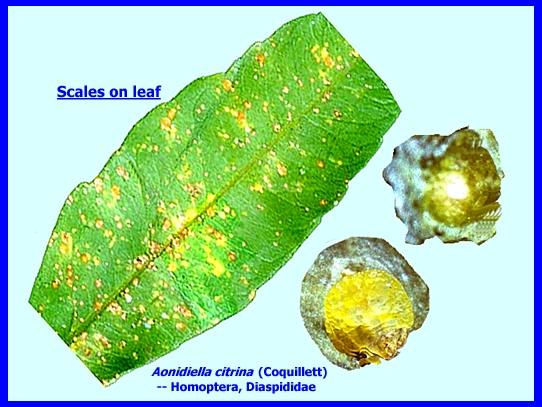
YELLOW SCALE Aonidiella citrina (Coquillett) -- Homoptera, Diaspididae (Contacts) ----- CLICK on Photo to enlarge &
search for Subject Matter with Ctrl/F. GO TO ALL: Bio-Control Cases
In California
yellow scale was a serious pest of citrus by 1880. For many years it was regarded as a separate strain of
California red scale, Aonidiella
aurantii (Maskell). However, cryptic morphological characters
were discovered which separated the two species (McKenzie 1937). Parasitoids found to attack yellow scale
in California prior to 1900 were Encarsia
(= Prospaltella) aurantii (Howard), Aspidiotiphagus citrinus and Aphytis citrinus Compere [(= aonidiae
(Mercet)], which were probably accidentally introduced from Japan. These parasitoids evoked excellent
biological control in the San Gabriel Valley in 1889 (Craw 1891), but they
were not as effective in other areas (Flanders 1956). A Japanese race of Comperiella bifasciata was discovered in
1931, which was imported for California red scale control. This parasitoid was propagated in culture
on yellow scale and colonized in the field (Smith 1942). Comperiella
bifasciata was believed to
give effective control within 1-3 years following colonization in the south
of California, but it did not do as well in the San Joaquin Valley (Flanders
1956). A Chinese race of C. bifasciata was colonized in the San Joaquin Valley during
1948-49, which resulted in temporary control on small acreage (Flanders
1956). However, DeBach (1955) and
Kennett (1973) found that the Japanese race had assumed a greater importance
in the San Joaquin Valley in unsprayed orchards. Laboratory examination confirmed that the Japanese race and not
the Chinese one, was the effective species.
In fact, C. bifasciata collected from
yellow scale in the field would not reproduce on California red scale (Rosen
& DeBach 1978). Several other
parasitoid species were released on yellow scale in California during
1953-1967, but only Aphytis melinus became established on
yellow scale in a very restricted area (Kennett et al. 1999). DeBach et al (1978) reported that the
yellow scale had become extinct throughout southern California by 1970, which
as attributed to competitive displacement by California red scale and
parasitism by C. bifasciata. For greater detail
on biological control effort and biology of host and natural enemies, please
also see the following (Smith & Compere 1931, Nel 1933, Anonymous 1936,
McKenzie 1937, Ferris 1937, 1938; Coy 1938, Flanders 1944, 1945, 1948, 1953,
1958, 1966; Compere 1955, 1961; Clausen 1956, Flanders & Gressitt 1958,
Ebeling 1959, DeBach & Sundby 1963, Teran & DeBach 1963). REFERENCES: [Additional references may be found at: MELVYL
Library ] Anonymous. 1936. Success shown in uses of parasite on
yellow scale. Citrus Leaves 17: 3-4. Clausen, C. P. 1956. Biological control of insect pests in the
continental United States. U. S.
Dept. Agric. Tech. Bull. 1139. 151 p. Compere, H. 1955. A systematic study of teh genus Aphytis Howard (Hymenoptera,
Aphelinidae) with descriptions of new species. Calif. Univ. Publ. Ent. 10:
271-320. Compere, H. 1961. The red scale and its natural
enemies. Hilgardia
31: 173-278. Coy, J. P. 1938. Comperiella bifasciata in San Bernardino
County. Calif. State Dept. Agric. Bull. 27: 445-46. Craw, A. 1891. Internal parasites discovered in the San
Gabriel Valley; recommendations and notes.
Bull. Calif. State Bd. Hort. 57: 1-7. DeBach, P.
1955. Validity of the insecticidal check method
as a measure of the effectiveness of natural enemies of diaspine scale
insects. J. Econ.
Ent. 48: 584-88. DeBach, P. & R. A. Sundby. 1963. Competitive
displacement between ecological homologues.
Hilgardia 34: 105-66. DeBach, P., R. M. Hendrickson, Jr. & M. Rose.
1978. Competitive
displacement: Extinction of the
yellow scale, Aonidiella citrina (Coq.) (Homoptera:
Diaspididae) by its ecological homologue, the California red scale, Aonidiella aurantii (Mask.) in southern California. Hilgardia 46: 1-35. Ebeling, W. 1959. Subtropical Fruit Pests. Calif. Univ. Div. Agric. Sci. Pub. 436 p. Flanders, S. E. 1944. Observations on Comperiella bifasciata,
an endoparasite of diaspine coccids. Ann. Ent. Soc.
Amer. 37: 365-71. Flanders, S. E. 1945. Coincident infestations of Aonidiella citrina and Coccus
hesperidum, a result of ant
activity. J. Econ.
Ent. 38: 711-12. Flanders, S. E. 1948. Biological control of yellow scale. Calif. Citrog. 34: 56, 76-7. Flanders, S. E.
1953. Hymenopteraous parasites
of three species of Oriental scale insects.
Portici R. Scuola Super. di Agric. Lab. Zool. Gen e Agric. Bol. 33:
10-28. Flanders, S. E.
1956. Struggle for existence
between red and yellow scale. Citrog.
41: 396, 398, 400, 402-03. Flanders, S. E.
1966. Unique biological
aspects of the genus Casca
and a description of a new species. Ann. Ent. Soc.
Amer. 59: 79-82. Flanders, S. E. & J. L. Gressitt. 1958. The natural control
of California red scale in China.
Calif. State Dept. Agric. Bull. 47:
23-33. Kennett, C. E. 1973. Biological control of California red scale
and yellow scale in San Joaquin Valley citrus groves--a progress report. Sunkist Newsletter No. 432. 2 p. Kennett, C. E., J. A. McMurtry & J. W. Beardsley. 1999.
Biological control in subtropical and tropical crops. In:
Bellows, T. S. & T. W. Fisher (eds.), Handbook
of Biological Control: Principles and
Applications. Academic Press, San
Diego, New York. 1046 p. McKenzie, H. L. 1973. Morphological differences distinguishing
California red scale, yellow scale and related species. Calif. Univ. Publs. Ent. 6: 323-36. Rosen, D. & P. DeBach. 1978. Diaspididae. In: Introduced Parasites and Predators of
Arthropod Pests and Weeds. USDA
Agric. Handbk. No. 480, Washington, D. C.
545 p. Smith, H. S. 1942. A race of Comperiella bifasciata
successfully parasitizes California red scale. J. Econ. Ent. 35:
809-12. Smith, H. S. & H. Compere.
1931. An imported paraaite
attacks the yellow scale. Calif.
Citrog. 16: 328. Teran, A. L. & P. DeBach. 1963.
Observaciones sobre Comperiella
bifasciata How. (Hymen.,
Encyrtidae). Rev. Agron. Noroeste Argent. 4: 5-23. |